
NY Times Editorial on Scott McClellan, U.S.-Iraq war, “culture of deception”

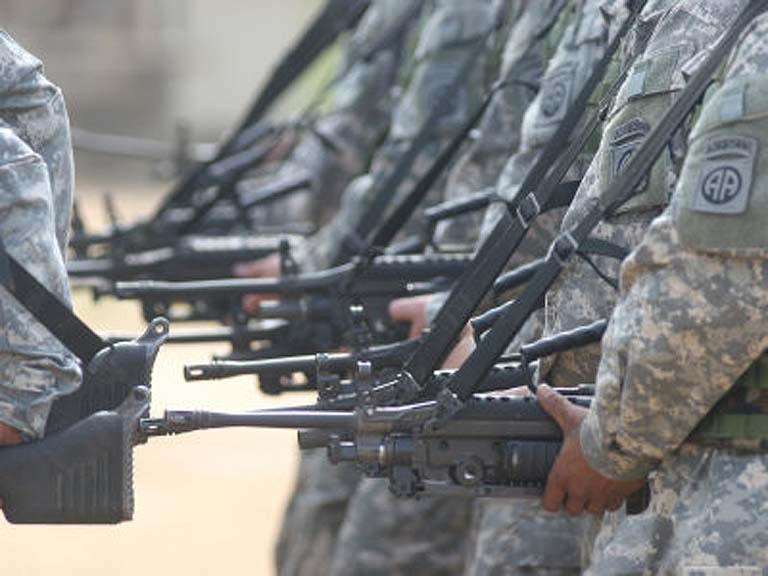
Photo by Skip Brown. Army Rangers Marching in Formation with Weapons. Used here for  educational, non-commercial purposes, free service by blog-use of image provided by and from www.allposters.com  Lonely Planet Collection.

The New York Times Editorial at

www.nytimes.com/2008/05/29/opinion/29thu2.html?ref=opinion

Quote “I Knew It All Along

Quote “Published: May 29, 2008

      Quote “There are several kinds of Washington memoirs: “I Reveal the Honest Truth,” a kiss-up-and-tell designed to settle scores (nod to honesty optional). “I Was There at the Start,” designed to make the author appear to be the linchpin of history. And, most tedious: “I Knew It Was a Terrible Mistake, but I Didn’t Mention It Until I Got a Book Contract.”

      Quote “ Scott McClellan’s memoir is the latest entry in the latter genre. Among his far-too-late admissions, President Bush’s former spokesman reveals that he knew the war in Iraq was “a serious strategic blunder,” but the White House decided the best course was “to turn away from candor and honesty.”

     Quote “This is the same Scott McClellan who presumably had a big role in creating the White House’s communications strategy and joined in the “culture of deception” with such zeal that we lost count of the times he ridiculed critics of the war and questioned their patriotism.

      Quote “Mr. McClellan also knew that the White House’s handling of Hurricane Katrina was a disaster. No doubt he misspoke when he sneeringly accused those who questioned the administration’s serial failures of playing a partisan “blame game.”

     Quote “The president’s retired mouthpiece now admits that it wasn’t true when he said that Karl Rove and I. Lewis Libby Jr. were not involved in leaking the identity of a C.I.A. operative, Valerie Wilson. But he blames Mr. Rove, Mr. Libby and “possibly” Vice President Dick Cheney for deceiving him. He says they also lied to the president.

      Quote “For all of its self serving, the book does serve one good purpose: It is a reminder that we still do not know precisely how far Mr. Bush, Mr. Cheney and the others were willing to wade into that “culture of deception” to sell Americans on the disastrous Iraq war.

      Quote “The Senate Intelligence Committee was supposed to answer that question years ago by comparing what officials claimed about Iraq — its missing weapons of mass destruction and Saddam Hussein’s hyped ties with Al Qaeda — with what they knew.

      Quote “Senator Pat Roberts, the former Republican chairman, tried to make sure the report never was completed. The current Democratic chairman, Senator John Rockefeller IV, is expected to finally issue it next week. We’ll be interested to see how Scott McClellan comes across.” Closed-quote.



Hostage-taking on a bus

Photo by Peter Hendrie, Lonely Planet Collection. Bus on Country Road Samoa. Used here for  educational, non-commercial purposes, free service by blog-use of image provided by and from www.allposters.com  Lonely Planet Collection.

     He was a hostage-taker who had no demands. He did not ask for money, he did not ask for freedom, he did not ask  for better living conditions, he did not ask to see anyone. Rey Digo took the  a Bataan-bound bus yesterday armed with a handgun, took out his gun and, according to the police, started firing randomly. The police said he had killed one passenger and wounded another. After five hours of negotiations, the police said there was a “grappling for the gun”, a shot rang and the hostage-taker was dead. Police later said they decided to end it because it was getting dark and  “the situation was getting  more dangerous”.  

     Had he lived, the paperwork  typed up against him would be  for “serious illegal detention”, a capital offense, and murder or homicide depending on the circumstances. Depriving a woman, a child, or a public officer, of  her/ his/her liberty, even for just a few hours or an hour or moments, constitutes the following crime:

     “Revised Penal Code. Art. 267. Kidnapping and serious illegal detention. – Any private individual who shall kidnap or detain another or in any manner deprive him of his liberty shall suffer the penalty of reclusion perpetua  to death:

      1.If the kidnapping or detention shall have lasted more than five days.

      2.If it shall have been committed simulating public authority.

      3. If any serious physical injuries shall have been inflicted upon the person kidnapped or detained; or if threats to kill him shall have been made.

     4.If the person kidnapped shall be a minor, female, or public officer.

      The penalty shall be death where the kidnapping or detention was committed for the purpose of extorting ransom from the victim or any other person, even if none of the circumstances abovementioned were present in the commission of the offense.”

    Justice Ramon Aquino, “The Revised Penal Code”: quote “Republic Act No. 18 passed in 1946 amended Art. 267 by reducing the minimum detention to five days and including the detention of a minor, a female person, and a public  officer among the forms of serious illegal detention. The purpose was to check the rampant kidnappings of children, women, and public officials after the war. XXXX”

   Whether the amount of force used by the police  was commensurate to the danger the suspect posed and the objective of saving lives and bringing the suspect to justice, depends on the  truth of the statements from the police: the firearm, the shooting, the grappling.   


Authored by Prof. Kamalaxi G. Tadasad, Ph.D. & Harish Ramaswamy, Ph.D: “Effectiveness of Community Solidarity and Promotion of Human Rights:ASEAN Aspirations and Acceptability”

Photo by Olivier Follmi. Young Girl from Rajasthan. Used here for  educational, non-commercial purposes, free service by blog-use of image provided by and from www.allposters.com

     On the topic: “Effectiveness of Community Solidarity and Promotion of Human Rights: ASEAN Aspirations and Acceptability” by  

Prof. Kamalaxi G. Tadasad, Ph.D.  & Harish Ramaswamy, Ph.D, BVB College of Engineering and Technology & Karnatak University, India

(Catch more at today’s parallel session of the ASEAN Inter-University Conference on Social Development at Century Park Hotel, Manila)

 ABSTRACT of the paper: quote “The story of Human Rights world over has been a difficult journey. Two major hurdles for this are Political Will and Social Acceptance. The first major attempt at Human Rights sensitization in the ASEAN was perhaps the meeting of the Foreign Ministers of Association of Southeast Asian Nations in 1993 to find out the possibility of establishing an (inter – governmental) mechanism on human rights for the region in support of the Vienna Declaration and Programme of Action.

     quote “It is nearly fifteen years since and yet, no such mechanism as one can understand has been established. The question then is why?  What ails such an attempt? What has been the role of community in this? What are the aspirations of the ASEAN in this respect? Is there a mechanism that can be marketed for this region to ease the situation? Are some of the questions this paper raises to find answers?

      quote “Our hypothesis for this paper therefore is two fold which hinges upon the cultural and the civil space issues. It is in the light of these hypotheses that we would like the participants to comments on the model that we are going to unveil here in this international conference.” closed-quote.

XXXXXX

About the authors: (written by conference organizers): quote “Dr.Kamalaxi G. Tadasad has a Ph.D. in Human Rights and Police Administration & has over 8 years of experience in teaching. She has earlier taught in the postgraduate department of Public Administration in the Bijapur PG Centre of Karnatak University, Dharwad. She is currently working as a Head, department of Humanities, BVB College of Engineering and Technology, Hubli.

      quote “Dr. Harish Ramaswamy has over 19 years of experience in teaching and research in the Postgraduate Department of Political Science both, at the University of Mysore, and at Karnataka University, India.  He is the author of over 20 research publications. He is also the Associate Editor of “Shodha Sara” and Editor of Karnataka Journal of Politics” closed-quote.