Ode to Henri Cartier-Bresson 1908-2004. All photos by Henri Cartier-Bresson

ACKNOWLEDGEMENTS: 

First photo from: National Gallery of Canada

  www.cybermuse.gallery.ca

 Henri Cartier-Bresson. Russian Child, Halle, Germany   1945, printed before 1947 gelatin silver print 16.8 x 24.2 cm Purchased 1984 National Gallery of Canada (no. 28609)

XXXXXXXXX

     The Metropolitan Museum of Art  www.metmuseum.org/toahHenri Cartier-Bresson (French, 1908–2004) Shanghai, 1948. Gelatin silver print; 9 13/16 x 14 9/16 in. (25 x 37 cm) Purchase, Evelene and Robert Wechsler Gift and Charina Foundation Inc. Gift, 2002 (2002.419) © Henri Cartier-Bresson/Magnum Photos

          Quote “In December 1948, Life magazine sent Cartier-Bresson to China to document the turbulent transition from Kuomintang to Communist rule. This photograph captures the pandemonium incited by the currency crash of that month, when the value of paper money plummeted and the Kuomintang decided to distribute forty grams of gold per person. Thousands waited in line for hours as the police made only a token gesture toward maintaining order, resulting in ten deaths by suffocation. Cartier-Bresson deftly captured the desperation and claustrophobia of the scene by compressing the mass of people within a tight frame as they propelled themselves toward the bank building just beyond the right edge of the picture.” Closed-quote. From source as cited

     Xxxxxxx

      Pavement School, Jaipur, 1948Henri Cartier-Bresson (French, 1908–2004)IndiaGelatin silver print; 13 7/16 x 8 7/8 in. (34.2 x 22.6 cm)Ford Motor Company Collection, Gift of Ford Motor Company and John C. Waddell, 1987 (1987.1100.174)© Henri Cartier-Bresson/Magnum Photos

     Quote “The French photographer Henri Cartier-Bresson has traveled throughout the world, working in Africa, China, the United States, Mexico, and all over Europe as a photojournalist on assignment for a number of magazines. He has made five trips to India, during which he captured large, historic moments such as Gandhi’s funeral and the refugee movement caused by partition. This photograph, however, taken at the time of independence, focuses on a small, everyday occurrence: a teacher instructing his students on the streets of Jaipur. The nature of the photograph exemplifies Cartier-Bresson’s dedication to representing human dignity and to working as an unobserved observer, often anonymous in the crowd and using only a simple 35mm camera. The aesthetic of this photograph certainly evolved from his work in press photography, in which each image must tell a story in a single frame.” closed-quote. from source as cited.

XXXXX

     Valencia, Spain, 1933 Henri Cartier-Bresson (French, 1908–2004)Gelatin silver print; 7 11/16 x 11 1/2 in. (19.6 x 29.2 cm)Gilman Collection, Purchase, Mr. and Mrs. Andrew W. Saul Gift, 2005 (2005.100.164)

     quote “This photograph shows the inside doors of the Valencia arena from the vantage point of the bull; to make this picture of an attendant watching the action from a small rectangular window, Cartier-Bresson entered the ring. The complex composition reflects the influence of Cubism on the artist’s work. All the major structural elements are fragmented: the arena doors are ajar, splitting the concentric rings into arcs and the number 7 into two abstract forms; the foreground figure is, in effect, beheaded by the door, his body linked to a faceless counterpart wearing identical clothing; even the attendant’s circular glasses are awry, one lens catching the light, the other remaining transparent. The picture as a whole illustrates the avant-garde theory of simultaneous multiple vision and is a sophisticated critique of the bull’s-eye school of photographic composition.” from source as cited.

XXXXXXXX 

    LACMA Collections onlinewww.collectionsonline.lacma.orgHenri Cartier-Bresson (France, 1908 – 2004) Henri Cartier-Bresson (France, 1908 – 2004) Collaborateurs, FrancePhotograph, Gelatin-silver print, Unframed: 6 1/2 x 9 5/8 in. (16.51 x 24.45 cm)Gift of Graham and Susan Nash in honor of the museum’s twenty-fifth anniversary (M.90.75.167)XXXXXXXXXHenri Cartier-Bresson (France, 1908 – 2004) Behind the Gare Saint-Lazare, Paris, 1932, printed laterPhotograph, Gelatin-silver print, Unframed: 14 x 9 3/4 in. (35.56 x 24.77 cm)Gift of the Sid and Diana Avery Trust (M.82.262.22)

     XXXXXXXXAlicante, 1933, printed laterPhotograph, Gelatin-silver print, 14 x 9 1/2 in. (35.56 x 24.13 cm)Gift of anonymous donor, Los Angeles (AC1999.233.24)XXXXXXXXHenri Cartier-Bresson (France, 1908 – 2004) Seville, Spain, 1933, printed laterPhotograph, Gelatin-silver print, Unframed: 9 1/2 x 14 1/8 in. (24.13 x 35.88 cm); Sheet: 11 3/4 x 15 5/8 in. (29.85 x 39.69 cm)Gift of the Sid and Diana Avery Trust (M.82.262.21)

     XXXXXXXXX 

    Henri Cartier-Bresson (France, 1908 – 2004) Gestapo informer recognized by a woman she had denounced, 1945, printed laterPhotograph, Gelatin-silver print, 9 1/2 x 14 in. (24.13 x 35.56 cm)Gift of anonymous donor, Los Angeles (AC1999.233.30) 

     XXXXXX

     Henri Cartier-Bresson (France, 1908 – 2004) Funeral of a Kabuki actor, 1965, printed laterPhotograph, Gelatin-silver print, 9 1/2 x 14 in. (24.1 x 35.6 cm)Gift of anonymous donor, Los Angeles (AC1999.233.33)

      XXXXXXXXX 

      Henri Cartier-Bresson (France, 1908 – 2004) Rue Mouffetard, 1959, printed laterPhotograph, Gelatin-silver print, 14 x 9 1/2 in. (35.56 x 24.13 cm)Gift of anonymous donor, Los Angeles (AC1999.233.38)

    XXXXXXXXXX

      Henri Cartier-Bresson (France, 1908 – 2004) Cafeteria of the Workers’ Building, the Hotel Metropol, 1954, printed laterPhotograph, Gelatin-silver print, 9 1/2 x 14 in. (24.13 x 35.56 cm)Gift of anonymous donor, Los Angeles (AC1999.233.22) 

     XXXXXXXX

      Henri Cartier-Bresson (France, 1908 – 2004) Brussels, 1932, printed laterPhotograph, Gelatin-silver print, 9 1/2 x 14 in. (24.13 x 35.56 cm)Gift of anonymous donor, Los Angeles (AC1999.233.21)

      XXXXXXXX

       Henri Cartier-Bresson (France, 1908 – 2004) Henri Matisse in his home, 1944, printed laterPhotograph, Gelatin-silver print, 9 1/2 x 14 in. (24.13 x 35.56 cm)Gift of anonymous donor, Los Angeles (AC1999.233.27)

      XXXXXXXXX

      Henri Cartier-Bresson (France, 1908 – 2004) Sprinager, Kashmir, 1948, printed laterPhotograph, Gelatin-silver print, 9 1/2 x 14 in. (24.13 x 35.56 cm)Gift of anonymous donor, Los Angeles (AC1999.233.31)

     XXXXXX

     Henri Cartier-Bresson (France, 1908 – 2004) Simiane-la-Rotonde, 1970, printed laterPhotograph, Gelatin-silver print, 9 1/2 x 14 in. (24.13 x 35.56 cm)Gift of anonymous donor, Los Angeles (AC1999.233.32)

     XXXXXXXXX

      Henri Cartier-Bresson (France, 1908 – 2004) At the Coronation Parade of George VI, 1938, printed laterPhotograph, Gelatin-silver print, 14 x 9 1/2 in. (35.56 x 24.13 cm)Gift of anonymous donor, Los Angeles (AC1999.233.25)

XXXXXX 

the confusely theorized search

edwardhopper.jpg

Edward Hopper. A Room in New York. National Gallery of Art. Right-clicked from www.nga.gov/exhibitions/2007 searched thru www.artcyclopedia.com

    [Update: As  of 4:11 pm or after i wrote the following post, NBI denied it conducted a search and said only one NBI agent was sent to the former office of ZTE deal witness Rodolfo “Jun” Lozada to deliver a letter asking for his papers such as his 201 file (– from ABS-CBN News Channel.) In any case, no independent determination has been made regarding the news report that a raid was conducted.]          

       The  only way that the warrantless search (“raid”) of the former office of ZTE deal witness Rodolfo “Jun” Lozada  conducted by the operatives of the National Bureau of Investigation could be legally justified is: if it were consensual, i.e., the lawful owners/ possessors/ occupants consented to the warrantless search. Of course, since he is no longer the president and CEO of Philippine Forest Corporation, someone else (an OIC or the corporate vice president or the building administrator or whoever is authorized by the articles of incorporation to succeed if no one has yet been appointed) has the authority to give that consent. If that consent was not given on the spot when the warrantless search was conducted, it would be fairly easy to “convince” that person in charge to say that the search was consensual (or to ratify it; or to not file any complaints against the NBI).   

        The rules require a warrant in case of a search by law-enforcement authorities; exceptions are: consensual searches, checkpoints (Valmonte vs. De Villa with three dissents), border searches (ports of entry, etc.); “stop-and-frisk” on probable cause; and search incident to a lawful arrest.      

       The DOJ Secretary said in an interview (www.abs-cbnnews.com) that he did not order the NBI to conduct such a warrantless search, but, he said, in any case , no warrant was necessary in that search because, he said, “a crime was being committed” (presumably in the office seached?) and therefore the law-enforcement authorities can  conduct a warrantless search; and that it was a public office and therefore no warrant was required.       

          What crime was being committed inside when the NBI broke into the premises and entered and searched the papers and effects? What crime?     

      If indeed a crime was being committed inside (what crime) who are the  malefactors?  Or those who are committing the crime. Who were committing the crime inside?  The employees? The officer-in-charge? Or, is it a crime that has no human malefactors? The crime was happening by itself without any malefactors? Geez, help me out here, maybe there’s such a thing: It was a crime that was happening by itself without any malefactors. The objects were moving by themselves and causing a crime to happen, don’t you get it?      

         Or maybe,  since what was searched was Mr. Lozada’s papers and effects (the DOJ secretary presumed so),  the DOJ secretary theorized that a crime was happening inside  because,  he thinks that Mr. Lozada was in the process of committing a crime when his papers and effects continue to be inside the building. What crime was that? The table drawers’s illegal possession of the papers and effects of Mr. Lozada. Yes, that’s the crime. Except that i don’t know whether the table  and drawers  were mirandized  before they/ these were arrested then searched.     

       Even the search for contrabands  (or drugs or illegally possessed guns) require a search warrant  UNLESS the contraband or drugs or gun are in plain view, under the “plain-view doctrine” , or they are on the surface and readily seen without a search.    

           Presumably, the papers and effects are not contraband; maybe the DOJ thinks they are evidence of something; but evidence of something, especially papers and effects, does not  a contraband  make (unless maybe if they were counterfeit money, but you still need a warrant for that unless as i said they were in plain view.)     

        (To summarize: I think the DOJ secretary is confusing “search incident to a lawful arrest”; and  breaking enclosures to effect a valid arrest (you have to make the lawful arrest before  the  search); and  the “plain-view doctrine.” I could just have said that in the beginning, you know,  instead of following through his convoluted logic and confused procedure by writing hyperboles  but i thought it was funny.)     

         What is probably hilarious is the DOJ secretary shooting his mouth off, again, for the nth time, without checking how in fact  the raid was conducted, and presuming the NBI agents went over his head, and accepting it was alright, because it involved Jun Lozada, it was  fine to bypass him; just like (if the testimony of Jun Lozada were true), when Lito Atienza last month assured Jun Lozada that he had talked to the Immigration Commissioner to just let him in without alert; the Immigration Commissioner being under the supervision and control of the DOJ secretary. But who cares  anyway if a powerful person  bypassed the DOJ secretary here and there and always went over his head?

Legend Falling

dekada.jpg

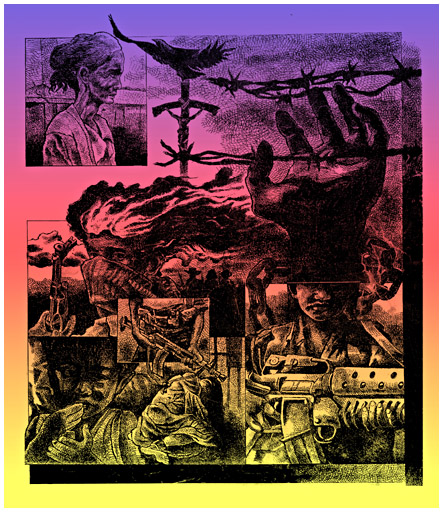
Jose “Pinggot” Zulueta. Dekada. Published with express permission from the artist (thanks much!). Asinta images. Right-clicked from www.asinta.netfirms.com


      The folkloric Joker Arroyo invoked his own legend as human rights lawyer during the Marcos era, trumpeted his  vaunted courage during that resistance, and proceeded to browbeat the witness, Rodolfo “Jun” Lozada, who was equipped with nothing but his traumatic experience  a week ago in the hands of agents of the state, and his retelling, coming out of it alive and reliving it again, was enough; his remembering came cascading again and it was enough  to shatter the myth that was Joker Arroyo, and the moral of Joker’s  story was: Wait for the historians to tell your legend instead of announcing it time and again else drop with a thud which was the sound of Joker falling, yesterday.                 

       Joker said “Do not trifle with the great writs of liberty…do not cheapen them….” Well, maybe PNP Senior Supt. Paul Mascariñas and his men, after bringing a shaken Jun Lozada at the La Salle dormitory should have stopped hovering around him  and trifling with his right to be secure in  his person; maybe they should have stopped taking him away again and  removing him from the dormitory and trifling with his liberty; maybe they should have stopped making him and his sister sign false affidavits with the use of intimidation, trifling with their free consent.               

            It was at that time when Mascariñas  and his men would not leave them alone and would not stop trifling with their rights that his wife and siblings signed and filed the petitions for the privilege of the writ of habeas corpus and writ of amparo, when Jun Lozada was removed from the dormitory and still in the hands of his captors. While the petition for the writ of habeas corpus today may be moot and academic, are the petitioners  expected to just dust their shoulders and consider it  enough consolation that at least the petitioners’ husband/sibling was returned alive? When you had been violated,  and  had survived the transgression, do you just charge it to experience  and “move on”?                 

          Is this how we wrested our liberties from the previous dictatorship?               

        If they have time, maybe the lawyers and their client can think of amending their petitions to include a prayer to declare the forcible taking of Jun Lozada as illegal and unconstitutional,  without prejudice to the filing of criminal actions in better times under a professional and just Department of Justice and Ombudsman.               

     We’re glad we did not grow up to be like Joker: whenever people ask: “How were you able to do that,” we tell them: “It wasn’t us, it was our clients; it had been our privilege to represent them.”