
“Specially for you”. Or for her.

schall.gif  

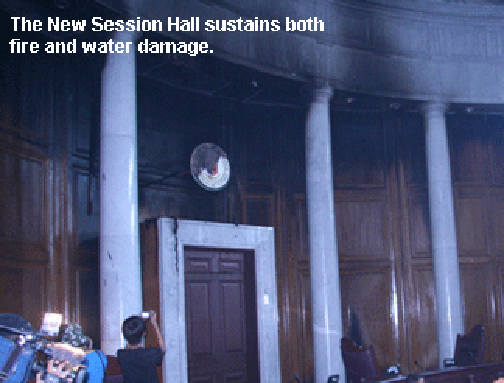
Photo and caption from www.supremecourt.gov.ph      

     Two days ago he was still the alter ego of the Chief Executive, whose claim to executive privilege is at issue in the Supreme Court  petition Neri vs. Senate.  Yesterday newly appointed Supreme Court Justice Arturo Brion asked upon his appointment: “What is so special about the Neri case?”.  Not having warmed his seat for five seconds (in fact, to be literal, he has not yet sat on that seat), he publicly expressed intent, desire, earnestness, even eagerness to participate in the deliberation and voting on Romy Neri’s injunction case.    

          There is nothing “special” about  Romy Neri’s injunction case: there is  something special about  Justice Arturo Brion, and it’s called “Disqualification”, Canon 3, Rule 3.12 of the Code of Judicial Conduct.      

          Conflict of interest is not a state of mind. The courts never perform mental telepathy or psychoanalysis or psychic regression through hypnosis or divinity to determine your previous incarnations in the astral plane. The most that judges do is say a prayer, then look at the evidence  and the law (ideally, that is).

         No matter how much one remonstrates about one’s objectivity, impartiality, fairness, competence, etc., those are not the factors in determining conflict of interest. There are objective conditions that create conflicts of interest or  there are  real  sources of conflicts of interest, such as professional relationships, business interests, personal relationships; and there is nothing much that a person’s disavowal can do about them, they exist in the real, four-dimensional plane and not in one’s heart (the figurative heart, that is.) 

           And what do the rules provide? The Code of Judicial Conduct provides:             

       “Canon 3. Rule 3.12. Disqualifications. A judge should take no part in a proceeding where the judge’s impartiality might reasonably be questioned. These cases include, among others, proceedings where:       

           “a)the judge has personal knowledge of disputed evidentiary facts concerning the proceeding;  

          “b) the judge served as executor, administrator, guardian, trustee, or lawyer or a former associate of the judge served as counsel during their association; or the judge or lawyer was a witness therein.         XXXX” (underscoring supplied.)   

        Guess what. There were Cabinet meetings held when he was a member of the Cabinet. A dozen. Dozens, between the time he was appointed justice and he was Cabinet member. Guess what. The principal issue in the Neri petition is the extent and the limits of executive privilege, or the prerogative of the President, his immediate former boss, not to disclose state secrets.  Guess what. His associates, colleagues, peers (if not he himself) gave  advice and legal opinions in those Cabinet meetings. Guess what. He was there,  nodded his head/ shook his head/ looked sideways/ drummed his fingers; he listened to the President, he agreed or did not express disagreement; i’m sure he was not sleeping or in comatose during those meetings.

      Since it can be taken judicial notice of that those Cabinet meetings took place, and it can be taken judicial notice of that he was not a somnambulist, Justice Arturo Brion is disqualified by reason of conflict of interest or disqualification under Canon 3, Rue 3.12, because having been the alter ego of the President in the period when executive privilege was being publicly discussed and taken up in Cabinet meetings, he was present in those meetings. He has  personal knowledge of “disputed evidentiary facts” even if he does not disclose those evidentiary facts to subject them to judicial scrutiny. That will influence and affect (and even determine) the way he votes in the Neri injunction case. His colleagues and associates (if not he himself) also served as counsel during those Cabinet meetings.     

       In fact, yesterday, he pre-empted his now new colleagues in the Supreme Court by  publicly stating matter-of-factly that he will participate and vote  in the deliberation and resolution of Neri vs. Senate.      

       The fact of the matter is, it is not up to him; it should not be up to him; because it is the Supreme Court that decides whether or not he possesses any of the disqualification  under Canon 3. This early, he has put the Supreme Court to which he now belongs, in an awkward position by trying to publicly pre-empt it.      

      Or maybe he knows something we don’t know (“personal knowledge of disputed evidentiary facts”) : Maybe it is  up to him; maybe it is  up to the President.

      (i read in the inquirer.net that the respondents are not pushing through with a motion to inhibit the alleged “golfing buddie” because they think it might affect the way the justices decide the petition. Normally, in the trial courts, the judge who is asked to inhibit himself/ herself, does so without admitting or conceding any bias or without need of proof either way.)

              To avoid any awkwardness, the immediately former alter ego of the President should be requested to volunteer to inhibit by his colleagues.   
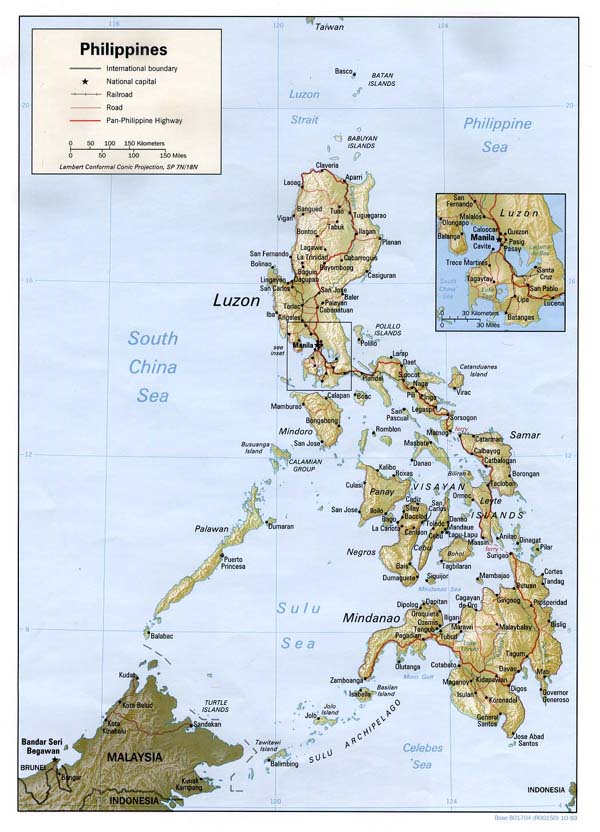
The Philippine Archipelago (and Malacañang- China deals, etc.)

archipelago1.jpg

(Image rightclicked from www.pia.gov.ph i’m looking for a more detailed map and ideally i should animate an imaginary line connecting the tips of the outermost islands and islets, run it, and connect it around the archipelago.)      

Malacañang representatives try to make this sound technical, convoluted, confused, and at the same time, threaten us that if Congress asserted  our  claim over certain territories (Kalayaan, Scarborough, and other islets), we have to go to war.  (see the warning issued by the Commission on Maritime and Ocean Affairs under the Office of the President, presented to Congress this week, www.inquirer.net “Proposed baselines: War or Surrender”, Inquirer article, March 14, 2008)   

          Today, Malacañang through the Executive Secretary admitted (see www.inquirer.net ) that it was behind the move to bring back the House bill on archipelagic baselines to the committee level (wasting years of hearings, studies, and discussion, and precariously near the U.N. deadline); while the DFA undersecretary admitted that indeed China last December in an unofficial communication, protested the latest assertion of claim by the Philippines over the Kalayaan group of islands.

              The DFA, the agency, next to the President herself, tasked to represent our interests in foreign relations, did not say what it did or how it answered the protest from China. Because they did not say anything, we should suppose  they just nodded their heads then.   

           Contrary to how the  Malacañang representatives make it appear in  their justification,  the conflict is not  so technical or so complicated for our countrymen  that we should all leave it up to  the trustworthy Malacañang bureaucrats.  It’s not technical and convoluted, it’s about our land — the outermost islets off  the coast of Palawan are disputed, yes, but we never gave up our claims based on rights created by law: treaties and international conventions.  (“off the coast” should probably not even be used anymore; the U.P. Law Center in a press conference showed studies of a continental shelf connecting the islets to Palawan) 

             The Philippine archipelago — the classic definition of an archipelago is:       

           An archipelago  is “a body of water studded  with islands”. That definition is embedded in the  consciousness of all Philippine lawyers because  the way it is worded  (it starts with the mass of water then says, “studded with islands”) is both striking and stunning.  And it is meaningful because  it’s our home and it’s who we are, we’re a group of 7,100 islands and islets, and a hundred languages and dialects and  provinces separated by seas and oceans but one nation.

            And so at the end of it all, after hundreds of millions of dollars in payoffs and witnesses disappearing, was it all about those territories, our land, our claim, our history? 

              The most important of the series of conflicts from January to March  came to light at the end, and it was the most valuable.   

           Were those deals with China all about our territories? 

             Our rights and claims are based on law. Under the archipelagic doctrine under the U.N. Convention on the Law of  the Sea, an archipelago is one unit determined by connecting the outermost islands and islets with an imaginary straight line; all bodies of land and waters inside the baseline form the entire archipelago. 

             The purpose of the archipelagic doctrine (i’m using Justice V.V. Mendoza’s notes; these are not mine) is to protect the territorial integrity of the archipelago. Without it, (according to Justice V.V.): there would be “pockets of high seas” between some of our islands and islets, as for instance between Bohol and Siquijor, thus foreign vessels  would be able to pass through these “pockets of high seas” and we would have no jurisdiction over them.  And so, in order to protect the land,  the group of islands  and the waters between them and all islets and shoal and rocks within the baseline are all considered one unit under the archipelagic doctrine under  UNCLOS. 

 (Here’s a pre-UNCLOSmap, or a map that does not reflect UNCLOS):  

philippines21.gif

[A pre-UNCLOS map, i think; or at least a map that does not reflect UNCLOS, note the “pocket of high sea” (the white part, Sulu Sea) inside the archipelago; or at least that’s how this map makes it look. Image rightclicked from www.navy.mil (an American site)]    

         Our rights are based not only on international law but also on treaties: (still using Justice V.V. Mendoza’s notes; these are not mine): The Treaty of Paris defining the metes and bounds of the archipelago; the Treaty of  Washington between the U.S. and Spain in the 1900’s; ceding Cagayan, Sibuto, and Sulu; the Treaty between U.S. and Great Britain, 1930, ceding Turtle Island and Mangsi Island. 

                It is true that through the years, some of the islets that are part of the disputed territories, or some of the islets that fall inside the baseline,  have been occupied  by China and Vietnam.  The Chief Executive, the Commander-in-Chief, speaking through her lieutenants and assistants, wants Congress to exclude those  islets by drawing the baseline in such manner that those islets fall outside our baseline, thus  Malacañang ordered its congressmen to bring back the House bill on baselines, already approved on second reading and up for approval on third reading, brought back to the committee level again.  

      It is true that we are a small country with a small military capability compared to China.    


        But we have never given up those claims, we have never recognized their occupation  as evidence of ownership; international law does not recognize invasion or occupation as a source of right; we have not authorized our “leaders” to sell or cede any part of our claimed territories; those “leaders” are under question and scrutiny now for allegedly accepting bribes and commissions in hundreds of millions of dollars from Chinese corporate officials; we are not about  to surrender any part of our land; the dispute over those territories should be resolved in the U.N. and in the meantime the  Philippine legislature  should be doing its job of  defending our rigts, and those “leaders”, whether they are in Congress, the Supreme Court  or in Malacañang  selling our territories would be disowned, disavowed and driven away from our land. Maybe together with their foreign  patrons. We have a history of doing that.                     

breaking news again

     Alright, breaking news again, this is a fast-moving story. Inquirer.net at www.inquirer.net  reported that Malacañang through the Presidential Legal Counsel urged the House to pass the bill on archipelagic baselines.

           Finally. (hindi na tayo kelangang  kumalampag at sumakal ng mga tao.)             

 Approve it on third reading today. Don’t give anymore room, or time, for armtwisting or giving away of sweeteners.