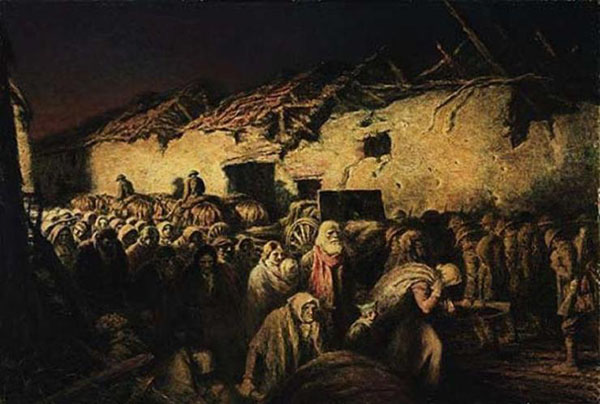
(“The Refugees” by Kerr Eby, ca. 1918-1935, from www.asu.edu
Smithsonian American Art Museum)
War is about not having drinking water. As long as you can go to a grocery or sari-sari store (small retail food store) and buy or “palista” (pay later) your food, or pick them up at the market, you’ll never know what a forcibly evacuated family or internally displaced person goes through in makeshift sheds or huts, a common sleeping area for a hundred families, no clean water, no firewood, no toilets.
There is a general directive from the President to the AFP that they should decimate the Abu Sayyaf. This has been a standing directive of the government for ten years. For the operation in Sulu, the President and the AFP probably have a target number and certain target areas and a timetable that should not be divulged publicly for tactical reasons. I just hope that they do have those specific targets and know how to attain them or to appease whoever those are, who need to be appeased. Because in the meantime, 14,000 internally displaced persons (Inquirer) in Sulu and Basilan have to wait it out a little longer and scrounge for food.
Based on international humanitarian law, the International Committee of the Red Cross has guidelines for governments in relation to internally displaced persons; they include the following: 1.it is the responsibility of government to protect and lend assistance to internally displaced persons; 2.government must observe its obligations in order to prevent internal displacement; 3.all internally displaced persons shall be protected from attack, from use as shield for military operations, from attack on their settlement, use of anti-personnel land mines; 4.internally displaced persons shall not be confined to a camp; if absolutely necessary, it shall not last longer than required by circumstances; 5.in no case shall they be taken as hostage.
Here they are verbatim; excerpts:
“Guiding Principles on Internal Displacement of the ICRC (excerpted)
XXX
Principle 3
XXX
1. National authorities have the primary duty and responsibility to provide protection and humanitarian assistance to internally displaced persons within their jurisdiction.
2. Internally displaced persons have the right to request and to receive protection and humanitarian assistance from these authorities. They shall not be persecuted or punished for making such a request.
XXX
Principle 4
XXX
2. Certain internally displaced persons, such as children, especially unaccompanied minors, expectant mothers, mothers with young children, female heads of household, persons with disabilities and elderly persons, shall be entitled to protection and assistance required by their condition and to treatment which takes into account their special needs.
XXX
Principle 5
All authorities and international actors shall respect and ensure respect for their obligations under international law, including human rights and humanitarian law, in all circumstances, so as to prevent and avoid conditions that might lead to displacement of persons.
XXXXXXXXXX
Principle 10
XXX
2. Attacks or other acts of violence against internally displaced persons who do not or no longer participate in hostilities are prohibited in all circumstances. Internally displaced persons shall be protected, in particular, against:
(a) Direct or indiscriminate attacks or other acts of violence, including the creation of areas wherein attacks on civilians are permitted;
(b) Starvation as a method of combat;
(c) Their use to shield military objectives from attack or to shield, favour or impede military operations;
(d) Attacks against their camps or settlements; and
(e) The use of anti-personnel landmines.
xxxx
Principle 12
1. Every human being has the right to liberty and security of person. No one shall be subjected to arbitrary arrest or detention.
2. To give effect to this right for internally displaced persons, they shall not be interned in or confined to a camp. If in exceptional circumstances such internment or confinement is absolutely necessary, it shall not last longer than required by the circumstances.
3. Internally displaced persons shall be protected from discriminatory arrest and detention as a result of their displacement.
4. In no case shall internally displaced persons be taken hostage.
xxx
Discover more from marichulambino.com
Subscribe to get the latest posts sent to your email.

(Unedited by blog administrator.)
On its August 10 issue, the Manila Bulletin has proven yet again that it is the nation’s leading PR agency. With the streamer “RP battles with dandruff 44% of Filipinos still have it,” the Bulletin fooled its readers — only for a few seconds, I hope — by that whole-page PR effort of an anti-dandruff shampoo market newbie. True, the Bulletin still retained its de jure front page on the third page, but the de facto one is much like the generic Bulletin front page (sans the usual “ID photos”). All three articles on the page were about dandruff and how it “poses potentially devastating social impact.” Its main story mentioned that 44% of Filipinos “still have [dandruff],” but it didn’t say which particular study discovered the alleged fact.
The photos accompanying the articles were of bad taste, too. With the Bulletin’s typical firing-squad style shot, the page’s main photo shows people crossing a street, all of them scratching their heads! Adding insult to injury, nowhere in page can one find a disclaimer that all that was just advertisement.
That day, indeed, the Bulletin goes another step down the plinths of credibility and ethics.
LikeLike
(unedited by blog administrator)
In the Inquirer’s August 11 issue, the report headlined “Abuse of Pinay worries DFA” reads thus:
“The DFA yesterday expressed concern over the growing number of Filipino domestic helpers raped or thrown into sex slavery in some Muslim countries.”
Does it really have to say that those countries were Muslim? The article seems to warn the reader of Muslim countries or, ultimately, Muslim people themselves. Even in this small, innocuous-looking paragraph is religious discrimination glaring. The editors could have just replaced “Muslim” with “Middle Eastern” or “Saudi Arabia,” because it is the only country mentioned in the article.
I am a Catholic and used to hearing the media call Italy, Spain, and the Philippines as they are, and not as “Christian countries” (since most of these countries population are Christian). Don’t Muslim also deserve having their countries called in an unbiased way, especially when they find themselves in a bad light?
LikeLike
(unedited by blog administrator)
In its August 8, 2007 episode, 24 Oras aired two crime reports involving children. The first one was Emil Sumangil’s report on a police raid in a suspected hideout of criminals in Pasig City where majority of those who were arrested were minors. The minors’ names were not given and parts of the video showing their faces were also blurred in the report. Thus, Sumangil did a good ethical practice in concealing and protecting the identities of the minors involved in the crime. Later in the program, Susan Enriquez reported about a child beaten up to death by his father. As they were interviewed, the faces of the victim’s two brothers, who were also minors, were not shown. They were given pseudonyms- “Joren” and “Jeffrey”- instead of mentioning their real names. However, the names of their parents were given and the mother even appeared in an interview. What then is the purpose of exerting efforts to hide the identities of the children if people would still get to know them by their immediate relatives? Thus, this is still a violation because the PPI Expanded Code of Ethics says that the identities of immediate family members should also be withheld.
I am quite bothered that contrasting journalistic practices involving children appeared in the same program. The media should be consistent in their practice of responsible journalism. All facets of good ethical practice should always be followed and remembered as lives are at stake. For a person to be involved in a crime is such a traumatic experience. What more to children? The purpose of protecting their identities is for them to live normal lives free from the scrutiny and judgment of the society.
LikeLike
(Unedited by blog administrator)
I was in a friend’s house for lunch today (Aug. 17). His mother let me sit first as she prepared the table. I helped by clearing everything on it. I picked a half-folded tabloid at the center of the table and set it aside. Since not everyone was ready yet, I took the tabloid again and read. Much to my surprise and dismay, three photos in the FrontPage took away my appetite. First, a traveling bag with legs sticking out from it; second was a whole body shot of a little girl and the third, a close up photo of the FACE of the poor child. She’s dead. Her body was found inside the traveling bag as it was noticed by three garbage boys. They thought they won some kind of a jackpot. The story said that the child was probably around 8-12 years old and she may have been dead for at least a day. Evidence of strangulation was seen as her neck bore a wire when she was found. The police are still in the process of identifying the child.
This is by far the most disturbing photo I saw in a tabloid. I know that tabloids really sensationalize their stories and photos to attract attention. That is why I thought I shouldn’t be giving much attention to such publications. But I didn’t know that they would go too far. So I felt it was my responsibility to blog about such disturbing action. The tabloid was PM. its front page bore a close-up photo of the face of a dead child, no blurs whatsoever. The tabloid clearly violated ethical standards on publications of pictures of victims especially minors. I believe that even though sensationalism is rampant in the country, this kind of abuse must be penalized.
I practically screamed “Oh my God!” when I saw the photos. Of course, I had to explain to my friend and to his family that what PM did was a grave abuse of its power and a definite inconsideration of the victim, its family, and the public. Again, this tabloid should be punished.
LikeLike
very interesting, but I don’t agree with you
Idetrorce
LikeLike