“The Sound of Light” by Ottoman42 on Flickr
A colleague of mine once said , “Not everything starts with the written or spoken word. There are also images.”
On the other hand, a psychology professor of mine in the GE courses once said, “No human thought is possible without words.”
So…are all thoughts and ideas in our heads created only in verbal language, whether articulated or not?
The Sandiganbayan in the promulgation of People vs. Estrada , plunder , will allow only words and sounds to come out of the courtroom , not images.
The Court will set up a speaker outside to let the audio out (by the way, when you broadcast audio from a speaker box, the sound is muffled). The Kapisanan ng mga Brodkaster sa Pilipinas filed a petition to ask the Supreme Court to revisit that policy of not allowing live media coverage of the promulgation of People vs. Estrada, plunder.
I don’t know whether the Supreme Court has any scheduled en banc between now and Wednesday morning or whether they would call for one on a day’s notice; it is therefore not clear whether that petition would be acted upon early enough. Maybe not.
But what does it matter? Wouldn’t the public get the substance of it when they hear the decision as it is read live? (or maybe only the dispositive portion of it.). That is the substance of the event, isn’t it?
Yes, if you think that all thoughts and ideas are derived only from verbal language.
“Light and Sound” by stickler on Flickr
Does everything begin and end with the word?
A hand clasped in prayer, looks that could kill, the memories it evokes, blood rushing with the beating of drums and feet, a teardrop. And the revolt it breaks open. Many times, the narrative of an event is conveyed “more perfectly” by images rather than words.
And so, what does it matter when images of an event are not allowed but only words of it? Your constitutional right of access to information on matters of public concern is not violated, is it? It’s just being regulated. You’re allowed sound only, just without motion and light. What does it matter?
Maybe it matters the world sometimes, when it is the sight of a senator-judge dancing a jig while people cry against injustice, that changes the world; maybe it matters the world sometimes when it the sight of a body sprawled on the tarmac that move people to change.
The judge pensively looking up from his bench and the bewildered look of an American soldier while members of his U.S. Secret Service close in on him and members of the Makati police take him away. The world turned that day.
Maybe sometimes, it matters the world to see the event unfold, and not just hear the crackling voice of the the clerk of court unwind.
It is a matter of curiosity therefore that: for Wednesday’s promulgation, the government does not want any images to come out of the courtroom, and the Estrada camp is “not inclined anymore” (quoting their statement) to ask for a live media coverage. Curious isn’t it?
Fear of crowds, fear of numbers, fear of the unknown, fear of the evidence, fear of the possible, fear of the impossible: all these prevail, so that the live media coverage of Wednesday’s promulgation is, as of this writing, not allowed.
We’re gonna miss this one, aren’t we?
“It (or ,the policy of not allowing live media coverage,) will, to a large degree, throttle the right of the press to access to information and choke the flow of knowledge to the people. It is the people who govern in a democracy and they can only govern if they are fully informed. A people kept in the dark by the blindfold of ignorance will only govern with mistakes. 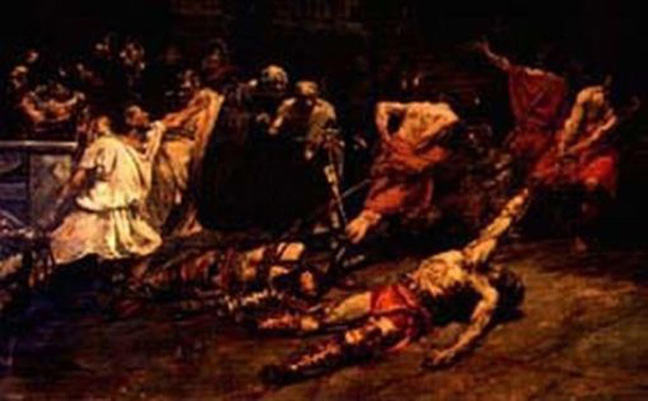
(“The Spoliarium” by Juan Luna, National Museum, right-clicked from http://www.ops.gov)
“Let it be stressed that the right of the people to know is strongest in times of turbulence for it is when the stakes to the State are high that they cannot afford to err due to ignorance….All these because the majority (the majority of justices in “In Re Live Media Coverage of People vs. Estrada, Petitioner DOJ Secretary Hernando Perez, KBP, et al vs. Estrada and IBP”) has persisted in the primitive belief that the courtroom is limited to the pad and pencil reporters. The majority will bring about the new Rip Van Winkles in this age of electronic media – We, I dissent.” – then Associate Justice Reynato Puno, dissenting in said case cited, June 29, 2001).
Discover more from marichulambino.com
Subscribe to get the latest posts sent to your email.
