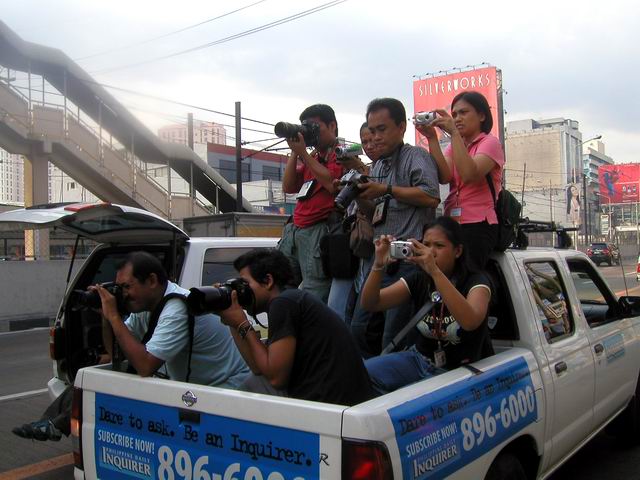
Photo from Philippine Journalism Review, Lito Ocampo.
Media Law Exam. Marichu C. Lambino. 8 October 2007. This is a closed-book closed notes exam. Answer all questions fully.
1.At the Senate hearing on the ZTE contract last week, former NEDA director-general Romy Neri testified that while he and Comelec Chair Ben Abalos were on a golf cart at Wack-wack sometime in January 2007, Abalos was telling him of the advantages of the ZTE contract and reportedly told him “Sec, may 200 ka dito.” (“Sec, you have 200 with this.”) When the senators queried what that meant, Neri said that it meant that Abalos was telling him, Sec, may 200 million ka dito (Sec, you have 200 million with this”). After Abalos resigned a week later, he threatened to sue Neri and the media outfits that published/ aired his statement. Questions: a)Is Neri likely to be liable for libel? If your answer is yes, state the elements of libel and explain each element and why he is liable. If your answer is no, explain fully.(5 pts.) b) What about the media outlets, are they likely liable? If your answer is yes, explain what malice in law means. If your answers is no, state all categories and , explain, and define fully the defenses in liable. (10 pts.)
2.In the recent episode of the CNN satire “news program” “The Daily Show” with Jon Stewart as host (a false news anchor, he is actually a stand-up comic playing a news anchor), one segment was entitled “Is America Ready for a Woman President?” with a photo of Hilary Clinton. Then stills of the following were scrolled on a laptop that was zoomed in: Indira Gandhi with superimposed “paint-sprayed” caption, ‘Oy”; Margaret Thatcher superimposed on another’s body doing a Britney-Spears-no-underwear-miniskirt- stepping off the car; and Cory Aquino with superimposed “paint-sprayed” caption “SLUT”. Questions: a)Using the American cases taken up in class, is the “Daily Show” liable for libel? If your answer is yes, explain what “libelous per se” means and cite the case; if your answer is no, explain the nature of the speech and cite/ describe the American case in point and explain what the Supreme Court said in that case. (10 pts) c) What about the fact that the statement in question here is obviously false, shocking, and in the opinion of Senator Noynoy Aquino, “in bad taste”? Explain the relevance/ lack of relevance of those observations as described in the pertinent cases. (10 pts)
3.A column by Mr. xyz came out in a national daily that stated that a package arrived at the office of a Supreme Court justice and that her secretary, who was named in the column, opened the package and that it reportedly contained 10 million pesos; according to the columnist, said secretary was fired for opening the package. News stories came out in almost all leading media outlets naming said justice as Justice Ynares-Santiago. The Supreme Court in a statement said that at the instance of Justice Ynares-Santiago, the matter would be investigated. Also, the Supreme Court issued an order to the columnist asking him to show cause why he should not be cited for contempt. Questions: a) Do you agree or disagree with the show-cause order of the Supreme Court? Why or why not? 5 pts. b) Do you think this test question itself is contemptuous, considering that there is a pending show-cause order for contempt? Why or why not? What about if these test questions were published in the internet, do you think they would be contemptuous? Why or why not? 5 pts. c)What is sub judice? Explain fully. Apply it to the two previous questions. 5 pts. d) Do you think the columnist is liable for contempt? If your answer is yes, state what kind and define and explain fully; if your answer is no, enumerate the overt acts of contempt and explain why each do not apply. (10 pts.)
4. A budding independent film maker, Dolly Leuterio, produced and directed a short film on the torture methods used during martial law and being used up to today based on testimonies. She asked her classmates to act in her film gratis. In all the torture scenes, the subjects were naked, full body shot, some scenes under bright lights and some dimly lit. The MTRCB X-rated the film on the ground of obscenity. Questions: a) What is obscenity? Use the Miller test in your definition. 10 pts. . b) Is nudity synonymous with obscenity? Why or why not? c) in your opinion, is the material in question, as described, obscene? Why or why not? 10 pts.
5. What is inciting to rebellion? Enumerate the overt acts. 5pts.
6.Enumerate all the limits to freedom of expression taken up in class. (9 pts.)
7.Enumerate and define/ describe all the limits (at least six) to news-gathering methods taken up in class. (12 points)
Discover more from marichulambino.com
Subscribe to get the latest posts sent to your email.

This morning, Unang Hirit aired two stories about dead bodies found in Quezon City. The victims died of stab wounds. In the first story, only the limbs of the dead body were shown, while in the second story, the corpses were pixelized.
The KBP Code of Ethics for television says that “good taste should prevail in the handling of news.” It also says that morbid details should be avoided if they are not necessary to reporting. Unang Hirit, by not showing the bodies was able to practice good journalism. Thus, this practice prevented the audience from seeing such gory and morbid images, especially that the news was aired at about 7:30 a.m. when probably, people are having breakfast. It catered to the sensitivity of viewers.
LikeLike
Today’s issue of The Philippine Star published a story with the headline “Water quality in RP declining, says Greenpeace.” It was a single-sourced story because it aired only the statement of the environmental group regarding a study it conducted to measure the water quality in the country.
One of the provisions in the PPI Code of Professional and Ethical Conduct says “single-source stories must be avoided as a rule.” It would have been better if it also included interviews from sources other Greenpeace to verify the accuracy of the study conducted. Greenpeace was quoted in the report saying, “Bottled water purchased in Metro Manila contained higher-than-usual levels of zinc.” The story would have been complete if it aired what the involved and affected sectors like bottled water companies and water service corporations like MWSS and Maynilad Waters would have to say to. This way, they would have a chance to validate the claim and defend themselves if necessary.
LikeLike