Jean Fouquet. The Battle between the Romans and the Carthaginians. From the book Histoire Ancienne. After 1470. Vellum. Louvre, Paris, France. Right-clicked from www.abcgallery.com
Did media persons who stayed put at the Manila Pen last November 29 and continued coverage even after being asked by the PNP to leave, overstep the bounds of professional standards? Eighteen U.P. journ ethics students were asked at the beginning of their class last December 3; : (one had grammatical and idiomatic errors that gave me a headache so I did not publish it; the other kept being returned by the computer as “unformatted); the following are 16 of the 18 opinions:
Written by Student 05-00353. 1. I think that there weren’t any violations committed by the media when they covered the Nov. 29 Manila Peninsula incident. They were only doing their jobs of informing the public of what is happening and they weren’t committing any unethical act. According to the Philippine Journalist’s Code of Ethics, journalists should resort to fair and honest methods in obtaining the news, shall properly identify themselves as a representative of the press, and should fight vigorously for public access to information. They followed all these and were vigilant in their coverage. Since they were instructed by the PNP to leave already, the news agencies’ desks were responsible enough to tell their reporters to abandon the premises and valued the safety of their personnel. I found out this piece of information from Mariz Umali, a reporter of GMA7 who was covering the incident from outside the hotel. However, it was up to the reporters whether or not they decide to leave, and with their refusal, they somehow obstructed justice because they jeopardized the operation of the police.
2. I believe that what the police and military did to the media persons after the suspects have been apprehended was pure harassment. If the police only wanted to identify these media personnel, they should just have called the desks of news agencies to verify identities instead of treating the media people like criminals themselves. Even television anchors like Ces Drilon of ABSCBN and other broadcasters were rounded up by the police even if they are well known already. It really was an abuse of authority by the police because they should have resorted to the legal process (warrant of arrest, etc.) instead of forcing the media people to come with them, leaving these journalists helpless and without any option. Also, I believe that the confiscation of their equipment like cameras, video tapes, and the like was too much. These weren’t illegal paraphernalia used by media but were only used as part of their job, which is to cover the ongoing siege of the Manila Peninsula by Sen. Trillanes and company.
XXXXXXXX
Written by Student 05-05065. I think the most important question to ask in order to resolve the issue surrounding the November 29 Manila Peninsula Takeover is whether the media hindered the authorities from performing their duties. Only after examining this point can we answer next if the media people deserved to be handcuffed, shoved to the ground, held at gunpoint and detained by the police. In Article 4 of The Philippine Journalist’s Code of Ethics it is stated that the journalist should “fight vigorously for public access to information, as provided for in the Constitution.” Given this, journalists take responsibility in covering news events irrespective of obstacles that the event may present. The media people, in covering the November 29 Takeover, risked their safety to deliver the news which is unquestionably relevant to the public. This risk is their choice to make and they are free to do so given that they do not violate any law.
In the same manner that journalists cover a report on robbery, bombing, or military combat, they covered the takeover knowing fully well the consequences that may arise. I have seen that like covering other incidents, the media people did not side, protect, or involve themselves with the news subject in the takeover (the news subjects being Trillanes and his companions). They did not violate any law in doing so and their intention was clearly to report a newsworthy event. Therefore it is unjust for the police to arrest them without any warrant stating a possible crime they committed. What is more, the manner in which they were handled is not justified given that the media people maintained its position as a medium from which the news reaches the people.
XXXXX
Written by Student 2003-45060: Provision E1 of the KBP’s Code of Ethics for Radio says that: “All stations must contribute to national development and must promote the educational, cultural, social, economic upliftment of the people.” In the passive sense, it’s the responsibility of the journalists to let the authorities do their jobs without interfering or being a hindrance to them. This means that the journalists have to obey the authorities when the latter ask them to do something which is related to the performance of their duties. In the Manila Peninsula incident, several journalists were trapped inside the hotel for hours because they failed to leave the said place even after the PNP asked them to. While 200 foreign guests scrambled to get out of the place as soon as they could, a lot of journalists opted to stay in the hopes of snagging. While it’s not wrong for journalists to make the extra effort to get ahead of their colleagues, their failure to leave the premises of the Peninsula Hotel was unethical. It also violates one of the provisions in the PPI’s Code of Ethics’: “I shall resort only to fair and honest methods in my effort to obtain news, photographs and/or documents.” True, the journalists may not have been guilty of taking advantage of fellow journalists, but their action wasn’t fair for the authorities. Instead of being able to single out the Magdalo soldiers and civilians involved in the coup and performing what they think needs to be done, the authorities had to hold back because there were a lot of journalists inside the hotel.
In my opinion, what the authorities did to some journalists (shoving them to the ground, holding them at gunpoint, handcuffing them, and detaining them) is unwarranted. The authorities should possess a warrant of arrest before being able to do what they did to the journalists. In the absence of the warrant, they should be aware of who committed the crime and what crime was committed. It’s not enough that they know someone was behind the coup and that some civilians also helped. They should be able to pinpoint what crime was committed, usually being present while it was being committed. Not only that, they should know more or less what that person looks like. They couldn’t just arrest everyone randomly, just like what they did. Our Constitution’s Bill of Rights says that:
“No person shall be deprived of life, liberty, or property without due process of law, nor shall any person be denied the equal protection of the laws and the right of the people to be secure in their persons, houses, papers, and effects against unreasonable searches and seizures of whatever nature and for any purpose shall be inviolable.”
XXXXX
Alexander Orlowski. Polish Insurgents in the Forrest at Night. 1811-1820s. Watercolor and Indian ink, 32.2×27.5 cm. The Tretyakov Gallery, Moscow, Russia. Right-clicked from www.abcgallery.com
Written by Student 200158245:
· No, there were no violations made during the coverage of the coup attempt at the Manila Peninsula Hotel last November 29, 2007. According to the fourth provision of the Philippine Journalist code of Ethics, journalists should fight vigorously for public access to information as stated in the Section 7 of the constitution.
· Also, the KBP Television Code regarding News Sources (A.2.3) was not violated because the interview of Senator Trillanes and company were not merely to showcase the staging of the crime, but also to broadcast how the authorities deals with the situation at hand
· Moreover, the KBP TV Code on News Reporting (A.3.4) holds the station management responsible for the decision regarding interviewing or not persons openly advocating the throw of government. In this case, Senator Trillanes and company were very careful in their statements. Every word was chosen carefully as to make sure there will be no loopholes and they cannot be charged with inciting to sedition
2. >frisked, shoved to the ground
>held at gunpoint, handcuffed, detained at police bus and later at the police station
· The harsh treatment given to media practitioners, PNP reasoned out, was necessary because a member of the coup attempt, Nicanor Faeldon, has escaped by pretending to be a media personnel. Authorities said that in order to sort out “real” journalists from those just pretending in order to escape, everyone had to be brought to Camp Bagong Diwa. However, this was totally uncalled for. Many known media personalities, Ces Drilon for instance, were even brought to to the holding camp in Bicutan when there was perfectly no reason to do so. Almost everyone already knew that she was “the real” Ces Drilon and not a member of the coup attempt masquerading to be a journalist.
· People are assumed innocent until proven guilty. However, it was the other way around for the media practitioners. They were presumed guilty unless they were able to prove their innocence.
· The harassment of journalists who covered the coup attempt was obviously at intimidation tactic of the authorities – to make journalists think twice about reporting events that are against the present administration.
XXXXX
Written by Dantes, Mark. 2004-13939
“The success of a free press is reflected in the ability of journalism to honor a primary responsibility to the public. Journalistic principles of truth-telling and independence work together to honor that loyalty.”
It is the duty of journalists to keep the public informed at all times. This duty of theirs grows in importance under dire circumstances such as those during last Thursday’s Manila Peninsula incident. Thus the act of staying with the coup plotters despite the warnings given by the Philppine National Police (PNP), given that this was an event of utter public importance, could indeed be justified and hailed as an act of valiantly keeping to the responsibility as the public’s watchdog in all affairs of the state.
“The dimunition of respect for the law or the process of law enforcement is unacceptable as program material.”
On the other hand, such an act could also be deemed as a blatant disregard of the proper decorum under such such circumstances. As stated a number of journalist’s ethical codes, being a hindrance in the accomplishment of police business is strongly discouraged and should be frowned upon. Given that the PNP had already issued a number of warnings to the journalists who chose to stay inside the hotel, and that thhese journalists made their decision with full knowledge of the imminent assult, it is only logical that they should therefore be held responsible for this for the possibility that their actions be read as a violation of their ethical codes.
I believe that any journalist’s code of ethics, as any other code, law, constitution or even rule book that ever existed on this planet, is undeniably an imperfect one. Conflicts will always exist between rules and it will ultimately be up to us as individuals as to how we decide to adhere to them. And in the end, own up to the consequences of the actions that result to these interpretations. In my opinion, the journalists involved in the incident, both followed the code and, at the same time, broke it. As much as a fencesitter’s opinion as this may sound, it is the truth I made out from the event’s reports.
“I shall conduct myself in public or while performing my duties as journalist in such a manner as to maintain the dignity of my profession. When in doubt, decency should be my watchword.”
Numerous codes of ethics end with a statement such as this, which inevitably leave it open-ended. It was as if, they were purposely left open to the interpretation of those who swear to follow it. Thus every single action of a journalist cannot be judged solely on such for it is an accepted fact of life that we all have our own beliefs which define what we do.
Given the chance of being caught in a situation similar to last Thursday’s incident, I would’ve chosen to stay. I would stay and eventually have to accept all ethical consequences of my decision, within the extent of my rights as a practicing journalist and as a free citizen of this country. The issue of rights being violated is, of course, another story.
When the media personnel were apprehended, I was undeniably appalled. After listening to hours of lectures on a journalist’s rights, the first thought that popped into my head was that “these policemen don’t know what they’re getting themselves into.” They simply didn’t realize that they were asking for a war on the media. Though I do agree that the journalists should face the repercussions of their actions, I also believe the severity of the actions taken on them were simply uncalled for. The PNP’s request to detain the journalist’s for identification purposes is indeed justifiable, but the fact that they were “pushed to the ground, held at gunpoint…etc…” was NOT. These journalists still have the basic right to be treated as citizens and civilians, not as common criminals. They were, after all, just doing their job.
We journalists are in the business of freedom. To adhere to a code in a way that restricts are every movement, our every decision, is just downright illogical.
XXXXX
Written by 2004-65794: As it is written in the Philippine Journalists’ Code of Ethics, journalists should “fight vigorously for public access to information, as provided for in the Constitution.” In this case, the journalists who continued covering the Nov. 29 Manila Peninsula event despite having been ordered to discontinue coverage were in the right to have stayed and fought for their right to get information as to what was happening at that moment. Prohibiting the journalists to cover the event for whatever reason there might have been would be suppression of the Press. The journalists should not be prohibited coverage even when the Philippine National Police would have had the journalists’ safety in mind (if that’s their intention) because it’s the journalists’ job to “scrupulously report and interpret the news, taking care not to suppress essential facts nor to distort the truth by omission or improper emphasis,” as stated in the Philippine Journalists’ Code of Ethics once again. Whatever was happening at the Manila Peninsula at that time should be covered and reported as it was of public interest, no matter how dangerous it was. The journalists’ safety and well-being is the journalists’ own responsibility, as it is part of their job and they obviously know the risks they are taking knowing the magnitude of the situation. If having a simple “no, you cannot have this recorded”, or “no, you cannot report about this” would be taken in so easily by any other reporter, then nobody would know the real deal as to what is happening to everything.
However, regarding the incidents when the Philippine National Police have finally apprehended the suspects and subjected the media to similar treatment as they would do the suspects and criminals, I think it is uncalled for to have those things done to the media. The media people have not committed any criminal acts while they are doing their jobs of covering the event, even when prohibited to do so by the Philippine National Police, as they should by all means be able to deliver the news to the Philippine people. How the PNP dealt with the media was too much, with the PNP having the journalists even held at gunpoint, and detaining them at the police station. If the only reason why the PNP were prohibiting the media from covering the event was to think about their safety, then treating them as they would do suspects and criminals is really “OA” of them.
XXXXX
Boris Kustodiyev. Reading of the Manifest. 1908-1909. Oil on canvas. The Art Museum of Nizhniy Novgorod, Nizhniy Novgorod, Russia. Right-clicked from www.abcgallery.com
Written by 2004-78861: Journalists, who covered the Manila Pen siege, had not violated any provisions of the PPI Code of Ethics, its expanded code of ethics, and the KBP Code of Ethics for Television. Rather, we should commend them for their decision to put their lives at risk in the name of balanced and fair reporting. According to the first paragraph of the PPI Code of Ethics, journalists should recognize their duty to air the other side. In its expanded code of ethical conduct (III-1), it states that, “All efforts must be exerted to make stories fair, accurate, and balanced. Getting the other side is a must, especially for the most sensitive and critical stories. The other side must run on the first take of the story and not any day later. From these terms, I can say that the media persons had not violated, but instead they were able to conform to these. If they stayed out of the Manila Pen because of the order from the PNP, they might not have been able to air the side of Senator Trillanes, Gen. Danny Lim, and their companions. This had stroked balance in their coverage, unlike covering the event when Trillanes and the others were already arrested. The media persons just attempted to show what really happened in the Manila Pen, wherein the public has the right to know. It is also chance to show to the people how the government and authorities respond to such crisis, which they claim as they had done for the public good.
In the case of the allegations of the PNP and the AFP that journalists obstructed justice and that some of them had collaborated with Sen. Trillanes, they should present their evidences. The arrest of the journalists during the live coverage is a blatant attack to the freedom of the press and an action to intimidate the journalists.
XXXXXX
Written by Student 2004-38319:
· No, the media who covered the Manila Peninsula incident on November 29 (last week) did not commit any ethical violations based on the provisions of the codes of ethics. The stay of journalists inside the area of the incident to cover the news even after the police orders is in accordance with the first provision of the PPI Code of Ethics – that journalists “shall scrupulously report and interpret the news, taking care not to suppress essential facts nor to distort the truth by omission or improper emphasis.” The insistence of journalists to stay even after the event clearly exhibits the journalists’ vigorous fight “for public access to information, as provided for in the Constitution,” (second sentence, fourth provision of the PPI Code of Ethics) especially that the so-called ‘coup attempt’ is an issue of immediate national concern. Furthermore, the media people did not violate the KBP Code of Ethics for Television, especially on the provisions on news reporting. Reports on television were related in a manner that avoid triggering panic and unnecessary alarm (Section A.2.1). No law of the land is violated when the media interviewed Sen. Antonio Trillanes and the members of his group, if they are to be called “fugitives from the law (Section A.2.3).” In addition, the code leaves the decision on the management of media outfits “whether or not to interview with persons who openly or publicly advocate the overthrow of government by force or violence (Section A.3.4).” What Trillanes was calling for was civil disobedience in the form of peaceful assembly. If the media companies did allow the continuous coverage of the turnover of events, thus, it is just right. The press, I believe, has been careful in the exercise of its duties, so as not to commit an act “inciting to rebellion or sedition.” After all, “no code of ethics can prejudge every situation (Epilogue, PPI Expanded Code of Ethics),” which means that collective judgment must be made by the members of the media on their actions when getting the news especially on matters of immediate concern such as the Manila Pen incident.
2. Did the media deserve to be shoved to the ground, held at gunpoint, handcuffed, and detained at the police bus and later, at the police station? Why or why not?
· The media, of course, did not deserve to be mistreated by the police officers, even if the premise presented by the national police for their action was that Magdalo group member Capt. Nicanor Faeldon disguised as a member of the media in order to escape from the eyes of the authorities. The authorities must recognize “the vital role of information and communication in nation-building,” as stated in Article II of the 1987 Constitution, where the media plays a key responsibility in disseminating information to the widest reach as possible. The policemen’s act was a clear abridgment of the freedom of the press, an important right enshrined in the supreme law of the land. However, what is unsure is if this is a manifestation of the implementation of Republic Act No. 9372, or the Human Security Act of 2007, which supposedly safeguards people from acts of terrorism.
XXXXX
Written by Student 2005-60979: Based on the Philippine Journalist’s Code of Ethics, the persons who continued to cover the Manila Pen Nov. 29 incident even after the PNP ordered them to leave is not a violation because the code states that media men should “fight vigorously for public access to information, as provided for in the constitution.” Therefore, the journalists were only doing there job. They were only covering an event which is of public interest. However, the Television Code of the Kapisanan ng mga Brodkaster sa Pilipinas states that “news should be telecast in such a manner as to avoid panic and unnecessary alarm.” The media coverage may cause panic because the PNP is goung to launch the assault. The code also states that when lives are at stake, it is the call of the authority.
What the PNP did to the mediamen is a violation of Article 3 Section 4,” No law shall be passed abridging the freedom of speech, of expression, or of the press, or the right of the people to peaceabkly assemble and petition the government for redress of grievances.” The mediamen were only doing their job. The public has the right to know what was happening especially that it is a national issue. The mediamen were pushed to ground on shards of glassses, fisked and held at gun point, handcuffed and detained at the police bus and later at the Bicutan police station. This is a form of injustice because what the mediamen did was not a crime but a part of their job. They do not deserve to be treated that way
XXXXX
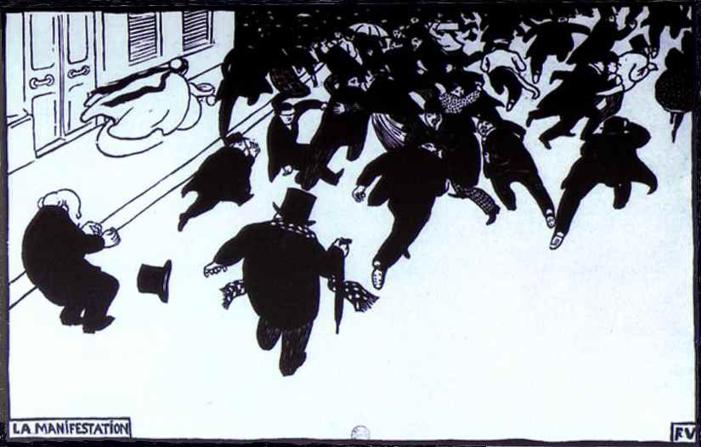
Félix Vallotton. The Manifistation/ La Manifestation. 1893. Woodcut. 20.3 x 32 cm. Bibliotheque Nationale de France, Paris, France. Right-clicked from www.abcgallery.com
Written by Student 2005-12250: 1. Based on the Philippine Journalist’s Code of Ethics, the reporters who stayed at the Manila Peninsula Hotel to cover the standoff even after the PNP had ordered them to leave did not violate any ethical provision. Instead, they upheld the second part of the fourth provision in the Philippine Journalist’s Code of Ethics, which states: “I shall fight vigorously for public access to information, as provided for in the Constitution.” The reporters who stayed at the Manila Peninsula were just doing their job – covering an event that is newsworthy and relevant to the public, whom they are meant to serve. They also did not violate any provision in the PPI expanded code of ethics. The Nov. 29 incident at the Manila Peninsula Hotel did not pose any conflict of interest to the reporters, nor did it make them use their “positions in the newspaper to get any benefit or advantage.” Reporters also did not use deception in covering the incident.
Based on the KBP Code of Ethics for Television, “rallies and demonstrations are legitimate news events and may be covered at the discretion of the station. However, care must be exercised that the coverage itself is not sensationalized so as to incite or alarm the listening and viewing public.” This provision was not violated in the coverage of the Nov. 29 incident at the Manila Peninsula Hotel. Coverage was not sensationalized. And as what is stated int he provision, “demonstrations are legitimate news events and may be covered at the discretion of the station.” It is the station who has the say on whether or not the incident should be covered.
2. The PNP’s actions towards the media persons covering the Nov. 29 incident were unreasonable. The reporters were just doing their job. The public had to know what was happening at the Manila Peninsula Hotel because it involves the government. The PNP getting ready for their assault does not justify reporters being shoved to the ground, frisked, handcuffed, detained at the police bus and then at the police station. The reporters were just upholidng the public’s right to know.
XXXXX
Written by Student 200570432: The media’s arrest during the Manila Peninsula Hotel incident was based on the government’s discomfort. In the KBP TV code of ethics in provision 3.2 – news reporting- , “good taste shall prevail in the selection of handling of news…” the seven hour coverage made the news more alarming than it needed to be. As journalists, we must know what we are risking and prepare for the consequences of such actions. With regard to the process of such an arrest by the police, brute force is never the answer. They have used their position as a weapon for irrelevant actions, being held at gunpoint, shoved to the ground et al is pure brutality. The journalists have literally put their lives in danger, they’re doing their job and they needed to pay a price.
In the expanded code of ethics of journalists it has been indicated in the advisory that there is no code of ethics that can prejudge every situation. In this situation, when journalists cry for the freedom of speech, we neglect the line drawn between the need to publish and not publish some sensitive situations that involved institutions need to control a circumstance.
XXXXXX
Written by Student 2005-07148: Yes. I will not deny that the Media, in one way or the other, did commit violations, however I cannot consider what the Military claims: “That the Media were obstructions to justice.” I mean, how vague and subjective is that? I think all of the issues that were brought about came from one thing, distrust. The military distrusted the impartiality and objectivity of the media, that is why the came up with such a vague (and lame) excuse to justify the arrests they made. Out fear of an expose’ of their harsh operations or God-knows-what, it was clearly out of their own (or most people’s) ethical standards. Had they believed that the Media were impartial and objective about their reports, they wouldn’t have had all of them arrested. Why would they arrest them when those media men inside are just observers and reporters of what is just actually happening? Don’t they allow Media when they are having their raids and other operations, or was that because the latter favored the depiction of them in a more ideal light? The way I see it, the Military already assumed that the Media inside the Manila Peninsula were allied to the coup-plotters, an inference that was beyond the due process they should be exercising. As most media practitioners agreed, there is no harm on being investigated or interrogated as that is all part of the investigation that they are all willing to participate in. The end does not justify the means and the Military are having all sorts of biases that they should not have. Should they wish the Media to respect their exercise of profession, the Military should show that they are willing to do the same. In this case they did not.
Still, the Media was not perfect. The code I clearly see that they violated was:
Article 3, section 4 of the KBP Broadcast Code which states that station management must exercise extreme caution on interviewing persons who publicly advocate the overthrowing of government and that only 1 minute “sound bites”, to establish the report, should be used. Several media networks aired the grievances of Sen. Trillanes and Gen. Lim for such an exceedingly long time such that it violates said provision.
The fact remains, the Media did not deserve the treatment they got. Again, the stand of the Military was vague, shady and non-conclusive, something not expected from a branch of state that seeks to protect the people. My suggestion? Trust and respect other professions and the rest would follow.
XXXX
Written by Student 2005-12380: 1. Media practitioners didn’t violate any ethical provisions stated in the KBP Code of Ethics and the Philippine Journalist’s Code of Ethics during their coverage of the six-hour-Manila Peninsula standoff. The thirty plus reporters who were arrested were simply doing their profession to inform the public, even though they became an obstruction to joint police and military actions against the coup plotters.
Media people exerted all their effort to make their coverage fair, accurate and balance even the situation at the Manila Peninsula imperils their lives. In addition, the coverage of media during the standoff didn’t violate the Article 3 Section 4 of the KBP Code of Ethics for TV. The said provision states, “Station management must exercise extreme caution and prudence in deciding whether or not to interview persons who openly or publicly advocate the overthrow of government by force or violence.” Media people who covered the incident exercised their duty to inform the public and didn’t commit any unethical act in doing so.
2. Media practitioners practice their profession when there is no restriction. Police brutality to media people who were apprehended after the standoff is harassment and interference in the duty of media practitioners.
Media people who were taken to camp Bagong Diwa in Taguig for “processing” include prominent reporters such as Ces Drilon of ABS-CBN and Sandra Aguinaldo of GMA-7. Some of their equipment was also damaged. The police argument that some Magdalo men posed as media practitioners is a lame excuse. In addition, no media poser was caught after the police interrogation. The arrest of media people is clear intimidation and a restriction of press freedom.
Xxxxx

Jan Steen. Rhetoricians at a Window. c. 1662 – 1666. Oil on canvas, 74 x 59 cm. Philadelphia Museum of Art, Philadelphia, PA, USA.Right-clicked from www.abcgallery.com
Written by Student 2005-67083: The media did not commit any ethical violations in choosing to stay and cover the November 29 Manila Peninsula incident. They were functioning on the principle that the said incident was newsworthy and an important incident that should be given full coverage for the benefit of the public, regardless of personal safety. Provision four of the PPI code of ethics provides that journalists should not “distort the truth by omission”, and “fight vigorously for public access to information, as provided for in the Constitution”. If media had not covered the incident, it would have been a greater fault. Also, media coverage of the event did not violate provision 2.3 of the KBP code of ethics for television, which provides that media may come in contact with “fugitives from the law” as long as they themselves did not initiate and just observed the incident. Given these reasons, the manhandling and detention of media personnel (print and broadcast reporters and crew), even when they were properly identified and were clearly only observers and not participants of the said incident was uncalled for.
Other issues, such as the KBP provision 2.3 that includes the phrase that “no law of the land is violated” on the coverage of such events – and said manhandling and detention of media personnel without corresponding warrants – raises issues on the Human Security Act. The issue is should it be considered an ethical violation – presuming that the said manhandling and detention was done in the spirit of this act – when media groups and other sectors of society have opposed its implementation in the first place? I think not. It is legally binding, but not morally so for the greater part of the media and the Philippine society.
XXXXX
Written by Student 2005-10087: The media who covered the standoff in the Manila Peninsula did not in any way, “jeopardize” PNP operations, as suggested by the police and the military. They were only, in my opinion only doing their jobs as journalists covering a newsworthy event. The media, particularly journalists who subscribe to the PPI Code of Ethics know that it is the primary responsibility of the press to report news as they happen without distorting the truth and leaving out essential facts. If the journalists covering the Manila Pen incident agreed to leave the hotel, they may not have bore witness to the attacks that the PNP and the military have done to the perpetrators of the said standoff. If they were not there, the PNP and the military may have done something to the group of Senator Trillanes and Brig. Gen. Danilo Lim. The journalists were not there to be an obstruction to police and military operations, or as police say, in connivance with the perpetrators of the incident, but they were there to fulfill their duties to the general public to scrupulously report the news impartially as they happen.
The arrest and detention of media persons after the major players in the standoff had already been apprehended was unnecessary and uncalled for. The PNP claimed that the detention of the media was part of a standard operating procedure that would enable them to see if there were Magdalo soldiers who have disguised themselves as part of the media to avoid detection come apprehension time. This justification of the police underscores the fact that these people were journalists who were properly identified as members of the media who were only there to cover the event. It is even stated in the PPI code of ethics that members of the media are required to introduce themselves first as members representatives of the press before they cover an event. Such manhandling and manacling of the media only shows up to what extent the police and the military will do to curb press freedom, even if it meant violating press rights along the way. If SOP means shoving media people to the ground littered with shards of glass, handcuffing them like prisoners and holding them at gunpoint, then I believe that the country, along with our reputation as the country with the freest press in Asia, has literally, and figuratively, gone to the dogs.
XXXXXX
Written by Student No. 2005-64041: 1.) For me, I think the media people who covered the said standoff did not commit any ethical violations if we’re going to analyze the provisions written in the Journalist’s Code of Ethics, including its expanded version and the KBP Code of Ethics for Television.
Even if we say that the journalists were “too eager” in their coverage of the Makati siege, I do not believe they violated any laws since there were no guidelines in the first place on how to cover “historic but threatening events.” There is no clear provision in these three ethic codes that penalizes this act, when media persons still cover the event though it would be risky for them.
But then I also share the same view by Edward Abad, president of the Kapisanan ng mga Brodkaster ng Pilipinas (KBP) Cebu chapter in an Inquirer interview last December 1 that there could have been a “lapse in judgment,” especially by the major TV networks, when they allowed their crews to remain inside the hotel with the rebel soldiers. I liked his suggestion that KBP Manila directorate or the NPC (National Press Club) that they sit down with the government and draft guidelines that will set the limitations of the media. They can come up with a MOA (memorandum of agreement) so those in the media can police their own ranks.
2.) Media groups have roundly condemned what they said were the illegal arrests of journalists who covered the Makati standoff, saying that such actions by the government posed a serious threat to press freedom and the public’s right to know. On that evening, as the police rounded up the Magdalo and their supporters, the men and women of the media found themselves being handcuffed with plastic ties and marched into buses for “processing.” Why were they arrested and taken to Camp Bagong Diwa in the first place? What law did they violate? They were just doing their jobs.
I don’t see any reason for the police to arrest and detain them. By the way, giant network ABS-CBN is said to be planning to sue the government for the arrests of its reporters and crew, and I hope the entire media community joins it in this cause.
XXXXXXX
Discover more from marichulambino.com
Subscribe to get the latest posts sent to your email.

In a story by Michelle V. Remo entitled “DOF opposing proposed tax perks for senior citizens” printed last November 22 on page B5 of the Philippine Daily Inquirer, the writer only used statements from the Department of Finance and failed to get the side of the legislator behind Senate Bill No. 269 which seeks to amend the Senior Citizen Act, and of the other parties concerned in the said bill.
This is in violation of Part III, Number 1 and 2 of the Code of Professional and Ethical Conduct of the Philippine Press Institute which states that “All efforts must be exerted to make stories fair, accurate and balanced. Getting the the other side is a must, especially for the most sensitive and critical stories. The other side must run on the first take of the story and not any day later,” and that “Single-source stories must be avoided as a rule. There is always the imperative to get a second, third or more source, the contending parties to an issue, the expert source, the affected party, the prominent and the obscure, in the story. We musy strive at all times to ascertain the truth of our sources’ assertions.”
—
In the November 25 episode of Rated K, a feature on the Ferrari cars served as a discreet (or rather indiscreet) promotional for the Shell-Ferrari promo, which involves selling Ferrari model cars. The commercial break immediately following the said segment even involved two runs of the TV advertisement for the said promo.
This is in violation of The KBP Television Code as stated in the section devoted to Placement of Advertising, which states that “Broadcast stations shall exercise particular discrimination in the acceptance, placement, and presentation of advertising in news programs so that such advertising in news programs is clearly distinguished from the news content. Further, commercials in the guise of of news shall not be acceptable.”
—
On December 3, in a morning radio program broacast over DZBB, Mike Enriquez was having a live interview about the Manila Peninsula incident with GMA reporter Lazatin, one of the media persons present in the said event. Enriquez, however, instead of asking questions about the uprising at the Manila Pen, asked leading questions meaning to put reporters from another station ina bad light. To these questions, Lazatin tried his best to give answers without feeding Enriquez’s tirade against reporters from another station who were detained. Despite his efforts however, Enriquez still pressed on with more questions unrelated to the Manila Pen incident and pressed on with how the detained reporters have been irresponsible in their actions — even having the gall to say on air that the incident should enlighten the public regarding which stations can honestly be tagged as “walang kinikilingan.”
All this is in violation of The KBP Radio Code as stated in the section devoted to Commentaries and Analyses (number 4, letters f and g), which states that “Personal attacks against fellow broadcasters and other stations are considered unethical and not be allowed. Management shall be primarily and directly responsible for utterances of their broadcasters in this regard,” and “Programs and commentaries which deal with sensitive, controversial issues must be fair, factual, and impartial.” It is clear that, in this case, Enriquez maligned fellow media practitioners from a competing station, and that he was not in any way fair and impartial.
—
In the November 28 newscast of 24 Oras, there was a news segment that discussed the situation of teachers in a school in Basilan. A number of teachers from Sinangkapan Elementary School have stopped teaching due to a delay in their salaries, some of them even have not received salaries for more than 4 months. The news segment was balanced and fair, with both the school administration and the faculty having the chance to air their side — for the school administration, they were given the chance to explain the reason for the delay, and for the teachers, they were able to voice out their complaint.
What made the news segment good, however, is that it was in a setting far from the national capital. Networks have the tendency to prioritize reports based here in Metro Manila, therefore leaving pertinent issues in the provinces to the broadsheets and local provincial stations.
LikeLike
Correction:
Moreover,the news segment is about a setting far from the national capital. Networks have the tendency to prioritize reports based here in Metro Manila, therefore leaving pertinent issues in the provinces to the broadsheets and local provincial stations.
LikeLike
I think that making it appear as though the rebel soldiers could use the media as a cover to escape is simply bad crime scene management. First, it was military intelligence that managed to infiltrate the media. Military agents were there posing as media practitioners, complete with cameras and mikes. Second, the fact that Capt. Faeldon managed to disappear (their excuse!) indicates that the mass arrests of journalists did not achieve their so-called purposes. Finally, blaming the media for getting in the way means that the cops had no idea how to handle the situation. In short, this is a simple case of finding someone to blame.
LikeLike