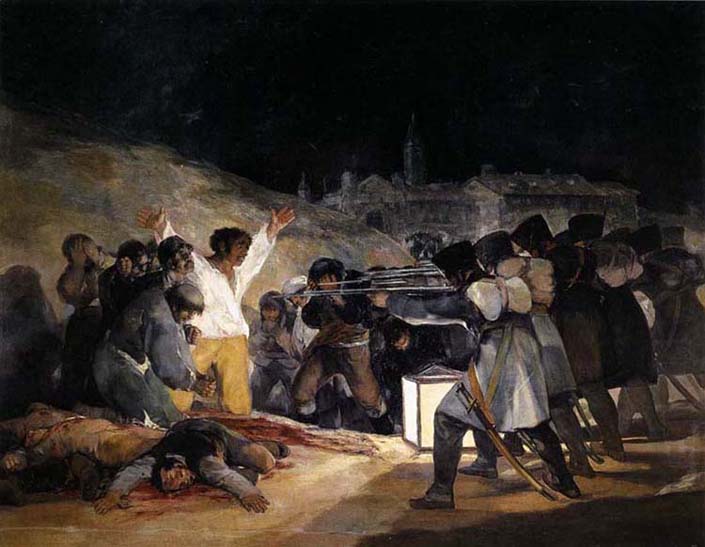
Francisco de Goya. The Third of May, 1808: The Execution of the Defenders of Madrid. 1814. Oil on canvas, 266 x 345 cm. Museo del Prado , Madrid. Downloaded with express permission from the Web Gallery of Art at www.wga.hu . Thanks
From American University Washington College of Law Professor Michael Tigar (Constitutional Law; Supreme Court; French legal system; criminal law and procedure; human rights); represented Terry Nichols in the Oklahoma City bombing trial; one of the most renowned lawyers in the United States; he has argued seven cases before the U.S. Supreme Court and more than 100 appellate cases; written extensively about litigation, aspects of trial practice, criminal law, the death penalty, and the role of the criminal defense lawyer. His books include Fighting Injustice (ABA, 2002); Federal Appeals: Jurisdiction and Practice; and Examining Witnesses. In addition, he has written several plays about famous trials. Throughout his career, Tigar has been active in pro bono cases, the American Bar Association, continuing legal education programs, and international human rights. During the apartheid period, he went to South Africa to train black lawyers. Prior to joining AU, Tigar served as a professor at the University of Texas Law School:
Quote “We do not want for examples of how claims for justice may be presented based on the rediscovered norms of human rights. In assessing these stories, one must keep in mind that using legal ideology to present claims for justice is not an end in itself. That is, the claims are made by and on behalf of a movement for change, and the purely “legal” maneuvers are but one element of the movement’s activity. To see matters otherwise puts law and lawyers too much in the center of things, and risks both reification of the norms and trivialization of the movement’s popular base.
Quote “My partners and I sued the Chilean junta (of Pinochet – blog admin) and won a judgment declaring it responsible for the killings. The damage award was eventually paid. This case thus helped to establish the principle of state responsibility for acts of terrorism conducted against political opponents. It was, of course, no secret that agents of reactionary governments used the United States as a base for operations against their own nationals. This was a pathbreaking decision on state liability for such conduct.
Quote “In the meantime, with renewed vigor after the junta yielded power, lawyers in Chile brought cases dealing with the junta’s abuses. General Manuel Contreras, head of the secret police, was tried and convicted by a military court. He then gave a statement implicating Pinochet in all the murders and tortures and disappearances. This statement added to a considerable body of evidence of Pinochet’s personal involvement in those crimes. After all, Pinochet’s favorite expression was “not a leaf moves in Chile but that I know of it.”
xxxxxxx
Quote “The answer to such difficulties lies in the relationship between law and movements for social change. The Pinochet litigation in London and Spain would not have had a lasting effect unless a movement in Chile had taken up the call to bring him to justice. All of our work on the Pinochet matter, from 1976 forward, has been done in close collaboration with the movement for change in Chile. That movement redoubled its efforts when Pinochet was released in Britain, and the Chilean courts have now stripped him of his immunity from suit and prosecution. In the same vein, aberrational invocations of human rights and universal jurisdiction principles will be countered by responses from the people affected by the alleged conduct. If no movement for change responds to an initiative, it will lose force.
XXXX
Quote “Principles of legal ideology, reflecting international consensus, become the basis for demands for change. And if the change does not come, the insistent argument that this represents a betrayal of “the law” helps to galvanize the movement for change. One need only look at the struggles for civil rights and against apartheid to see the point. To say that one desires change is one thing. To say that one is entitled to change, and to back that argument up by appeals to legal ideology, makes the demand clearer. And, as I noted above, the great powers no longer possess a monopoly on formulating principles of legal ideology. Thus, the conduct of the most reactionary government—as in Chief Justice Marshall’s day—is no longer the defining principle of international norms. XXXX closed-quote. – Michael Tigar, “Law and the Rise of Capitalism” new edition at www.monthlyreview.org/lawrise
Discover more from marichulambino.com
Subscribe to get the latest posts sent to your email.