
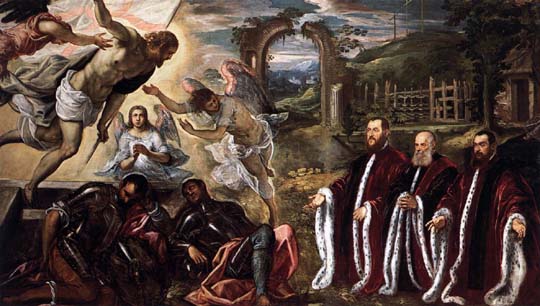
Robusti, Domenico. Italian painter, Venetian school (b. 1560, Venezia, d. 1635, Venezia). Resurrection and Three Avogadri. Oil on canvas. Palazzo Ducale, Venice. Downloaded with express permission from the Web Gallery of Art at http://www.wga.hu from site admin Emil Kren, Ph.D.. Many thanks.
quote “Lawyers, Jails, and the Law’s Fake Bargains”
by Michael E. Tigar
(July-August 2001 issue of Monthly Review at http://www.monthlyreview.org/0701tigar.htm)
(Michael E. Tigar is an American University Washington College of Law Professor (Constitutional Law; Supreme Court; French legal system; criminal law and procedure; human rights); one of the most renowned lawyers in the United States. He has argued seven cases before the U.S. Supreme Court and more than 100 appellate cases; written extensively about litigation, aspects of trial practice, criminal law, the death penalty, and the role of the criminal defense lawyer. His books include Fighting Injustice (ABA, 2002); Federal Appeals: Jurisdiction and Practice; and Examining Witnesses. In addition, he has written several plays about famous trials. Throughout his career, Tigar has been active in pro bono cases, the American Bar Association, continuing legal education programs, and international human rights. During the apartheid period, he went to South Africa to train black lawyers. Prior to joining AU, Tigar served as a professor at the University of Texas Law School)
(Excerpts of a 15-page article by Michael E. Tigar; excerpted by this blog with apologies; studies show blog viewers have a very short attention span, hence the excerpted, installmentized version.)
Quote “XXX The heavy toll of jailed people reflects the extent to which the criminal process is used as a mechanism of social control, directed mainly at the poor and at people of color. XXXX
Quote “The proceduralist would tell us that these figures are not reason for alarm, for every person faced with incarceration has an array of due process rights. I sat at dinner with a Supreme Court Justice, who explained to me that the constitution was drafted by people who had read Isaac Newton, and who devised a mechanism of checks and balances, like clockwork. The Framers, he said, were concerned with the mechanism of government. This view is, to be sure, partial; the Framers had been revolutionaries, battlers for a certain social vision, threatened with jail or execution themselves. They were also white males who owned property, and many, if not most, of them counted human beings among their property. However, the clockwork idea is powerful, for it reveals something of current Supreme Court attitudes towards the criminal process that puts all these people behind bars.
Quote “Clockwork is a powerful image because a clock is quintessentially “form,” the substance is what time it is. If there is only one clock, and it is kept by a small group of the powerful, then the time is whatever they say it is. The clock, and even the rather arbitrary decision to divide its units into sixty, sixty and twelve or twenty-four, is itself a convention established by somebody or other. “Twelve o’clock and all’s well,” says the town crier from the castle parapet. In this essay, I want to talk about how, procedurally, all those people could have been put into jail or onto death row.
XXXXX
(Niccolo Dell’ Arca. Italian sculptor, Bolognese school (active 1462-94 in Bologna). Prophet Wearing a Turban. 1473-94. Marble, height: 51 cm. San Domenico, Bologna. Downloaded with express permission  from the Web Gallery of Art at http://www.wga.hu from site admin Emil Kren, Ph.D.. Many thanks.) Quote “That brings us to the lawyers. Regardless of how biased may be the judge, how inhumane the criminal law, and how corrupt and malignant the police and prosecutors, the accused will have a champion, a lawyer. I state the issue in this fashion because its premise has been documented over and over. A Columbia Law School study found fundamental legal error in two-thirds of the capital cases tried in the United States since capital punishment was upheld by the Supreme Court in 1978 subject only to certain broad limits. Most of those errors involved police officials hiding exculpatory evidence, prosecutors and police denying the accused basic rights in the criminal justice system, and judges who overlooked those errors. XXXX
XXXXXX
Quote “This brings us to the bargain between the accused and court-appointed counsel. This is a bargain only in the most formal sense. The indigent accused will have the services of a lawyer selected by the judge, and paid only what the local custom will allow. That payment may be so low that the lawyer’s most financially rewarding course is to take on as many appointed cases as possible and make as many plea bargains as quickly as possible. Although figures are difficult to obtain, about 90 percent of all criminal defendants, and an even higher percentage of defendants of color, have court-appointed counsel.
Quote “The National Law Journal did a study of appointed counsel in capital cases in 1990. Given what is at stake, one would expect that only the most qualified lawyers would be found adequate to the task. By now, almost everyone has read the anecdotal evidence that this is not so. The classic story of the Texas-appointed lawyer who slept during his client’s capital murder trial has made the rounds. The trial and penalty phase lasted just thirteen hours, and the lawyer did not even make objection when the prosecutor said the jurors should sentence the defendant to death because he was gay.
Quote “Here is a short summary of what the National Law Journal found:
Quote “the trial lawyers who represented death row inmates in the six states were disbarred, suspended, or otherwise disciplined at a rate three to forty-six times the discipline rates for lawyers in those states;
 (Empoli. . Italian painter, Florentine school (b. 1551, Firenze, d. 1640, Firenze). Still-Life with Games. 1620s. Oil on canvas, 114 x152 cm. Private collection. Downloaded with express permission from the Web Gallery of Art at http://www.wga.hu from site admin Emil Kren, Ph.D.. Many thanks.)
Quote “there were wholly unrealistic statutory fee limits on defense representation ;
Quote “nonexistent standards for appointment of counsel ;
Quote “capital trials that were completed in one to two days, in contrast to two-week or two-month long trials in some states…where indigent defense systems were operating.
Quote “In short, the right to effective counsel is ignored in the cases where the stakes are highest, and error rates are demonstrably high. The idea that a capital case can be well-tried in one or two days is laughable. XXXX
(footnotes and biblio omitted by blog admin. To be continued next week – blog admin)
Discover more from marichulambino.com
Subscribe to get the latest posts sent to your email.


