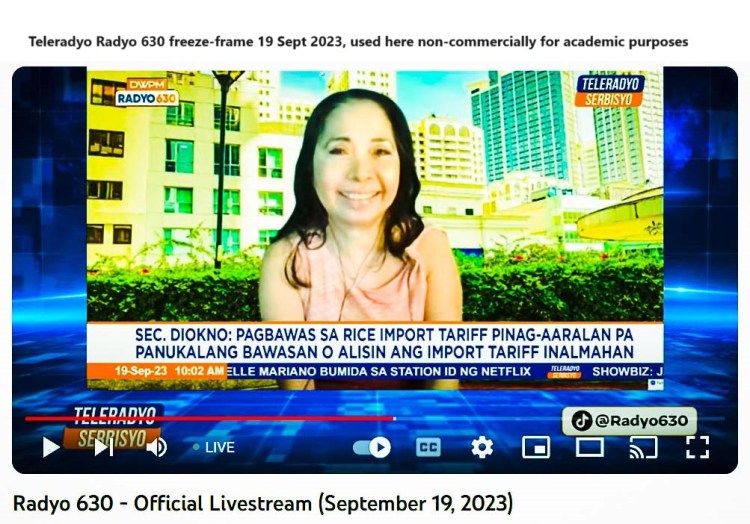
Bright and beaming Radyo 630 Teleradyo anchors Johnson Manabat and Joyce Balancio explore the proposal of Senator Raffy Tulfo to combat disinformation and to form a guild of vloggers (also, blog admin’s discussion on how to uproot disinformation: Hopefully, this is useful)
Bullet points of my answers to the interview questions (how to uproot disinformation: Strike at the funding sources and the agency operators; push for laws or guidelines to regulate tech giants’ refusal to use enough resources to prevent their platforms from being networks of disinformation)
The objective of fighting disinformation by Senator Raffy Tulfo is inspiring and should be encouraged.
Based on the study of Cambridge University Prof. Jonathan Ong and his colleagues, half of the disinformation content online is funded by the State or by government agencies.
Factchecking and the filing of cases against disinformation peddlers are very useful tools to combat disinformation and should be supported and expanded.
To root out and decisively route disinformation peddlers in the form of troll armies, we should strike at the roots by looking for and then uprooting the funding sources (mga nagpopondo) and the agency operators.
Based on the study, half of those who are funding troll armies can be found in government agencies. These are hidden in communication and information budgets and disbursements. We should look at the negotiated contracts with private PR firms and advertising agencies (including confidential funds) : Strike at that and you strike at the roots of disinformation.
The Commission on Audit can be instructed to root these out by disallowing disbursements of dubious negotiated contracts with PR firms, etc. by government agencies.
Based on the research of graduate students (not yet published), the deployment of troll armies has become an “acceptable” “industry practice” among PR firms and advertising firms. There should be an open discourse among leaders in the industry about this practice.
Itis true that vloggers fall outside the journalism profession — i’m theorizing that since legitimate vloggers engage in promoting products, personalities, and programs, they can be categorized as part of the promotion industry/ public information profession, and lifestyle and entertainment industry. They are therefore also governed by a set of ethical standards (and the community guidelines of their platforms) and many of them can be organized under the Ad Standards Council (ASC). Any association of vloggers should be voluntary and for self-regulation. Vloggers can be encouraged to form such associations with incentives like workshops, trainings, accreditation as members of the industry, more advertisements (and therefore revenues) referred to them upon their accreditation.
Tech giants’ platforms (Facebook, YouTube, Tiktok, X, etc, should be regulated in their refusal to use enough resources to prevent their platforms from being networks of disinformation. In the U.S., there is such a move in the legislature but it is being blocked by powerful lobby groups.
The voluntary vloggers’ association for self-regulation can be jumpstarted by convening the leading legitimate vloggers (those who are not disinformation peddlers) and the leading members of the Ad Standards Council, PR firms, and advertisers.
The Pintig ng Bayan Radyo 630 interview will pixelate below the freeze-frame photo, all produced by Radyo 630 Teleradyo used here non-commercially for academic purposes
The virtual background is an original photo i shot in person of the sprawling and lush roof garden of the Skyplace, above this is Cpt. Teng’s and Jane’s part of the Skyplace near the clouds.
Oops, you have to sign in on YouTube … When i saw this, i reviewed the morning live-streamed programs … i think it’s because in the program showing hospital or medically infirm persons, there are photos of patients with infected wounds, etc., so the entire 12-hour live-streamed programs became age-restricted…
Discover more from marichulambino.com
Subscribe to get the latest posts sent to your email.
