


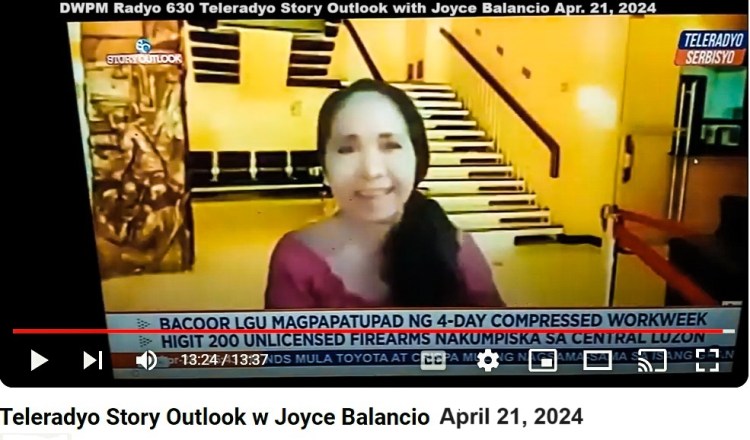
Lack of Info, Dangerous online behavior. Teleradyo Story Outlook anchor Joyce Balancio throws interesting questions on vloggers, how to avoid lack of info, disinformation, deceitful practices, dangerous behavior
Summary of interview and discussion on responsibility of vloggers, Sunday April 21, 2024 at 6:20pm:
Asking the right questions in order to get more information for content should be practised by all content-creators. For example, regarding the reported “large number” of residential foreign students, nationalities from China in one barangay in the north, the following questions should be used to get more info, based on experience in degree-granting academic programs:
1.Usually, in the University, for graduate degree-granting academic programs, for residential foreign students of one nationality, we ordinarily have a dozen or so residential foreign students. We never had hundreds, let alone, thousands, of residential one-nationality students in one graduate degree program – not in residence. So, this is a curiosity.
2.Second, foreign students from countries where English is not the lingua franca and are seeking an academic degree in a reputable University in the Philippines: There is a required English-proficiency exam. So, it should be asked whether an English-proficiency exam was administered.
3.Most universities now offer a blended mode of learning in their graduate program, and so, for practical reasons, foreigners need not be physically in residence but just need to be present during the admission exam and the required in-person exams, usually two or four. So, it is curiosity that they are all in residence in their hundreds, regardless of nationality, concentrated in one barangay or one sitio.
Vloggers should avoid making judgments where there is lack of information and at the same time they should have the right questions in mind so they can gather more information — they should know the right questions to ask.
On whether vloggers should be “regulated” : In general, vloggers and other online content-creators should be governed by self-regulation rather than any kind of censorship.
There are however laws that govern those that engage in deceitful practices or dangerous behavior.
There are several categories of vloggers: There are influencers and/ or those who promote products and services. There are those who have an advocacy or who are advancing a cause or movement. Then — I will put in a separate category – there are those who are engaged in disinformation.
If they are promoting products or services, they are governed by the Consumer Act and other laws. If they engage in deceitful practices for commerce, they may be the subject of a complaint to be filed with the Department of Trade and Industry.
Those who engage in dangerous behavior to promote a product like simulating a kidnapping in order to get clout or views: They can be the subject of a complaint to be filed with the PNP or the National Bureau of Investigation for violation of the Cybercrime Prevention Act.
On the need for vloggers to have their own guild: Yes this is a good idea. Those who are engaged in promotions may be organized into a guild by the Advertising Standards Council (ASC). We can, for example, request the ASC to require that they undergo seminars in order to qualify to be members of a guild and, as an incentive, they would be given privileges such as being favored by advertisers, and be given more product placements — which would result in more income for them: So this will encourage them to adhere to the standards of their guild and the ASC.
All audio-visual materials (video above, freeze-frame below) produced by DWPM Teleradyo, used here non-commercially for academic purposes
Discover more from marichulambino.com
Subscribe to get the latest posts sent to your email.
