

ANSWER: Relevant. The Continuing Relevance of Academic Freedom (Nemenzo, 1977), Author: Dean, Chancellor, and 18th University of the Philippines President Francisco “Dodóng” Nemenzo Jr., PhD, Professor Emeritus
on mobile, tap “Listen in browser…”
Quotable Quotes: from UP President Francisco “Dodóng” Nemenzo Jr., PhD, Professor Emeritus (excerpted by the Defend Academic Freedom FB site, formerly the UP Faculty Regent FB site; full text jpegged below published by UPDate)
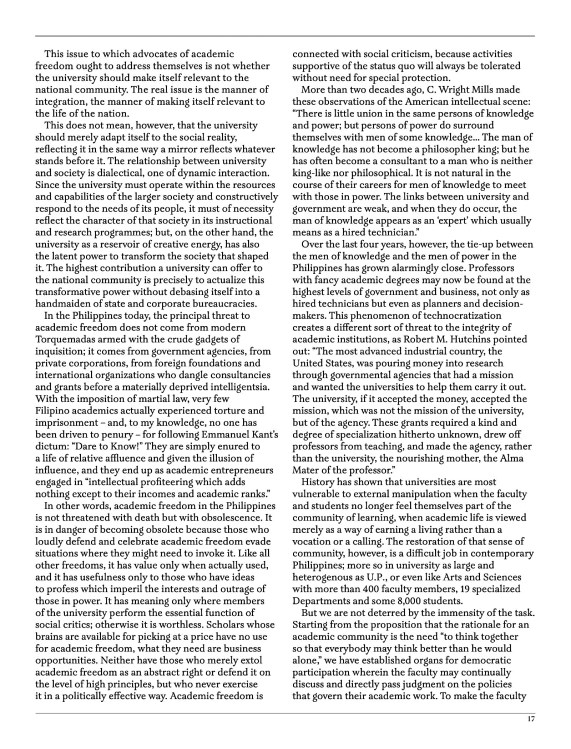
“Like all other freedoms, [academic freedom] has value only when actually used, and it has usefulness only to those who have ideas to profess which imperil the interests and outrage those in power. It has meaning only, where members of the university perform the essential function of social critics: otherwise it is worthless. Scholars whose brains are available for picking at a price have no use for academic freedom, what they need are business opportunities. Neither have those who merely extol academic freedom as an abstract right or defend it on the level of high, principles, but who never exercise it in a politically effective way. Academic freedom is connected with social criticism because activities supportive of the status quo will always be tolerated without need for special protection.”…
…
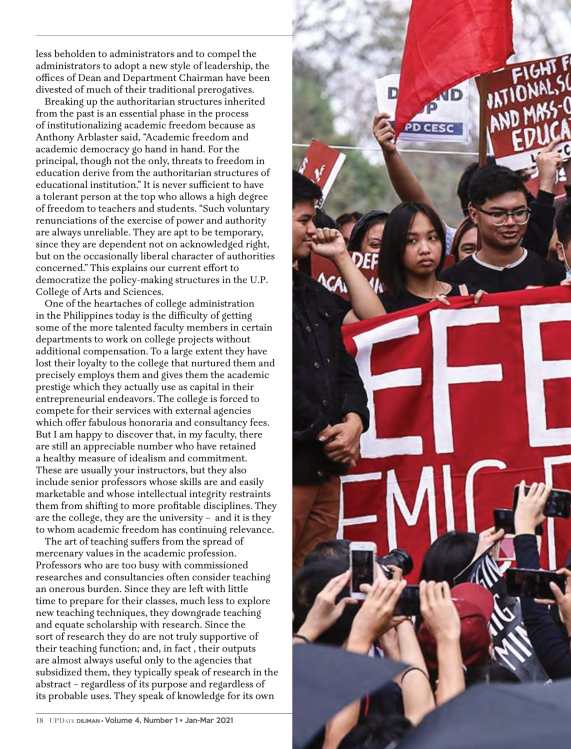
“In the context of contemporary Philippine reality, the demand for academic freedom should start from the assertion of our right to determine the purposes and priorities of academic work. To clamour for freedom, from external pressures is futile as it is misdirected. Let us admit that the subordination of the university to external forces has internal causes and its liberation will come when its faculty and students, as a cohesive community, shall gain the courage and foresight to exercise their critical function.
“There are numberless aspects of Philippine reality that ought to be studied, countless problems to be analyzed and policies to be evaluated. The university must relate itself to society by undertaking these projects, but according to its priorities, according to its own perception of the people’s needs and aspirations. It is the national community that the university should serve, not the ones who rule it. If our convictions and our findings dictate that we denounce the policies and actions for our rulers, let us do so with, courage, vigour and honesty. It is precisely this critical function that sets a value to academic freedom. Since the critical-prophetic function is indispensable to social progress, other and more vital and vibrant institutions will take it over whenever the universities relinquish it through default. We have seen how the salons usurped intellectual leadership from the Sorbonne, when the latter allowed itself to become an instrument of the anclen regime. And only a few years ago we witnessed how our universities in the Philippines lost its intellectual leadership to “the parliaments of the streets.”
“We have indeed reason to worry about the future of a nation whose universities have degenerated into sanctuaries of entrenched social irrelevance and factories for the production of marketable skill.
“When the men and women of intellect can no longer ‘define the purpose of their lives in words that; stir, the souls of the noble and chill the bones of the base,’ the relevance of academic freedom is indeed a dubious proposition.”

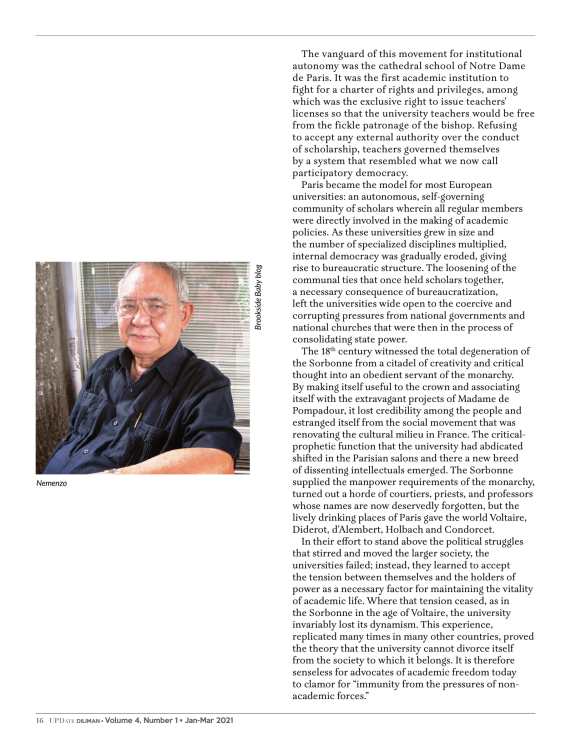
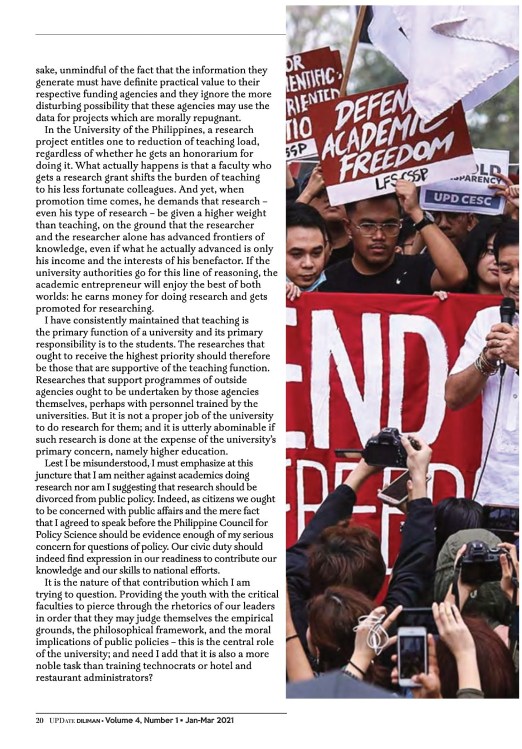
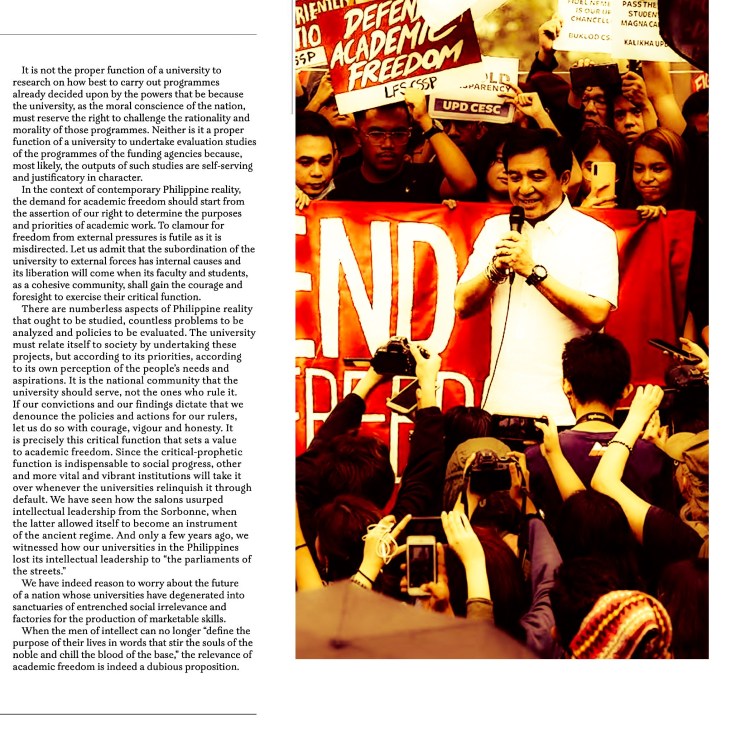
From former UP Diliman chancellor Fidel R. Nemenzo, Dec. 19, 2024: “We announce the passing of Dr. Francisco “Dodóng” Nemenzo on December 19, 2024. Born in Cebu City on February 9, 1935, Dodong lived a life rich in thought, action, and impact. He was 89 years old.
“Dodóng Nemenzo was a distinguished political scientist and Marxist scholar, known for his fearless views on Philippine society, politics, and international affairs. As the 18th President of the University of the Philippines, he left an indelible mark on the institution. He modernized the university and spearheaded initiatives that fostered critical thought and academic excellence.
“He received his Bachelor’s and Master’s degrees from the University of the Philippines and his PhD from the University of Manchester. Dodóng joined the UP faculty in 1957, rising through the ranks to become full Professor and Professor Emeritus of political science. He also served as UP Faculty Regent, Chancellor of UP Visayas, and Dean of the College of Arts and Sciences at UP Diliman.
“A leading leftist intellectual, Dodóng practiced his ideals — and was incarcerated for his actions during the martial law regime of Ferdinand E. Marcos. He advocated unwaveringly for social justice and reform, and played leadership roles in political organizations and social movements.
“Dodóng is survived by his beloved wife of 65 years, Ana Maria “Princess” Nemenzo; their children and their spouses — Dr. Fidel Nemenzo and Dr. Marivic Raquiza, Dr. Leonid Nemenzo and Ruvelyn Lim Nemenzo , Lian Nemenzo-Hernandez and Von Hernandez — their six grandchildren (Alaya, Miguel, Annika, Rafael, Anton, and Luiz), two great-grandchildren (Mila and Rafa), and his youngest sister, Gemma Nemenzo-Ver. He leaves behind a legacy of passion, perseverance, and principle, cherished by all who were fortunate to know him.
“Dodóng Nemenzo’s life was a testament to the power of ideals and conviction. His contributions to academia and society will be remembered and celebrated by many. A memorial service will be held for family, friends, and comrades, at a date and venue to be announced later.”
Discover more from marichulambino.com
Subscribe to get the latest posts sent to your email.
