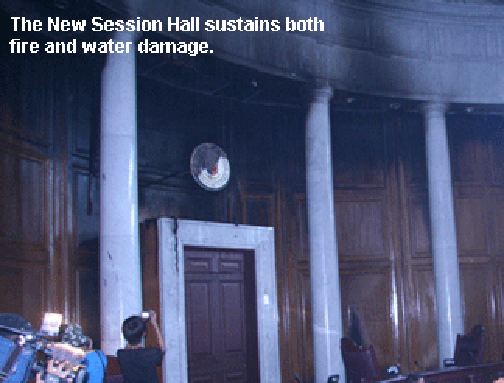
Photo and caption from www.supremecourt.gov.ph
Two days ago he was still the alter ego of the Chief Executive, whose claim to executive privilege is at issue in the Supreme Court petition Neri vs. Senate. Yesterday newly appointed Supreme Court Justice Arturo Brion asked upon his appointment: “What is so special about the Neri case?”. Not having warmed his seat for five seconds (in fact, to be literal, he has not yet sat on that seat), he publicly expressed intent, desire, earnestness, even eagerness to participate in the deliberation and voting on Romy Neri’s injunction case.
There is nothing “special” about Romy Neri’s injunction case: there is something special about Justice Arturo Brion, and it’s called “Disqualification”, Canon 3, Rule 3.12 of the Code of Judicial Conduct.
Conflict of interest is not a state of mind. The courts never perform mental telepathy or psychoanalysis or psychic regression through hypnosis or divinity to determine your previous incarnations in the astral plane. The most that judges do is say a prayer, then look at the evidence and the law (ideally, that is).
No matter how much one remonstrates about one’s objectivity, impartiality, fairness, competence, etc., those are not the factors in determining conflict of interest. There are objective conditions that create conflicts of interest or there are real sources of conflicts of interest, such as professional relationships, business interests, personal relationships; and there is nothing much that a person’s disavowal can do about them, they exist in the real, four-dimensional plane and not in one’s heart (the figurative heart, that is.)
And what do the rules provide? The Code of Judicial Conduct provides:
“Canon 3. Rule 3.12. Disqualifications. A judge should take no part in a proceeding where the judge’s impartiality might reasonably be questioned. These cases include, among others, proceedings where:
“a)the judge has personal knowledge of disputed evidentiary facts concerning the proceeding;
“b) the judge served as executor, administrator, guardian, trustee, or lawyer or a former associate of the judge served as counsel during their association; or the judge or lawyer was a witness therein. XXXX” (underscoring supplied.)
Guess what. There were Cabinet meetings held when he was a member of the Cabinet. A dozen. Dozens, between the time he was appointed justice and he was Cabinet member. Guess what. The principal issue in the Neri petition is the extent and the limits of executive privilege, or the prerogative of the President, his immediate former boss, not to disclose state secrets. Guess what. His associates, colleagues, peers (if not he himself) gave advice and legal opinions in those Cabinet meetings. Guess what. He was there, nodded his head/ shook his head/ looked sideways/ drummed his fingers; he listened to the President, he agreed or did not express disagreement; i’m sure he was not sleeping or in comatose during those meetings.
Since it can be taken judicial notice of that those Cabinet meetings took place, and it can be taken judicial notice of that he was not a somnambulist, Justice Arturo Brion is disqualified by reason of conflict of interest or disqualification under Canon 3, Rue 3.12, because having been the alter ego of the President in the period when executive privilege was being publicly discussed and taken up in Cabinet meetings, he was present in those meetings. He has personal knowledge of “disputed evidentiary facts” even if he does not disclose those evidentiary facts to subject them to judicial scrutiny. That will influence and affect (and even determine) the way he votes in the Neri injunction case. His colleagues and associates (if not he himself) also served as counsel during those Cabinet meetings.
In fact, yesterday, he pre-empted his now new colleagues in the Supreme Court by publicly stating matter-of-factly that he will participate and vote in the deliberation and resolution of Neri vs. Senate.
The fact of the matter is, it is not up to him; it should not be up to him; because it is the Supreme Court that decides whether or not he possesses any of the disqualification under Canon 3. This early, he has put the Supreme Court to which he now belongs, in an awkward position by trying to publicly pre-empt it.
Or maybe he knows something we don’t know (“personal knowledge of disputed evidentiary facts”) : Maybe it is up to him; maybe it is up to the President.
(i read in the inquirer.net that the respondents are not pushing through with a motion to inhibit the alleged “golfing buddie” because they think it might affect the way the justices decide the petition. Normally, in the trial courts, the judge who is asked to inhibit himself/ herself, does so without admitting or conceding any bias or without need of proof either way.)
To avoid any awkwardness, the immediately former alter ego of the President should be requested to volunteer to inhibit by his colleagues.

