I can’t help myself; i know that people who went here yesterday and today have most probably seen and read Manolo’s column, 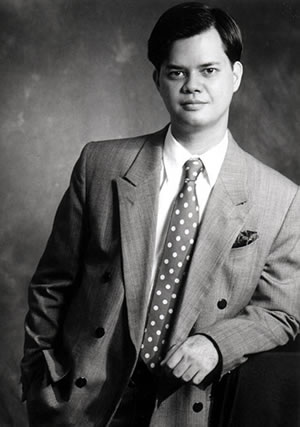
but i’m publishing it in full here anyway, because he adds a lot more to the discussion, something i don’t do, (i’m just a lawyer, kid; i’m saying that using my Humphrey Bogart facial expression and tone in Casablanca, i was inspired by this black-&-white photo to your right) i try to limit myself to “legal opinions” (i put that in quotes because the legal opinions in the blog are not written the way i write them when i’m working, ha-ha). Here’s the column; Manolo said the President didn’t care about the law and it (the law) wasn’t the reason why she didn’t order a take-over of Sulpicio Lines (ouch). Of course, Manolo said it better, as follows:
(Manolo’s avatar at www.quezon.ph )
He also coined or “Englishcized” the word “busy-bisihan”. I used to have layers and layers of bosses in my previous lives and whenever one of them was about to walk in the study area or library where we were, someone near the door would shout “O, ayan na, look busy!”, and we’d hide all our junk food and start grabbing our small staplers and started stapling any sheaf of paper in sight.
From www.inquirer.net also linked in www.quezon.ph
Quote “The Long View
Quote “Sulpicio Lines as political decoy
By Manuel L. Quezon III
Philippine Daily Inquirer
First Posted 01:16:00 07/03/2008
Quote “For once, President Gloria Macapagal-Arroyo and her Cabinet acted with prudence, in resisting the public clamor to takeover Sulpicio Lines. According to lawyer Marichu Lambino in her blog, the President needs emergency powers to do that. Of course, it could be asked whether the administration’s deference to the rule of law has something to do with her closeness to the owners of other shipping lines.
Quote “The more likely reasons for the President’s solicitude to Sulpicio Lines are three. First, the President realizes asking for emergency powers will reignite public anger over her visit to the United States, and open herself up to embarrassing questions about her handling of Typhoon “Fengshen.” Second, the maritime authorities and agencies (whether Maritime Industry Authority, the Philippine Coast Guard, or even the Philippine Navy) are ill-equipped to take control of a commercial shipping line. And third, it is politically convenient to keep public attention focused on the Sulpicio Lines tragedy rather than allow people to dwell on the implications of the continuing tragedies in the provinces of Iloilo and Aklan, to name just two places devastated by Typhoon Fengshen.
Quote “But as she hopes people will forget the other typhoon victims and concentrate their rage on Sulpicio Lines, she has to protect Transportation and Communications Secretary Leandro Mendoza, who, in any other country under similar circumstances, would have handed in his resignation by now. Instead, he was on hand to be photographed greeting her upon her return from America.
Quote “I do not doubt, however, that the President is personally and deeply concerned over the plight of the families of those who drowned in the MV Princess of the Stars sinking, and over the misery and devastation caused by the typhoon in Iloilo and Aklan. I do doubt that the twin tragedies are being handled objectively. This is crisis management, pure and simple. It is about getting over the public-relations hump so as to live to fight, politically, another day.
Quote “Take, for instance, Vice President Noli de Castro’s fire-breathing pronouncement that he has a suspicion the captain of the ship is not only alive, but is being kept in a safe-house by Sulpicio Lines. Maritime tradition dictates that a captain should go down with his ship; it reserves a special scorn for a captain who allows his passengers to drown and saves himself. Yet all we have is a suspicion that, since it’s been publicly-aired, has the twofold effect of tipping off Suplicio Lines to move the captain to another safe-house (if the rumor’s true) while stoking public anger.
Quote “On Monday, I ended my column by pointing out that if officials were really interested in improving things, they would have instituted, long ago, the Western practice of holding post-mortems after big events. This is particularly necessary after crisis situations, to see how things can be improved and operate more effectively and efficiently the next time around. Because there will always be a next time, sooner or later.
Quote “The other day, a lady, whose brother is still among the missing in the MV Princess of the Stars tragedy, told me she was angry at Suplicio Lines not so much because the ship sank but because of the way the shipping line was treating her family and the relatives of the missing and the dead.
Quote “Among her catalog of grievances was that Sulpicio announced it was giving P2,000 as temporary allowance to passengers from Cebu—only for her family to find out it applied, literally, only to passengers from Cebu City and not to those from Cebu Province (they’re from Mandaue City); that its commitment to defray the cost of passage for families and to give them board and lodging as they trooped to Cebu or Manila, wasn’t being honored: that at best, passage was paid for one way, and accommodations were nonexistent; and that the ordeal family members were subjected to, in identifying recovered bodies, was inhuman.
Quote “Her last complaint—the indignities distraught families are subjected to—is at the heart of the point concerning post mortems. The families line up, hour after hour; then they are paraded, eventually, before rows of bloated corpses. If they fail to identify their loved one, they must do this again and again, day after grisly day.
Quote “Neither Suplicio Lines nor the authorities, it seems, have made much of an effort to segregate the corpses according to relative age, or sex, or to arrive at some sort of database by cataloging the details of the missing (including possible identifying marks) to possibly match them to recovered bodies. In 1912, during the recovery of those who drowned on the Titanic, bodies would be photographed, then temporarily interred, which aided identification efforts.
Quote “We’ve been through all this before. After the sinking of MV Doña Paz two decades ago, this sort of gruesome, continuing trauma, should never have been inflicted on anyone. Having ordered a thorough inquiry, the President could have devoted her organizational abilities to easing the plight of worried families. That would have been in keeping with her declared policy of cutting red tape and instituting efficient management of data within the government as a whole.
Quote “Instead, yet again, “busy-bisihan.” Yet what other choice has the administration? Since the transportation secretary is untouchable and can’t be fired, neither can the heads of the Philippine Coast Guard and the Philippine Marines. You do not need an inquiry to know they all deserve to quit.
Quote “Meanwhile, in Aklan and Iloilo, out of sight, and therefore out of mind, the victims of the typhoon turned victims of state inefficiency and ineptitude go starving on. Glory, Glory Hallelujah indeed! In this, the media, particularly broadcast media, have culpability, too. For the cameras are so focused on Sulpicio Lines that neither Iloilo nor Aklan register in their viewfinders. And if the media’s attention wanders to those areas—well, why do you think the Vice President announced his suspicion that Sulpicio is playing hide-the-captain?” closed-quote.
