(If on mobile device: To hear the free streaming music for this post, pls click “Listen in browser” on the soundcloud pod below, then click the play button. Happy viewing and listening!)
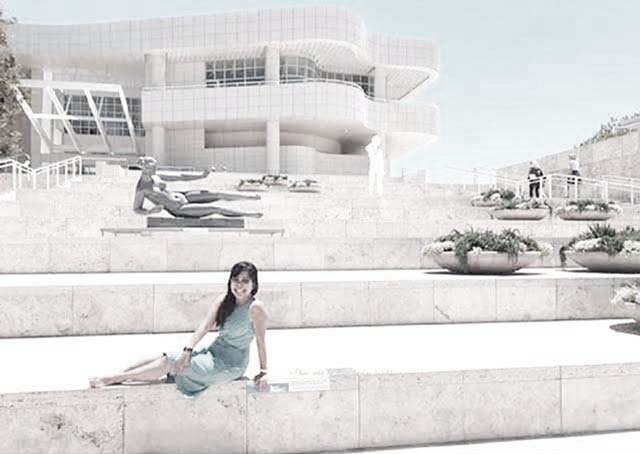
“Air”, Aristide Maillol, Getty Center (described as the floating female figure by the Getty Center, onsite) (apologies for the impromptu i-Phone “photoshoot”, hwag ka magalit) i-Phone shot by Myra Lambino, July 7, 2017
“Air” by Aristide Maillol at the Getty Center Title: L’ Air Artist/Maker: Aristide Maillol (French, 1861 – 1944) Culture: French Date:design 1938; cast 1962 Medium:Lead Dimensions: 127 × 238.8 × 93.3 cm, 687.1995 kg (50 × 94 × 36 3/4 in., 1515 lb.) Credit Line: Gift of Fran and Ray Stark “This monumental nude seems to float in space. Although cast in lead, the smooth, grayish-blue surface actually enhances the form’s light, buoyant appearance. Perched delicately on her right hip, the figure’s extended legs and left arm create a strong horizontal, echoed in the plinth beneath her. Resting on an imaginary center of gravity, she teeters between immobility and movement, suspension and flight. The nude’s face and figure are idealized–rather than a portrait of an individual, it is a personification of air.
“In 1938, the city of Toulouse in southern France commissioned Aristide Maillol to commemorate the pilots of the pioneering airmail service, l’Aéropostale, who had been killed in the line of duty.Air was cast from the plaster model for this monument. Its form was initially inspired by a small terra cotta sculpture Maillol had made several decades earlier depicting a reclining figure resting on wind-blown drapery. The artist often used the female form to symbolize aspects of nature like the sea, the seasons, and even a subject as elusive as air.” (from getty.edu)
(If on mobile device: To hear the free streaming music for this post, pls click “Listen in browser” on the soundcloud pod below, then click the play button. Happy viewing and listening!)
Annotation: Myra with Juno, Venus, Minerva at the Getty Center, July 7, 2017: (impromptu i-Phone “photoshoot” at the Getty Center)
Information from getty.edu Title: Venus Artist/Maker:Joseph Nollekens (English, 1737 – 1823) Culture:English Place:England (Place created) Date:1773 Medium:Marble Dimensions: 124 × 50.8 × 50.8 cm (48 13/16 × 20 × 20 in.) Title: Juno Artist/Maker: Joseph Nollekens (English, 1737 – 1823) Culture: English Place: England (Place created) Date: 1776 Medium: Marble Dimensions: 139.1 cm (54 3/4 in.) Title: Minerva Artist/Maker: Joseph Nollekens (English, 1737 – 1823) Culture: English Place: England (Place created) Date:1775 Medium: Marble Dimensions: 144 cm (56 11/16 in.) From getty.edu , written by Anne-Lise Desmas: “Who’s the fairest, Venus, Minerva, or Juno? The contest is happening at the Getty Center, in the galleries of the West Pavilion, through an unprecedented display mixing antiquities with 18th-century sculptures. “The contest all started because Jupiter did not invite the goddess of discord, Eris, to the wedding banquet he organized for Peleus and Thetis (but frankly, who would have?). Offended, Eris invited herself to the feast, and cast a golden apple marked “to the fairest” among the assembled goddesses. Immediately, three of them laid claim to the fruit: Venus, Juno, and Minerva. Jupiter was asked to mediate, but couldn’t do much—after all, Juno was his wife! “Hoping to avoid a quarrel, Jupiter decided that the young shepherd Paris, prince of Troja (Troy), would decide. When brought in front of Paris, the three goddesses did their best to gain the shepherd’s preference. Paris eventually gave the apple to Venus, who had promised him as a reward Helen, the most beautiful mortal woman. But when Paris took Helen, the tragic war between the Trojans and the Greeks broke out.”