

Artwork by Henri Matisse, published by www.greatmodernpictures.com, selected for this post by the blog administrator
On Crawls, Posted by student # 9 , J192, (unedited by blog administrator)
quote “My partner and I reported (sic) the KBP Code of Ethics for Television, and with regard to the use of text crawls the code says that it would be for news updates (breaking news)and national emergencies.
Quote “The two major TV stations (GMA, however is not a member of the KBP) use text crawls to: 1. advertise/promote their shows, 2. tell audience the what the next program will be. These crawls are usually shown during the primetime slots.
Quote “During the past week I have been sleeping late and I saw the crawls even after the late night news has finished. They (sic) not just these little chracters (sic) flashing on the bottom of your screen, they have pictures of the actors starring in these programs.
Quote “It is quite irritating. By the way, as a form of advertising the networks also flash some products for promotion of their sponsors. It is funny to see a laundry detergent on the bottom of your screen while watching the serious faces of news anchors. Jul 25, 11:02 AM” closed-quote.
XXX
Posted by Jericah Regado Fifth Blog Entryby Jericah Regado – Comm 191/WWX Unedited by Blog Administrator
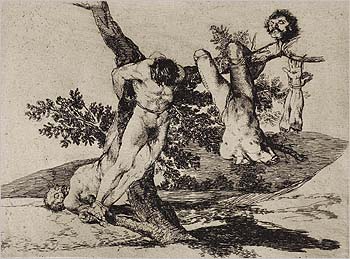 “The Disasters of War” by Francisco Goya, re-published in www.smh.com.au (Sydney Morning Herald) chosen for this post by the blog administrator
quote “Last night, I watched TV Patrol and noticed two ethical practices.
The first one followed the KBP Television Code provision on news reporting which says that “Good taste shall prevail in the selection and handling of news. Morbid, sensational, or alarming details not essential to factual reporting shall not be allowed.” The news story was about the result of the autopsy conducted in the corpses of the Marines killed in Basilan. The medico-legal officer said that the soldiers were tortured first before they were killed. In relation to this, the medico-legal officer showed some photos of the corpses to the reporter. There was a part where some photos were not blurred, but they were shown only for about two seconds so it was still tolerable for me. But the second time the photos were shown, which was longer compared to the first one, they were already blurred. It is proper to do this because these photos show morbid details of the corpses. On the other hand, I did not find airing the medico-legal officer’s descriptions about the corpses (such as the possible ways the suspects killed the soldiers) unethical because those were essential to the news.
Quote “On the other hand, another news item was about the panic in a school caused by the death of an alleged meningococcemia-inflicted child (who was studying in that school) in Quezon City. The reporter interviewed the seatmate of the alleged victim of meningococcemia, and the face of the child was blurred.
 painting by Juan Luna published by www.lopezmuseum.org.ph chosen for this post by the blog administrator
There was also a footage which showed the class, and the children’s faces were also blurred. This practice is ethical because it protects the children from the possible reactions of the people who can indentify (sic) them if their faces weren’t blurred.
Quote “I hope that media practitioners continue to comply to ethical standards so that the Filipino audience can have better mass media.
Jul 31, 8:41 AM —“ closed-quote.
XXX
Posted by Student #8 , J 192, (Unedited by blog administrator)
quote “While on a bus going to school, the TV was tuned in to “Umagang Kay Ganda” of ch.2. That was last July 24 after the SONA the day before. Most of the news were about the SONA and one portion talked about the reactions of people.
Quote “There was a man interviewed about how he thought of PGMA’s SONA. That portion violated the KBP Codes for TV for the interview do (sic) not have a caption(name and designation).
Quote “Under the KBP Codes (sic) for TV, when it comes to sources,”Voice and video clips of persons involved in the news shall be properly identified.”
He was expressing his opinions but we are sic) not sure who he really is.(sic) He is (sic) not a prominent person or the ones you usually see on TV. There was a voice-over saying that they got the reactions of people, including economists about the said SONA.
Quote “However, I still believe that proper attribution is a must even for a short interview like that. I would have the impression that the man interviewed is an economist, but how would I know?
Quote “He might not even be an authority on matters like the one’s (sic) discussed in the SONA and yet he was sharing his views and people might actually believe him not knowing who or what he really is (sic).Aug 1, 12:16 AM” closed-quote.
Discover more from marichulambino.com
Subscribe to get the latest posts sent to your email.

Last Saturday, August 18, 2007, “Kapuso Mo, Jessica Soho” featured a story on how great Filipinos are when it comes to inventions and creativity. A few Filipinos exhibited their creations such as vitamin-beer and a machine which can be used simultaneously both as a refrigerator and a cloth-dryer, to name a few.
A student from Philippine Science High School was interviewed in the latter part of the report. The said school was known for its superiority in training students’ creative and imaginative minds. The student, a guy, related how such training really helps for students like him. However, proper attribution (name and designation) was neglected in that portion, a violation of the KBP Code of Ethics for Television.
Under the KBP Code,”Voice and video clips of persons involved in the news shall be properly identified.” This is to acknowledge those persons for expressing their ideas and sharing their opinions on the issue at hand. Also, this is to let the viewers know who the sources are.
Same violation was also committed by the same TV program, on the same day, when it presented a brief account of global warming. On its discussion of the effects of global warming, Jessica Soho reported that the unpredictable changes in weather brought by global warming caused the high-level flooding in various places in the country, as well as the drying out of lands in the provinces. In line with this, interviews with people living in those affected areas were presented. Reactions of two residents from Navotas City were aired. However, both were not properly attributed.
All three people involved in the said violations were not prominent ones nor authoritative. However, no matter how short their reactions or comments were, it is still a must to put their names and designations, not only to acknowledge them, but also for the viewers to know who those persons are.
LikeLike
Yesterday, August 20, 2007, “TV Patrol World” reported about fifteen alleged rugby sniffers/addicts caught in Rosario, Cavite. Nine of the alleged rugby sniffers were minors and two of these minors were interviewed on air. Fortunately for these youngsters, their faces (or rather, their eyes) were blurred/pixelized and their names were not revealed in the report.
This news report was an example of an ethical media practice. It followed the provision of the Philippine Journalist’s Code of Ethics, which states that a reporter (whether from print or broadcast) must be careful in revealing the names of minors involved in criminal cases so that “they may not unjustly lose their standing in society.” This provision is to be followed by all journalists to protect the privacy as well as the future of the minors (whether guilty or not)involved in wrongdoing.
from student no.12, J192
August 21, 2007, Tuesday
LikeLike
A. Antonio student #21 (unedited by blog administrator)
While I was watching TV Patrol last night (August 22), I came across a news story about the danger of this particular kind of closed rubber slippers to children who ride the escalator. There was this recent incident where the child’s parents complained because of their son’s foot getting stuck at the edge of the escalator and having his toe almost broken. I personally never thought this accident was possible until they showed a live visual reenactment of the scene where the slippers was literally ‘swallowed’ and torn at the end of the ramp.
I would like to commend their presentation of this news item because of many favorable reasons. First, they did not hesitate to mention the brand name of the rubber slippers –CROCS, despite its popularity and international recognition. Second, it was just correct that they blurred the face of the child to protect his identity. Third, the story was impartial by making both parties talk and stand by their claim. The victim’s parents related their piece, however the CROCS’ local distributor refused to give a statement. Fourth, they made a research and showed previous incidents from other countries where this same kind of accident took place. Pictures of the kids toe and foot after the accident was also shown to prove that this is not just an isolated bizarre occurrence in our country. Moreover, they flashed on the screen a written response of CROCS to these past complains claiming that their slippers are ‘safe’ and that the escalators may be the cause of the problem. Fifth, they got a statement from the distributor of escalators regarding the problem and presented it as well. Lastly, they gave tips and precautionary steps to parents on how they would be able to prevent these kinds of accidents in the future.
I would say this is one good media practice which all news reports must follow and practice.
LikeLike
(Unedited by blog administrator)
Record companies and radio stations can be too money-oriented these days! When I switched on the radio last Saturday, August 25, I first heard the song “How Do You Fall In Love” by Jose Mari Chan. I was very surprised, however, to hear the DJ announce the title of the album (Love Letters and Other Souvenirs) and its label/brand (Universal Records) from which the song was taken! The KBP Radio Code doesn not allow that!
The station that made this serious error turned out to be Yes FM 101.1 and it violated a provision from the KBP Radio Code which says that “the mention of the label or brand of the record played or the title of the LP album from which the selection is taken shall not be allowed.” It committed a blatant act of album promotion-in short, a shameless plug. Isn’t it enough to let the song speak for itself and let the public look for the album if the song is any good? Why should record companies and radio stations ignore ethical principles in order increase album sales, anyway?
LikeLike
A. Antonio student #21 (unedited by blog administrator)
Last Tuesday night (August 28) at 10:55pm, while I was switching radio stations, I came across a live concert telecast in a local barangay. This concert was sponsored by 97.1 Barangay LS FM. What caught my attention was when a local band by the name of Silent Sanctuary sang the song “Rebound” and added a curse word in the chorus of the song. It goes, “Tangna, rebound mo lang pla ako…” It was really absurd to hear a band play and curse on air no matter how ‘heartfelt’ the song was.
The act that was done by Silent Sanctuary was a violation of the radio code which does not allow any form of vulgarly and displeasing taste in words. Even if it wasn’t LS FM’s direct offense, it is their responsibility and accountability as a carrying media outfit to remind the bands to be careful of their language. To add to the injury, the vocalist of the band was trying to hype up the crowd by making ‘toilet’ jokes that goes, “First time nyo ba magkaron ng concert? Mga virgin pa pala kayo! First time nyo kaya na virginize nyo kami.”
After a few minutes they made an apology statement, “Hindi nga pala pwede magsalita ng bastos, pasensya na sa mga nakikinig sa LS, hindi namin alam.” Despite making an on air apology, I believe a disciplinary action should be taken by the KBP to penalize the violation made. What has happened is not to be emulated and must be reprimanded immediately. As the saying goes, “Ignorance of the law excuses no one.”
LikeLike
This is about the Aug. 8, 2007 issue of the Philippine Collegian. On the Opinyon page (page 9) of the said issue, an article by Collegian writer Noel Hernaiz, titled “For Chris S. A.”, appeared. In the said article, Hernaiz comments about the columm of Chris Agrava. Hernaiz wrote that Agrava’s columm has no social relevance and that all he writes about are all about his travels and experiences. Here Hernaiz calls Agrava, though not explicitly, “pot bellied”. What is even more intriguing about this is that Agrava’s columm “Return to Sender” appears on the right side of the page, its regular spot in the page.
Here, Hernaiz’s article was a clear attack on Agrava’s. However, there are no ethical provisions against a journalist commenting against another’s work. There are provisions, however, against a journalist personally attacking a fellow journalist. Hernaiz clearly violated such provisions by calling Agrava names and ridiculing his phusical appearance.
What was more agrevating of the situatuin was the articles’ placement. PLacing an article commenting about a writer and/or his work beside that writer’s work would undoubtedly lead a reader to verify the claims of the commentary. In this case, however, the commentary also has comments on the writer himself. This may lead the reader to incorrectly look into thing in the same way as the commenting writer did.
i talked to Collegian EIC Jerry Abella about the matter and he said that he would refer it to his staff.
LikeLike
Although GMA 7 is no longer a KBP member, it is not an excuse for them to practice unethical procedures in their programs. I often watch “Kapuso Mo Jessica Soho” and often do I observe the same violation from time to time in some of its segment reports.
Last August 25, the program featured a report entitled, “Plastik Para Sa Inang Kalikasan”. A plastic bag worker from Negros was interviewed where he related on his native tongue how Yabang Pinoy bayong and bags are created from pandan leaves. The information obtained from the man was undoubtedly an essential element in reporting the said topic. However, no designation was attributed to him. In fact, he was not even named. The fact that the man, who was not of prominence, contributed to the completion of the story but was not acknowledged, clearly violated the KBP code which states that “voice and video clips of persons involved in the news shall be properly identified.”
LikeLike
Last September 1, I watched GMA 7 news and current affairs program Saksi, hosted by Arnold Clavio and Vicky Morales. It was the height of public attention on UP student Chris Anthony Mendez, an alleged victim of fraternity hazing. On his report, Arnold Clavio mentioned Chris Anthony Mendoza instead of Chris Anthony Mendez. He did not even asked an apology on air for mistakenly mentioning the surname of the student, although his co-anchor Vicky Morales stated right after his spiels the correct one.
This is a clear violation of the Journalist’s Code of Ethics which states that it is the duty of the journalist to correct substantive errors promptly. Although such an error wasn’t quite a big issue, for it might be a mere slip of the tongue, it is still his responsibility to correct himself. Such deed of not correcting himself affects the accuracy of the report.
LikeLike
I know I’m not supposed to read Manila Bulletin but I couldn’t avoid it… my father reads it every Sunday! Anyway, last September 9, I read an article about Loren Legarda’s proposal for a National Strategic Missing Children Recovery Program that aims to help find the children who are kidnapped or taken away from their parents and guardians. The article described in detail the aims and strategies of the said program. However, I had noticed that the story was single-sourced. The details of the story came from Legarda’s Senate Bill 1385 only. Even if a quote about the proposal did appear in the story, it came from Legarda alone. No other sources of information apart from Legarda and her own Senate bill appeared; in short, the “news” story was one-sided and unbalanced.
This was a clear violation of the expanded Journalist’s Code of Ethics which states that single-sourced stories must be avoided and that there is always the need to get two or more sources in order to clarify all sides of the story. Even if the story was not that sensitive or controversial, it is still the reporter’s duty to make the story fair, accurate and balanced. Such violation might distort the reader’s perception of the issue being discussed in the article.
LikeLike
This is to laud GMA 7’s new Sunday show, “Kap’s Amazing Stories”. The said show features incredible and shocking stories from various parts of the world every week. Most stories contain ghastly elements, which I think, at some point may be sensitive for children and young adults. Nevertheless, the host, Sen. Bong Revilla had been responsible enough to warn the audience earlier that stories of such matter were sensitive ones, and thus parental guidance is of significance. In some cases, when stories which include dangerous acts are presented, he reminds the audience not to imitate nor attempt to do such acts.
Some programs nowadays often ignore such ethical deed of warning or reminding the audience when unpleasant acts are on screen. A quick flash of warning on screen or a warning o reminder by the host himself is a good practice when the need to present “language, photographs, visuals or graphics which are insensitive to men, women and children (PPI expanded code of ethics)” is unavoidable.
LikeLike
Last September 30 (Saturday), Pilipino Star Ngayon published an article entitled, “Basura sa Senado, irerecylce.” The article talked about the organization of recycling programs for the Senate and its officials. Such include garbage segregation and use of back pages of non-private documents. However, it is quite noticeable that all information and quotations came from only a single person, Senate President Manny Villar.
This is a violation of the Code of Ethics, which states that single-sourced stories must be avoided, and gives much emphasis on a fair and balance treatment of news by getting the sides of all the parties involved. Such single-sourcing could have been avoided had the writer (I forgot to note her name) asked reactions and comments from the people involved, the Senators on the top list.
LikeLike
The article, entitled “4 cop teams going after the suspect in Laguna execs slay”, published in the October 8, 2007 issue of the Philippine Star is an example of a multiple-sourced article.
Last Thursday, Lumban Vice Mayor Zaldy Raga was ambush-slain while on board an Isuzu Highlander with his wife Belen, on their way to Pagsanjan.
Writer of the article Non Alquitran, with reports from Ed Amoroso, had sources including Laguna Police Director Senior Superintendent Felipe Rojas Jr., Mrs. Belen Raga, who survived the attack, and witnesses along the national road in Barangay Sampaloc, Pagsanjan. Information from the Department of Interior and Local Government, the family of slain Mabitac Mayor, and Laguna Governor Teresita Lazaro were also obtained. (Suspect Luisito San Juan is also wanted for the killing years back of prominent lawyer Clarence Agarao and a Mayor of Mabitac town.
LikeLike
(unedited by blog administrator)
One good practrice i would like to note was done by 24 oras of GMA 7 during teh ZTE scandal.
Amidst the controversy and media frenzy over the issue, 24 oras 3 weeks ago did a report on how the National Broadband Project works.They had sources from the DOTC as well as from UP.
The University of the Philippines have what is called the “Dilnet” which works like the planned NBN. It connects the whole UP system. The NBN on the other hand will connect all governement offices and agencies to make communication and work faster.
it was good good thing for GMA to do a background on the NBN project and not solely feast on the personalities and make the issue a telenovela.
They also had sources who have the authority to speak on the issue.
LikeLike
hi, just need help guys. i’m a communication student and we have a media law and ethics subject. i just want to know where can iget a copy of code of ethics of KBP? I really need it. The website of KBP is not available. Just reply to my e-mail add.. thanks poh….God Speed!
LikeLike
For Princess: Hi! Are you my student? It’s at the back (appendices) of one of the books assigned in class. thanks. – marichu
LikeLike