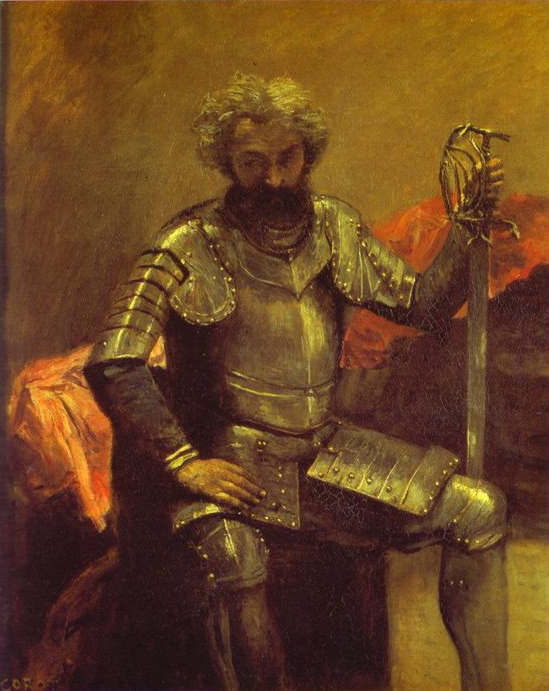
Jean-Baptiste-Camille Corot. Man in Armor or Seated Man at Arms. c. 1868-1870. 73 x 59 cm. Musée d’Orsay, Paris, France. Right-clicked from http://www.abcgallery.com
The camera equipment and tapes of some media outfits were confiscated during the apprehending of media persons at the November 29 Manila Pen stand-off.
Tapes and films are not contraband, i.e., not illegal per se, neither are they weapons used in the commission of the crime; they cannot be summarily confiscated without a court order.
Are media organizations legally required to surrender to the Philippine National Police or the CIDG their tapes of interviews and activities of their news subjects based on a request or “subpoena” of the PNP (without a court order)? Would failure to do so constitute “obstruction of justice”?
The pertinent provision of the “obstruction for justice” law (Presidential Decree 1829) is as follows:
quote “Sec. 1. The penalty of prision correccional in its maximum period, or a fine ranging from 1,000 to 6,000 pesos, or both, shall be imposed upon any person who knowingly or willfully obstructs, impedes, frustrates or delays the apprehension of suspects and the investigation and prosecution of criminal cases by committing any of the following acts: xxxx (b) altering, destroying, suppressing or concealing any paper, record, document, or object, WITH INTENT TO IMPAIR ITS VERITY, AUTHENTICITY, LEGIBILITY, AVAILABILITY, OR ADMISSIBILITY as evidence in any investigation of or official proceedings in, criminal cases, or to be used in the investigation of, or official proceedings in, criminal cases;” closed-quote (capitalization supplied). xxxx
The essence of this provision is punishing any person who destroys evidence or hides evidence in order that those pieces of evidence could not be used in criminal investigations or official proceedings. Intent is determined from over acts. In other words, if the person destroys the evidence knowing it would be used in a criminal investigation or denies (hides) the existence of such objects altogether knowing they would be used in an investigation, then the law enforcement authorities can file a complaint for obstruction of justice. What is punished is the destruction of evidence or being involved in cover-up. Footage, tapes, and photographs that were produced or filmed or shot by the media outfit are properties of that company. Also, as recorded images of events, they fall in the category of documentary materials or documents, or “papers and effects”. Whenever the State or government or law enforcement agencies seek to examine the contents of such films and tapes, the search requires the consent of the owners. In other words, films and tapes are covered by the right to be secure in one’s person, houses, papers and effects against unreasonable searches; and a court order (or, otherwise, consent from the owners) is required for the seizure or examination thereof. Without consent from the owners, law enforcement agencies need a court order to compel the owners to surrender the records. But the owners of the tapes and films here are not just ordinary private owners, they are also media organizations; and as such they are bound by certain laws and a code of ethics.
One would be the Shield Law which states that reporters cannot be compelled to reveal the source of any news report or information relayed to them in confidence (the law says reporters of newspapers, magazines, or periodicals of general circulation; but in a digital multi-media world, I think this should be construed by our courts to refer to reporters in the news media, not just print). If the films and footage show images that would reveal sources which the reporters have been sworn not to divulge, then those films and footage, for containing the photographs and images of sources, are covered by the Shield Law.
Media organizations are also bound by their own code of professional ethics, among which are: not taking sides in the prosecution or defense of parties in criminal cases or armed hostilities, etc. Being forced to cooperate with the police in the capture of its enemies, absent a court order, may run into some obligations that journalists have been sworn to uphold under their code of ethics.
For all these reasons, a court order is required before a media organization can be compelled to surrender its tapes and films. Of course, the media company can always be consensual about it and surrender all its footage; but it must be sure it is not running into any of its obligations under the code of ethics, such as a breach of sources’ confidences.
I once asked a fiscal friend, “Bakit, wala naman kayong contempt powers, ah, bakit mo tinatawag na subpoena yan?” (“Why, you don’t have contempt powers; why do you call that a subpoena?”). And he got to thinking, and said, “well, yeah, we don’t have contempt powers, but it just means that if you don’t give us evidence in your favor, we will resolve the preliminary investigation based only on the evidence of the prosecution.”
I guess that warning applies when one is a suspect or a respondent in an investigation.
(when a third party or an innocent witness or a reporter becomes a suspect or respondent as a result of not surrendering their tapes without a court order, and without any other facts, it’s probably because he/ she had incurred the ire of the police and not because of any probable cause.)
Discover more from marichulambino.com
Subscribe to get the latest posts sent to your email.

The Center for Media Freedom and Responsibility objected earlier this morning the arrest of the media people covering the Manila Peninsula Hotel siege last November 29.
LikeLike
Student and journalist organizations condemned today the arrest of members of the media covering the incident in the Manila Peninsula last Thursday.
LikeLike
11-29 Manila Peninsula assault of the press freedom leads to the assault of sovereign public information; as the Center for Media Freedom and Responsibility condemned today about the members of the media.
LikeLike
11-29 Manila Peninsula assault of the press freedom leads to the assault of sovereign public information; as the Center for Media Freedom and Responsibility condemned today the outrage about the members of the media.
LikeLike
Philippine media practitioners demanded for press freedom during a news conference held earlier today regarding the Manila Peninsula siege.
LikeLike
Students and media practitioners led by the Center for Media Freedom and Responsibility denounced today via a press conference the arrests of several mediamen covering the Makati standoff last November 29.
LikeLike
It was “an unprecedented outrage.” This was the statement given during the press conference held this noon at UP Diliman by the Center for Media Freedom and Responsibility (CMFR) referring to the arrest of mediamen who covered the Manila Peninsula Hotel incident.
LikeLike
Voices were raised in outrage today in a press conference in UP Diliman by students and the Center for Media Freedom and Responsibility at the arrests and harassment of the media in last Thursday’s Manila Peninsula standoff.
LikeLike
The Center for Media Freedom and Responsibility and various student organizations yesterday condemned the harassment of journalists by police after last Thursday’s stand-off at the Manila Peninsula.
LikeLike
The Center for Media Freedom and Responsibility and other student organizations in UP condemned the arrest of media men who provided the live coverage of the stand-off by the group of Senator Trillanes last Nov. 29 in the Manila Peninsula Hotel.
LikeLike
In a press conference held at the CMC auditorium earlier today, media groups gave their statements regarding the Manila Peninsula incident. The CMFR and several UP organizations condemn the arrests of media personnel who covered the stand-off last Thursday.
LikeLike
The “processing” done by the PNP to media personnel covering the Manila Peninsula incident last Thursday was condemned by the Center for Media Freedom and Responsibility and other UP student organizations.
LikeLike
The Dec.3 issue of the Philippine Daily Inquirer carried an analysis written by Amando Doronilla which stated that the Estrada administration collapsed in 2003.
Errors in news reporting and analysis should be immediately corrected because it might mislead the readers. According to the Philippine Journalist’s Code of Ethics, it is the duty of the said publication to correct substantive errors promptly. However,the Dec.4 of the Inquirer didn’t correct the said factual error.
In addition, the front page of the said publication carried a story about an actress-singer telling stories to children at the Inquirer’s Read-Along Program. More important news that need to be emphasized should appear on the front page instead of PR-like stories. “Storyteller Karylle also plays Cat” was written by Eliza Victoria. The said publication allowed their business interests to influence them in their reportage. Furthermore, the said article is single-sourced. A single-sourced news,which is considered unethical in journalism,is biased.
POSTED BY STUDENT NUMBER 12
LikeLike
The College of Mass Communication condemned the attack on Philippine press in the Manila Peninsula stand-off.
LikeLike
A press conference was held at UP Diliman in violent reaction to the arrests of journalists at the Manila Peninsula Hotel.
LikeLike