
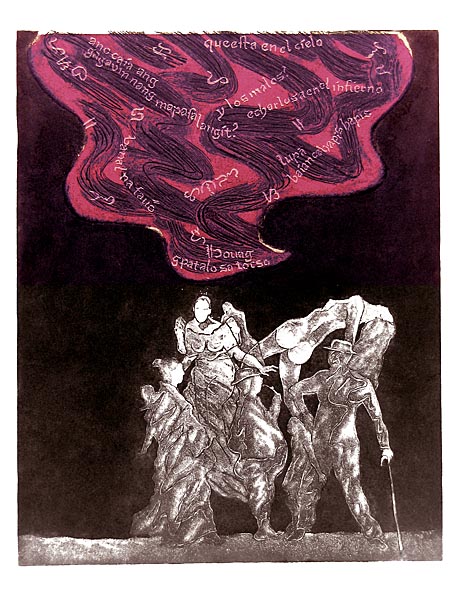
Imelda Cajipe-Endaya. Mga Anino Kahapo’y Tanaw ko pa Ngayon APIII/25. [“Yesterday’s Shadows are still on Today’s Horizon” (my rough translation)] Photoengraving, etching, and collagraphy. 35 x 28 cm . 1979. . Hiraya Gallery. Rightclicked and uploaded with express permission (thanks thanks!) from the www.hiraya.com
The Supreme Court last night proposed a Solomonic solution, a compromise, during oral arguments on Romy Neri’s petition for the issuance of a prohibitory injunction against the enforcement of the Senate arrest warrant (or to stop the warrant of arrest from being enforced).
According to news reports, the Supreme Court proposed the following compromise: Neri can be made to attend the Senate committee hearing but the following questions are deemed to have been responded to by the invoking of executive privilege by Neri and would not anymore be asked: “1.Did the President tell you to approve the project in spite of the bribery disclosure?” “2. Did the President tell you to prioritize the project?” “3.Did the President follow up her directive on the project?”
Second, when Neri attends the Senate hearing, depending on the query, he could still invoke executive privilege and if the Senate is not satisfied, they could file a supplement to their pending petition (or to another pending petition.)
The senators who were present asked for time to consult their peers on the proposed compromise and, as i understand it, close to midnight, the oral arguments were deferred.
Some of the senators (in particular Senator Biazon) had misgivings with the proposed compromise on the ground that it would set a precedent and effectively “shackle the ability of the Senate” to ferret out information.
Why is this compromise being proposed when : it is a certainty that on any and all questions arising from the offered “commissions” during the ZTE contract negotiations, on the overpricing, on Jun Lozada’s revelations, etc., Neri will invoke executive privilege, and on other questions he will say he doesn’t remember?
Since that is a certainty (it is a certainty because the petitioner thru counsel already stated at yesterday’s oral arguments that Neri’s communication with the President consisted of diplomatic and military secrets although the lawyer himself admitted he did not know the contents of the communication!), since it is a certainty that Neri would invoke it if he were allowed to do so by the Supreme Court, why not resolve the question now, here, on whether or not those questions (the first three on what the President did) and other matters related to it are matters of executive privilege? Why defer a “final resolution” on whether the subject matter is covered by executive privilege?
To my mind, the Supreme Court is proposing a compromise because it does not want the conflict between the Senate and the Malacañang to escalate. It wants to defer that.
In other words, it does not want the coercive powers of one branch of government to collide with or be enforced against a co-equal branch, the executive branch, which has a monopoly of armed force and which has publicly manifested it would resist the enforcement of the warrant of arrest on Romy Neri. (else, Romy Neri might find himself being “escorted” to Cavite, Calamba, Los Baños.)
In other words, maybe…the Supreme Court is trying to tell the parties they should behave like statesmen and diplomatically resolve their differences without asking the Supreme Court to use its own coercive powers.
If the Supreme Court were to use/ not use its own coercive powers and deny Romy Neri’s petition, paving the way for Romy Neri’s arrest to attend the Senate hearing, and then the Senate arrest order is disobeyed, and disobeyed effectively by the executive branch; and the Supreme Court is compelled to issue a contempt citation too but that too is disobeyed, there would be a final breakdown in the last “democratic institution” that people rely upon, the Supreme Court. The Macapagal-Arroyo government would have held the record for that: destroying all the institutions of checks and balances in government including the final institution that people resort to for redress of grievances.
Where do we turn to when that happens?
Malacañang if it defies the Supreme Court, would have destroyed the last vestige of civilized order in our society.
Maybe the Supreme Court is not deferring a final resolution, it is deferring a final destruction.
(the Senate can be creative when it is tossed back to them, i.e., trust the wisdom of the Chief Justice and bring back the subject matter to the halls of the Senate. i don’t know. Work it.)
Discover more from marichulambino.com
Subscribe to get the latest posts sent to your email.

Eh kung feeling ng SC Glo will not hesitate to break the last democratic institution then why avoid a face-off? They are only helping keep the facade of an administration that respects the rule of law. That makes the SC justices enablers.
If Gloria defies the SC then she loses all legal and moral authority to rule and leaves her with her guns.
Why not remove the make-up and expose her ugly face once and for all?
LikeLike
My foot! Revoking EO 464 while keeping Memo Circular 108 has not changed anything with respect to the executive trying to cover up its own messy affair.
This is another attempt toward grand deception. Nice try, but a cheap one. So cheap it is that even the street vendors and janitors would see the difference: this govt under Gloria is fond of monkeying the Filipino public.
LikeLike
With all due respect, I think you miss the bigger point that this is not mainly about the truth of the ZTE NBN any more, but the Separation of Powers, Congress’ Right to Know and Executive Privilege.
Even if they had taken the compromise, being able to ask questions doesn’t mean getting the answers, as the deal would’ve excluded the very questions you say can be asked because of “declassification”. Yet it is precisely that which is “litis pendentia” no?
I though it was most disrespectful of the High and Mighty Supreme Court to send the nonentity Midas Marquez to speak for it in an official capacity about such weighty issues. To hear him say that they were sending Neri back to the Senate, what more do they want, was infuriating to me.
I think it will soon be time to shine the light of Congressional inquiry into the darkest corners of the Judiciary too. They have 15 impeachable officers, not two like the Executive, and as many secrets to hide, from many administrations. And on Public Accountability, I wish lawyerdom would clarify this point for the public:: the Senate is Supreme Court in all cases of impeachment. The supreme court has zero jurisdiction in ALL cases of impeachment. Not even executive clemency touches the supremacy of Congress in this regard.
But since Davide, we have been running a Mutant Republic, with his barrio carpentry erected on the Constitution, and the inteligentsia supine in idolatry!
LikeLike
Regarding the use of the term “solomonic” perhaps “anti-solomonic” applies to this case better. You see, King Solomon did not want the Baby cut in half. He was trying to find out who the real mother was. In this case, Senate v. Ermita already cut the baby in half long ago. The Baby called Congress’ Right to Know.
LikeLike