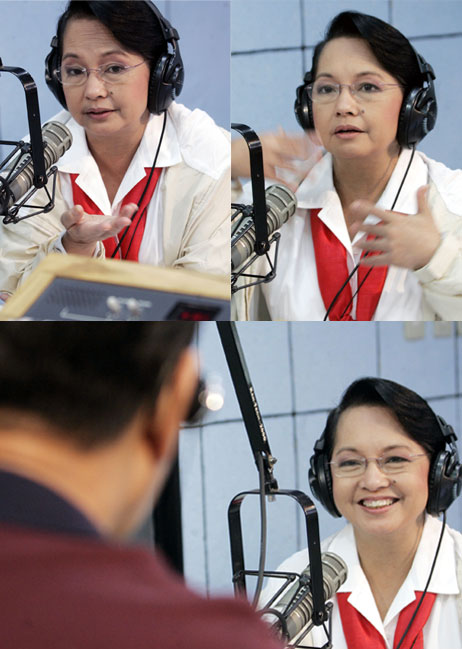
 All photos from http://www.ops.gov.ph
She had every perfect excuse to defer the signing of the supply contract of the ZTE deal and to move the trip to Boao, China last April 21, 2007 – her husband lay at the ICU on the brink between life and death, given a 50-50 chance of living thru the heart bypass. It’s called fortuitous event or force majeure or what civil law jurists call “an act of God”; it was a perfect excuse to defer the signing, yet she went on and boarded the plane knowing that the contract was tainted with irregularity.
When the whole world knew that her husband might die and even her own “enemies” and critics were so concerned that they called for a ceasefire on the “accusations” of money-laundering, smuggling, and plunder against FG, the President without hesitation donned her shoes and led her entourage that night to China.
Intent, the Supreme Court has held in many criminal cases, is determined not from the pronouncement or words of a party but from their overt acts; because, as the Supreme Court had stated time and again, we cannot read the minds of an accused, we resolve the presence or absence of criminal intent based on contemporaneous acts of the accused.
[Parenthetically, to illustrate (you don’t have to read this part, it’s parenthetical) The classic example is the case of the husband who killed his wife; subsequently on a charge of parricide/murder, the husband’s defense was that he caught his wife in bed with her paramour and in a “fit of blind rage” shot her, so the penalty should only be destierro and not the capital penalty for parricide/murder; the evidence however showed that after he caught his wife in the act, he went home and then for a few hours saw a friend and played chess with him, for several hours, and it was after this that he got his gun and went back and shot his wife. The Supreme Court held that the acts of the accused in taking his time and even playing chess, a “game of stratagem”, for a couple of hours, showed that he had deliberated upon his moves and decision to kill his wife and only after he had thought about it did he proceed to go back and kill her.] Okay, i know that example is parricide/murder but it’s one of the classic cases used to illustrate how the Supreme Court determines intent; and i’m writing this off-the-cuff-after-work-without-books.
Here, the intent of the President would have to be determined based on her overt acts, or those that could be seen and perceived, and not on what she says; and here she gave the explanation ten months after the fact! After witnesses and their families have been put at risk and are now in danger, after multitudes day after day clamour for her to resign, now she tells us: “Nung una may isinumbong sa akin kaya naghahanap na ako ng paraan para makansela, tapos sinumbong sa akin the night before signing of the supply contract, that was one of many signings. (Pero) paano mo i-cancel the night before, may ibang bansa kang kausap.” (“In one instance i was told about it so i had started to think of ways of how to cancel it, then I was told the night before signing of the supply contract, that was one of many signings. (But) how do you cancel the night before, you’ve already agreed with a foreign country?”).
This is the video version of the DZRH interview where the first “sumbong” clause (“i was told…”) of her sentence was not edited out. In other words, in that sentence, she talked of two “sumbong” (“i was told..”) instances; in other words, it wasn’t just on the eve of the signing – she was told once even earlier than the eve of the signing. (Look at the uncut video again.)
Some PR adviser of hers probably wanted to pre-empt or anticipate whatever other “explosive” testimonies would be revealed in the week, and thought that making her say “I was told…. but couldn’t cancel” portrayed her as a passive signatory and not the central player in the payment of commissions and kickbacks. She was just told; and to further make her look innocent, added that for diplomatic reasons she couldn’t cancel it on the eve of the signing.
I’ll leave the politicians to tell you what they’re gonna do with this pronouncement of the President. This blog already broke this story as early as Saturday morning when i read the news in www.gmanews.tv
Lemme see the score. That’s the fourth corroborating evidence of the testimony of Jun Lozada that the ZTE contract negotiations were tainted with big-time, dizzying commissions.
In the legal arena, as lawyers go, the field that lawyers have to move in is really narrow and the outcome in that arena is determined by the reliability of government insitutions; the best and most urgent that could be done is to file an “Urgent Motion to Lift TRO based on the President’s Extrajudicial Televised Admission of Irregularity” in the Supreme Court (in the petition that Romy Neri filed) or an urgent Supplement to the MR if one had been filed earlier.
As for intent, the overt acts of the President in gearing up that day, with full knowledge of the irregularity of the contract, twice informed of the anomaly, getting dressed, going over the contracts, her wardrobe, her speech, going on the plane trip while her husband lay almost dying showed not hesitation but persistence, insistence, single-mindedness, determination, deliberation, and even cold-bloodedness.
(it’s a good thing FG was able to surmount the difficulties of the surgery; it is unimaginable that FG, then unable to speak reminded her with hand signals to go to China. The final decision to approve and sign a contract tainted with $130 million in commissions wasn’t his, it was hers; the entire scheme, conjugal. )

