
Beheading

One of the suspects in the beheading offered to be a state witness
twofurious.jpg

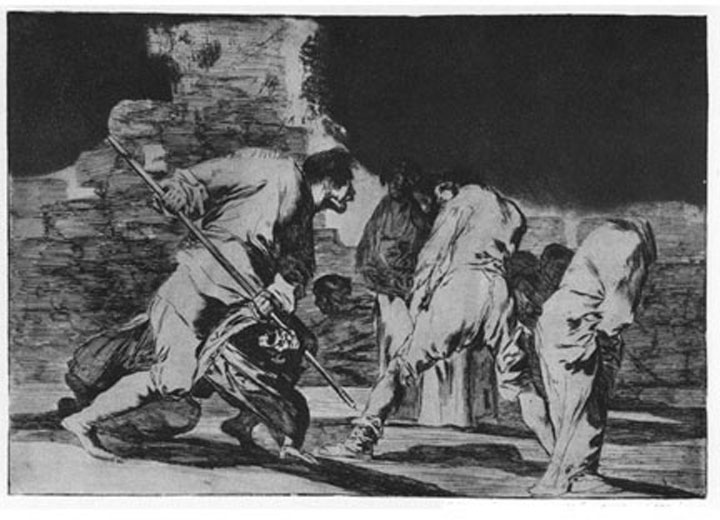
(“Disparate Furioso” (“Furious Folly”) by Francisco de Goya from www.artregister.com)

contending that he did not decapitate anyone, he just fired his gun. The ARMM police chief superintendent said that if the suspect was on the arrest warrant he could not be a state witness.

Can he be a state witness? It depends on the testimony he is offering. Like… is he telling the truth. Duh. How do you know? Since I don’t have mental telepathy, it’s probably useful to find out: 1.who he is. 2. where did he come from? 3.he claimed to have been a military asset. What was his mission? You need to verify; if not true, if he is lying, what would make you think he is not lying now. 4.some assets have been known to go to the other side and reach a point of no return when they participate directly in the crimes; so you need to see his files; 5.and his file on the contract assassination of which he was accused; 6. on the beheading: if the details of his testimony can be independently corroborated, i.e., there are other pieces of evidence other than his word, that buttresses what he says. For example, the hours, the particular area, the weapons used, the cuts, the wounds inflicted; sights and sounds; names, etc. If the testimony is general, forget it. The witness needs to supply details that only a person who was present while the crime was on-going or being planned, could supply. Otherwise, forget it.

In any case, the Rules of Court set forth the following requirements of when an accused may be discharged as state witness: 1.the prosecution absolutely needs the testimony of the accused and does not have any other evidence or even enough evidence to establish guilt beyond all reasonable doubt; 2.the testimony can be verified or corroborated in its material points; 3.he is not the most guilty (note that the rule does not say he/ she should be the least guilty; it just says “not the most guilty”). In other words, he/ she should not be the mastermind (I’d probably prefer too that the state witness was not a principal by inducement or the person who forced or induced his/her co-accused to commit the crime). 3.he/ she has not been convicted of any crime involving moral turpitude; examples are estafa, qualified theft, falsification, etc.

Here’s the verbatim rule on the matter:

“RULE 119. Sec. 17. Discharge of accused to be state witness. – When two or more persons are jointly charged with the commission of any offense, upon motion of the prosecution before resting its case, the court may direct one or more of the accused to be discharged with their consent so that they may be witnesses for the state when, after requiring the prosecution to present evidence and the sworn statement of each proposed state witness at a hearing in support of the discharge, the court is satisfied that:

(a) There is absolute necessity for the testimony of the accused whose discharge is requested;

(b) There is no other direct evidence available for the proper prosecution of the offense committed, except the testimony of said accused;

(c) The testimony of said accused can be substantially corroborated in its material points;

(d) Said accused does not appear to be the most guilty; and

(e) Said accused has not at any time been convicted of any offense involving moral turpitude.

Evidence adduced in support of the discharge shall automatically form part of the trial. If the court denies the motion for discharge of the accused as state witness, his sworn statement shall be inadmissible in evidence.

“ Sec. 18. Discharge of accused operates as acquittal. – The order indicated in the preceding section shall amount to an acquittal of the discharged accused and shall be a bar to future prosecution for the same offense, unless the accused fails or refuses to testify against his co-accused in accordance with his sworn statement constituting the basis for his discharge.”
Bedol the Untouchable

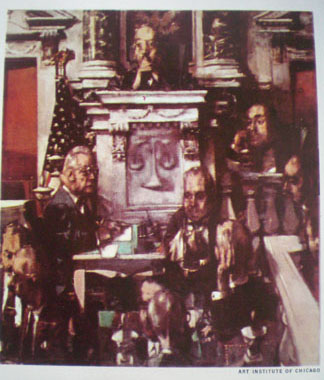
trial.jpg“The Trial” by Jack Levine, photo of a print published by the Art Institute of Chicago


Lintang Bedol was admitted to bail a few hours ago, that meant in a few hours he’d walk and may never see the inside of a jail cell in the lifetime of this administration. The charges were not only lenient as most commentators called it, they were also specifically designed such that he could easily bail himself out in a matter of hours. If you look at the overt acts alleged, charged, and proved in his rap sheet, he should have been charged and found guilty for at least four counts and not just one count of indirect contempt; there were four separate acts. Why does this matter? If four counts, the penalty would have been two years, it takes it out of the penalty for arresto mayor and puts it inside the penalty for prision correccional; if the term is prision correccional, after conviction (if the accused had been convicted and on appeal), bail is discretionary and not a matter of right; it can be denied. (of course his lawyer can argue that the six-month penalty for the four should not be put together, but it is arguable). What I’m saying is: The Comelec did not make any effort!


The Comelec’s own rules of procedure (and the Rules of Court) punish any of the following acts as indirect contempt:


“Comelec Rules of Procedure . Rule 29, Section 2

“(a) Misbehavior of the responsible officer of the Commission in the performance of his official duties or in his official transactions;

“(b) Disobedience of or resistance to a lawful writ, process, order, judgment or command of the Commission or any of its Divisions, or injunction or restraining order granted by it;

“(c) Any abuse of or any unlawful interference with the process or proceedings of the Commission or any of its Divisions not constituting direct contempt under Section 1 of this Rules;

“(d) Any improper conduct tending, directly or indirectly, to impede, obstruct, or degrade the administration of justice by the Commission or any of its Divisions;

“(e) Assuming to be an attorney and acting as such without authority; and

“(f) Failure to obey a subpoena duly served..


Bedol was charged with and found guilty of the following overt acts:

1) repeatedly disobeying summonses of the Comelec

2) failing to attend to the counting of the votes in Maguindanao

3) failure to deliver the municipal COC’s to the Comelec office in Manila. (and losing them! and not knowing how he lost them! and if indeed he lost them failing to report it! and if indeed he lost them, failing to investigate how they were lost!). this alone is four counts

4) publicly taunting the Comelec to sue him

5) brandishing a pistol on tv

6) publicly bragging he had an armory


In other words, the Comelec legal department and the Comelec en banc even if it only had the rule on indirect contempt in its legal arsenal could have easily kept Bedol in jail and with bail dsicretionary if convicted. It can if it wanted to, even with just the rule on indirect contempt.


Four counts would make the penalty two years (he could on plea bargaining negotiate to serve terms concurrently), but the penalty takes it out of arresto mayor and brings it into the prison term for prision correccional, the bail for which after conviction (after trial and conviction in the lower court, here, in the Comelec) discretionary and not a matter of right (because it is after conviction.)


Rules of Court, Rule 114, bail, proceeding by analogy, if the offense is cognizable by the MTC (arresto mayor, six months or less), bail after being convicted is still a matter of right, as follows:


“SEC.4 Bail, a Matter of Right. – All persons in custody shall: (a) before or after conviction by the Metropolitan Trial Court, Municipal Trial Court, Municipal Trial Court in Cities and Municipal Circuit Trial Court xxx

“SEC.5 Bail, When Discretionary. – Upon conviction by the Regional Trial Court of an offense not punishable by death, reclusion perpetua or life imprisonment, the court, on application, may admit the accused to bail.

“The Court, in its discretion, may allow the accused to continue on provisional liberty under the same bail bond during the period of appeal subject to the consent of the bondsman. XXX”


It is discretionary after the accused had been convicted if the penalty imposed is within prision correctional (of course, his lawyer can argue: don’t combine the four 6-month penalties. But the prosecution never made an effort!).


Even outside of the election sabotage case, they could keep him in jail if they wanted to; an efficient and professional prosecutor or legal department could. To this day, the nation does not know what happened to the missing COC’s. (And technically, you could detain a person until he answers the question of the court).