Supreme Court issues circular on use of cartoons in view of Syjuco use of Clipart in complaint vs FPnoy Aquino

if on mobile device: Pls click “Listen in browser” on the soundcloud pod below to play today’s animated Christmas theme at:

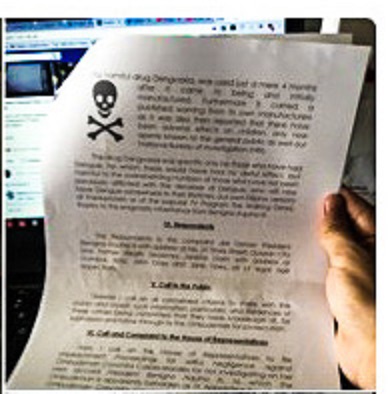
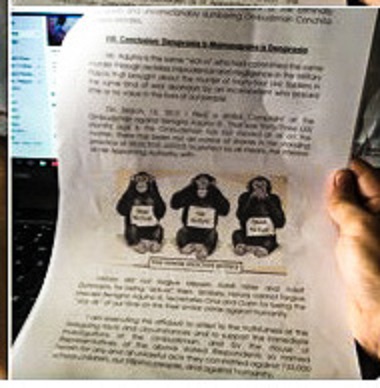
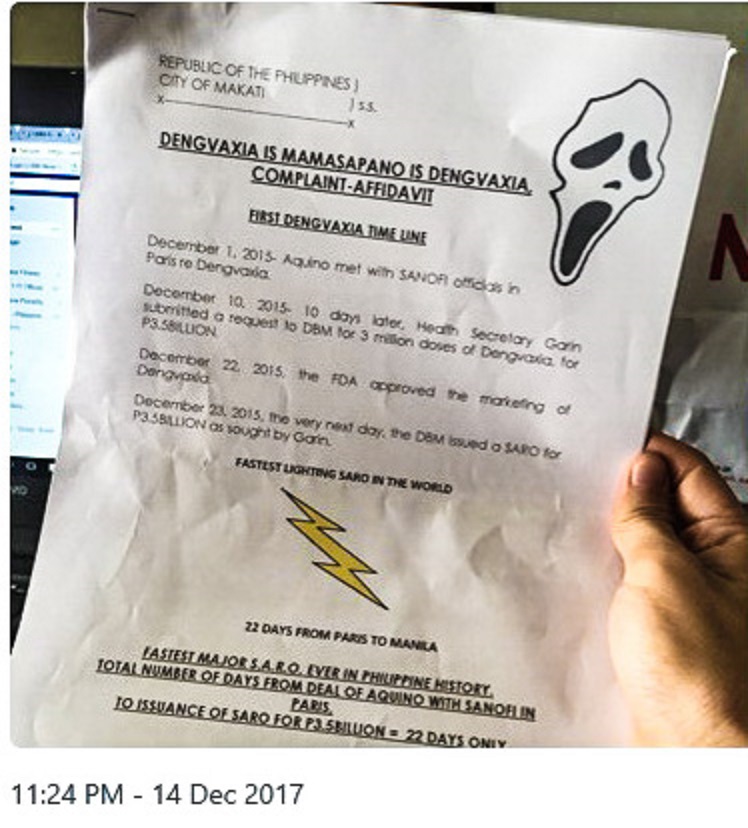
Supreme Court issues circular on the use of Clipart/ cartoons/ drawings/ artwork in pleadings in view of Syjuco use of clipart in criminal affidavit-complaint vs. FPNoy Aquino

               The Supreme Court (SC) en banc issued a circular on the use of cartoons and Clipart in pleadings today following the filing of a complaint by Syjuco against former President Benigno Aquino using Clipart and drawings in his pleading. Quoted below is the SC circular: 

SC Circular No. 12-15-2017

 On the Use of Cartoons/ Clipart in Pleadings

              In view of the practice of certain litigants or lawyers in using “Clipart” in their pleadings, the Supreme Court en banc hereby issues the following circular amending the Revised Rules of Court:
        1.Any cartoon, artwork, drawing used in a pleading should be original and drawn by the lawyer or litigant himself using a stylus and touchscreen, or pencil and paper (watercolor and other media may also be used as long as the artwork is allowed to dry before being filed in Court).
      2.Any downloaded or rightclicked Clipart image should be properly attributed to its source with proof that permission from Clipart was secured for the use of its images. 
       3.Said cartoon, artwork, drawing, whether original or downloaded, shall be accompanied by a dialog box with text summarizing the causes of action; the evidence offered/ presented; the legal arguments in support of the causes of action; and the reliefs prayed for.
          4.Said cartoon, artwork, drawing used in pleadings formally filed in Court shall be admissible in evidence as proof of the lawyer’s or the litigant’s mental and emotional age, and without prejudice to applications for other reliefs such as a petition for medical or clinical  evaluation of the parties responsible for the cartoons,  and for other purposes. 

     5.For this purpose, any physician, medical doctor, psychiatrist, and similar medical professional whose services may be required to evaluate the lawyer’s or litigant’s mental and emotional state shall be properly compensated for,  with costs against the parties responsible for the cartoons,  Clipart, and similar doodles.

      This circular shall take effect immediately upon posting and publication in the Supreme Court website.
         SO ORDERED.
        15 December 2017, Supreme Court of the Philippines, Manila.

(Credits: as stated in the embedded images; images by TJ Roxas GMA7 News)
the impeachment complaint

holbein31.jpg Hans Holbein. The Triumph of Riches (copy by Lucas Vorsterman the Elder after Hans Holbein the Younger). Pen and brown ink with brown, grey and green washes, black and red chalks and blue and white bodycolor. Ashmolean Museum, Oxford, UK. Right-clicked from http://www.abcgallery.com

(Update as of 2:26 pm: According to inquirer.net, Uno through Atty. Tamano filed a 38-page supplemental complaint to the impeachment complaint against the President while Atty. Roque filed an 11-page supplemental complaint to the impeachment complaint against Abalos, impleading the President; the complaint against Abalos was reportedly never archived but remained pending.)

* * *

The “opposition” through representatives said they would either (1) file asupplemental pleading or (2) file a supplement; or (3) file an amended one; or, a fourth option, implead the President in the archived impeachment complaint against Benjamin Abalos.

The Rules of Court govern in a suppletory manner. That means when the rules of procedure of the House do not provide for a specific situation, the Rules of Court can be used to fill the gap.

A supplemental pleading and filing “supplements” are different from each other.

On supplemental pleading: A party may, upon motion, be allowed to file a supplemental pleading to an initiatory pleading (here, the original impeachment complaint) for occurrences that took place after the initiatory pleading was filed.

According to former Justice Regalado, the difference between an amended pleading and a supplemental pleading are as follows:

Quote “ (a)Amended pleadings refer to facts existing at the time of the commencement of the action; supplemental pleadings refer to facts arising after the filing of the original pleading.

Quote “ (b) An amended pleading results in the withdrawal of the original pleading; a supplemental pleading is merely in addition to but does not result in the withdrawal of the original pleading.

Quote “(c) An amended pleading can be made as of right, as when no responsive pleading has been filed; supplemental pleadings are always with leave of court.” Closed-quote. (Regalado, Remedial Law Compendium).

A “supplement” consisting of affidavits on the other hand is different; it’s like, the party simply wants to submit additional annexes; it does not touch the initiatory pleading itself, and, in my practice, can be filed ex parte without leave of court and without even a hearing on it; it’s “non-adversarial” for lack of a better term on my part, ex parte means the party is allowed to file it even without notice and participation of the other party. So, all that would be required is something like a motion to admit Annex “A-1” to “A-27” and Annexes “Z” , “T” “E”, for example.

For a supplemental pleading (the first i discussed), here’s the provision:

“Rules of Court. Rule 10. Sec. 6. Supplemental pleadings. Upon motion of a party the court may, upon reasonable notice and upon such terms as are just, permit him to serve a supplemental pleading setting forth transactions, occurrences or events which have happened since the date of the pleading sought to be supplemented. The adverse party may plead thereto within ten (10) days from notice of the order admitting the supplemental pleading.”

dali36.jpg

Salvador Dalí. The Invisible Man. 1929-33. Oil on canvas. 140 x 81 cm. Museo Nacional Centro de Arte Reina Sofia, Madrid, Spain. Right-clicked from http://www.abcgallery.com

For a “supplement” or “supplements”, that would just be a Motion to Admit Annexes etc. , that’s a motion, and not a pleading so the party filing it does not have to jump the hoops on initiatory pleadings, and amended and supplemental, etc.; the general rules on motions apply; it shouldn’t be much bother because in fact it can be filed ex parte.

For impleading the President in the archived impeachment complaint against Ben Abalos, I blogged about it last October 1, 2007, minutes after Abalos resigned. Here’s the link. following the evidence At that time, nobody thought of impleading the President (as i blogged about) before the impeachment complaint was archived.

There’s also another one. Practically unwritten or implied. You can actually introduce and present evidence on matters newly discovered and not raised in the initiatory pleading. That’s what we did when the House impeached Estrada, and during the trial in the Senate; it’s allowed by the rules of procedure, except in the end, the eleven Senator-judges voted not to allow us anymore to present evidence even if the rules allow it. The rules allow it as follows:

“Rules of Court. Rule 10. Sec. 5. Amendment to conform to or authorize presentation of evidence. When issues not raised by the pleadings are tried with the express or implied consent of the parties, they shall be treated in all respects as if they had been raised in the pleadings. Such amendment of the pleadings as may be necessary to cause them to conform to the evidence and to raise these issues may be made upon motion of any party at any time, even after judgment; but failure to amend does not affect the result of the trial of these issues. If evidence is objected to at the trial on the ground that it is not within the issues made by the pleadings, the court may allow the pleadings to be amended and shall do so with liberality if the presentation of the merits of the action and the ends of substantial justice will be subserved thereby. The court may grant a continuance to enable the amendment to be made.”

But that day in 2001, it wasn’t the Rules of Court that changed the world.

more ramblings on, holiday

bruegel.jpg

Jan Brueghel the Elder. Allegory of Hearing. 1618. Oil on wood. Museo del Prado, Madrid, Spain. Right-clicked from http://www.abcgallery.com


While in practice, and like many if not all lawyers, we invoke specific laws (in a legal positivist manner, in the great grand tradition of “rule of law”) i never actually use the phrase “rule of law” in pleadings, motions, statements, etc., although it is the concept and principle we use in practice, all lawyers are trained to go by it. When i was a freshman in law school i used the phrase once in a statement or a speech, and then Law Student Government president Manny Goyena saw it, pinagalitan ako! (he scolded me!), but in a funny way, he scolded me in a funny way, and said, “ba’t mo ginagamit yan `rule of law’! Hindi natin ginagamit yan!” (“Why are you using that phrase “rule of law”, we don’t use that.”). He was ahead of me in law school, a senior student and we were both in the alliance (Students’ Rights and Welfare Alliance, i think that alliance holds the distinction of being the first to wrest from the dictatorship, during the dark years of martial rule when students were being “salvaged” and when organizations were banned, the right of students to have a student government. I think).


Anyway, if you’re ahead of me in year level and if you’re an alliance-member, you’re allowed to scold me. So i said, “eh nabasa ko sa libro eh” (“i read it in the book.”). Ngek. And he said, “Hindi natin ginagamit ‘yan, si Marcos lang gumagamit nyan.” (“we don’t use that phrase, only Marcos uses that.”). Much later on, Marvic Leonen, or i think it was someone else, explained to me that the “constitutional authoritarianism” of Marcos taught us that what is legal is not necessarily just, that’s why he, or we, don’t use that phrase.


Mga astig ano?. (I don’t have a translation of astig. They had a firm grasp of the law and how to fight for what was just).


Manny Goyena later on of course was one of the leading post-Marcos human rights lawyers, he together with friends, founded Alterlaw, i saw in Google that he’s in Geneva lawyering for organizations and Filipino migrants. Marvic, as everyone knows, founded one of the first environmental legal resources center, and later on was asked to be General Counsel of U.P., then Vice President for Legal of U.P.


So, from then, i never used that phrase. Baka biglang may umalingawngaw sa kaliwa at kanang tenga ko (a boom might suddenly echo from my left and right ear): “Ba’t mo ginagamit yan!” (“Why are you using that phrase!”)


Although in reality all lawyers have been trained to be legal positivists: Find a law or rule, if there’s none, dig up one; if you can’t find one, go back to ancient times, go back to the Romans for chrissake just find a law or precedent, short of going back to pre-history.


And that’s the pre-history of that.