On “interfaith rally”: Checkpoints : Police not authorized to compel occupants to step out of vehicle

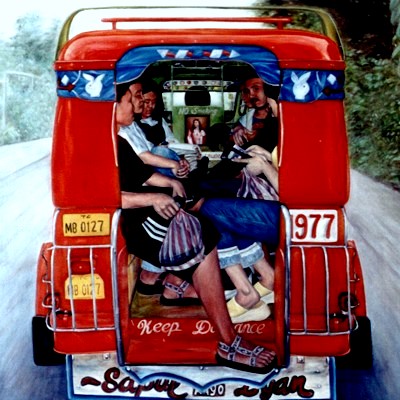
motorelabacol.jpg  Michael Bacol, “Motorela”, Oil on Canvas, 122 x 122 cms., 2003. Kulay-Diwa Gallery of Philippine Contemporary Art. Rightclicked and downloaded with express permission (thanks much!) from the webmaster at www.kulay-diwa.com                

      A couple of days ago, the Department of Education warned that schoolteachers who joined  the interfaith rally in Makati would be  disciplined. The Department of Education should however be advised that under civil service rules, government employees are entitled to leave credits that they can avail of in case of sickness, vacation, and for any other reason. Government employees who do not avail of their leave credits can monetize them after the end of the year. As long as  a government employee does not go on AWOL (absence without leave) and files the corresponding  form for leave for that day (today), he/she cannot be proceeded against for being absent today to join the interfaith rally. The Department of Education therefore has no authority to proceed against any schoolteacher who fills up the necessary forms for leave for today and who joins the rally.  (In fact, the warning itself, if worded as stated in the news item, appears to be unconstitutional.)              

             Yesterday, convicted plunderer Joseph Estrada said he would join the rally; this, coming in the heels of several PR media coverage of him asking for the resignation of Gloria and offering himself as a successor should Gloria be ousted, since, as he said, he never finished his term. The rally being an open assembly, anyone and everyone is welcome. These movements however have been successful in attracting many and new participants precisely because organizers studiously avoided giving leading roles to politicians and candidate-wannabes although some of them have managed to insert themselves in the program. Estrada in his continuing bid to be relevant will no doubt try to attract media attention to himself during the interfaith rally. Showing  Estrada there at the head of the march and occupying a prominent place on stage would make the entire anti-corruption anti-plunder movement a farce – nothing more than a power struggle between and among plunderers.             

         Today, the  news media reported that several checkpoints have been set up at the NLEX to search delegations coming from the provinces and in fact this morning, a delegation of students from Pampanga was stopped on the highway.

       (I think the participants are  usually identified by the streamers and rally paraphernalia they are carrying.)        

        While checkpoints have been ruled upon as legal (Valmonte vs. De Villa with three dissenting justices), the Supreme  Court set down guidelines to make such warrantless searches legal, primary of which is that the search should only be visual (no contact) and law enforcement authorities are not allowed to force passengers to get off or get out of the vehicle. Here are those guidelines and standards (from Valmonte vs. De Villa, second ruling, on MR, 1990):      

       1.Compartments of the vehicle and the vehicle itself are not searched (absent a real probable cause) but merely visually searched with the use of a flashlight, for instance.     

        2.Occupants cannot be bodily searched.    

       3.Occupants cannot be compelled to get off or get out of the vehicle.

        4.The driver and occupants cannot be compelled to open  any compartments or luggage or bags in the absence of a real probable cause (e.g., the smell of marijuana, or drops of blood, or unruly behaviour, or objects that on plain view look like deadly weapons, etc.) 

            The conduct of the checkpoints right now  — occupants being asked to get off their vehicles and being stopped from proceeding without probable cause — violate these guidelines and make those searches without probable cause , illegal.
Woodwork

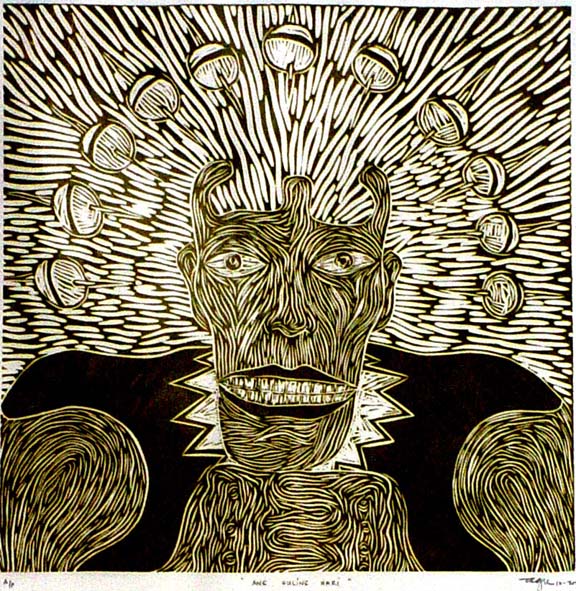
secondroldan.jpg Amiel Roldan, “Ang Huling Hari”, Print, 44 x 44 cms., 2000. Kulay-Diwa Gallery of Philippine Contemporary Art. Rightclicked and downloaded with express permission (thanks much!) from the webmaster at www.kulay-diwa.com      

         I saw only bits and parts of Senate hearing, more like small bits here and there; and saw parts of  the testimony of  the new arrival, the “witness” Dante Madriaga. I didn’t have any background information on him and  this is just based on what i saw at the hearing.      

           Every lawyer likes his/her witness to be well-mannered. You’d  like your witness to say “you honor” when he/she is addressing the judge, no matter what you think of the judge; or if in the vernacular, to use “oho” or “opo” or “ho” or “po”; you don’t like your witness to talk to the judge like he was talking to his drinking buddies during a streetcorner (kanto) drinking session.  That’s why the purpose of a witness-prep is not so much to tell your witness what to say (we don’t; we don’t tell them what the substance of their testimony should be) but just to make the witness comfortable and make him/her learn how to comport himself/herself on the witness stand. You’d also like your witness to be lucid in their narration and you’d like their testimony to more or less have a certain flow. You’d also like your witness to know how to write down his/her thoughts or to be coherent during your interviews so it would be easier to help him construct his/her affidavit. Laypeople might think  all that is form; it’s not; the demeanor of a witness becomes part of the substance  because it is considered by the judge in weighing whether the witness should be believed.

           This witness came forward on national TV with no antecedent events behind him. People don’t know him from Adam; and literally the participants in the ZTE contract negotiations  don’t know him; have never seen him before. Since he is coming out of the woodwork, whoever presented this witness or whoever allowed him to testify, should have made some effort to  make him lay out his background with the use of documentary evidence like his appointment papers, his payslips, his drafts of contracts, his memos, his previous employment papers, etc. That more or less establishes where he came from. I do not know if it’s a  good idea for the Senate committees to just let anybody pop out there and give him a big portion of the time and humour him with “searching” questions when it hasn’t been established yet where he came from;  unless we are letting him take up space  because there’s nothing else to do with the time.       

               It is not a good sign that he is not known to all the other “participants” like Chairman Romy Neri, Chairman Ben Abalos, Joey de Venecia, Jun Lozada, and the other government officials (Lito Atienza, Avelino Razon, Manny Gaite); wittingly or unwittingly all these participants are corroborating each  other in parts of their testimony;  they’re testifying on the same events,  but just conveying different meanings for the acts testified on.

              In the testimony of the new arrival, the most useful information that could be gotten from him are the names: Leo San Miguel, Ruben Reyes, et al; and the information is useful if those persons could be brought to the Senate. (I don’t have any comment for the rest of the testimony.)      

        Also, if your witness is being presented as an ordinary witness and not an expert witness, you don’t like him/her to “overreach”. If he/she is being presented as an ordinary witness, you just want him/ her to testify on what he/she saw or what was said in his/her presence (only as to the fact that it was said and not necessarily the truth of what was said). An expert witness on the other hand can, based on his/her studies, give an opinion or analysis on situations similar to the case or on the case itself. You don’t like your ordinary witness to “overreach” or to say, “Sa palagay ko sa First Couple nga napunta ang kalahati nyan” (“In my supposition, half of that went to the First Couple”) or “Sa tingin ko, alam ko, noon pa nya alam yan” (“In my view,  i know, she’d known that a long time”). It gives the impression that the witness is playing to the gallery and giving statements that he/she thinks would please the judge and those listening to his/her testimony.  Not good.  Even during witness-prep or the interviews, statements like that are annoying so the lawyer usually asks the witness to backtrack and state what he/she saw, or to describe what  he/she saw.

              Unless the persons he named could be presented, that’s about it.