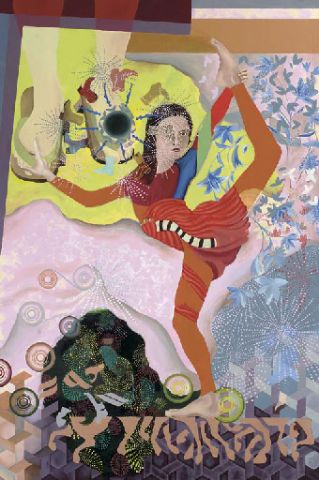
 Shahzia Sikander. Elusive Realities no. 2. Oil on canvas. Christie’s New York, May 12, 2005, sold. Right-clicked from http://www.artnet.com
At 5pm yesterday I was already on my way to yoga class (Ashtanga, just my third month) when a couple of journalists called regarding the DOJ “advisory”. I gave an answer that cited Article 151 of the Revised Penal Code and PD 1829 (obstruction of justice). And then I texted it wasn’t possible to phone-patch anymore because the yoga teacher will cite me in contempt. (I’m just kidding, she doesn’t do that; but it’s rude to bring your earthly beeping gadgets there.) The news report gave a good gist of the quick interview (time constraints of the medium allow only a few words).
The DOJ “advisory” to CEO’s, directors, editors of media organizations states that that their field reporters, cameramen, crew, would “incur criminal liability” if they “disobeyed lawful orders” of duly constituted authorities during “emergency” situations that may result in “collateral damage” etc.
As read to me, the “advisory” as worded by the DOJ is vague; and it is intentionally vague; in fact, the nature of such an advisory is not clear either. The DOJ did not issue a legal opinion, which is what it usually does either on its own or when an entity or citizen comes to it with a query. A DOJ legal opinion, while not law, can inform those concerned how an agency of the executive branch would interpret a specific law. A DOJ legal opinion states the query, the facts, the issue, the short answer (or executive summary) then the pertinent law and jurisprudence and discussion.
They did not do that here. Why?
I’ll let you in on a trade secret. Once, I was told by other lawyers that Ka Pepe Diokno used to tell his junior associates, “If you’re strong on the facts, pound on the facts. If you’re strong on the law, pound on the law; if you’re not strong on the facts and not strong on the law, keep pounding, young man, keep pounding!”. To which I’d retort “What about women lawyers, why is that addressed only to men lawyers?” And so, I heard an amendment of it once: “If you’re strong on the facts, pound on the facts, if you’re strong on the law, pound on the law; if you’re not strong on the facts or the law, keep pounding on the table!”
Here, the DOJ is pounding on something, but it’s certainly not on facts or the law: they didn’t state any. And intentionally.
The lawyer who wrote that “advisory” was probably advised by some smart or concerned state prosecutor that they cannot be specific in their “advisory” because that would constitute a prejudgment of any preliminary investigation of any criminal complaint that the police might lodge in their office when a reporter or cameraman or photographer or researcher does not leave an area of conflict when asked by the police or the military to do so, and they’d have to be arrested and inquested, or if not arrested, be made the subject of a criminal complaint.
But the DOJ secretary gave an interview! (as I saw later that night when I got home). He referred to the Manila Pen incident in explaining why they issued the “advisory”. Doesn’t that constitute a prejudgment of any similar incident in the future? If the purpose is not to be accused of “prejudgment” by not issuing an official legal opinion and by issuing only a general advisory, then why say in the next breadth in an interview that it refers to the Manila Pen incident and similar situations?
And that’s what happens when you have a few or some professional state prosecutors but the head of them all doesn’t know what he’s doing and gives off-the-cuff remarks that destroy whatever proper procedure you’d want to observe (not that the issuance of such advisory is “proper procedure”, or that it does not transgress certain boundaries: Does the Department of Justice, the prosecutorial arm of government, have the authority or discretion to threaten members of the Press with criminal liability couched in vague legalese, as it were; aren’t the laws enough; isn’t the existence of criminal laws and the performance of functions of law-enforcement agencies enough deterrence; but I’m saving that for later).
The DOJ secretary’s obeisance to marching orders from Malacañang and his off-the-cuff remarks show what a politicized bureaucracy does to our institutions. A politicized bureaucracy means that the heads of government agencies are primarily concerned with protecting the President and the actions of his/her officials. In contrast, professional career employees, whether they’re investigators, Comelec election inspectors, soldiers, prosecutors and fiscals, tax collectors, immigration agents, customs collectors, etc., do their job regardless of who are involved, i.e., they act on the basis of what the laws provide, not what their masters and their masters’ relatives tell them. A politicized bureaucracy breeds more malignant problems: inefficiency, corruption, injustice and then grows roots to entrench itself further, making it impossible to weed it out without destroying the soil on which it is planted. A politicized bureaucracy recreates itself, engenders itself, then perpetuates its creators, to make it impossible to uproot it without bulldozing and digging up the soil itself. How do you do that now?
A politicized bureaucracy, such as what we have, such as what the DOJ had become, is one of the worst legacies of the Macapagal-Arroyo administration.