
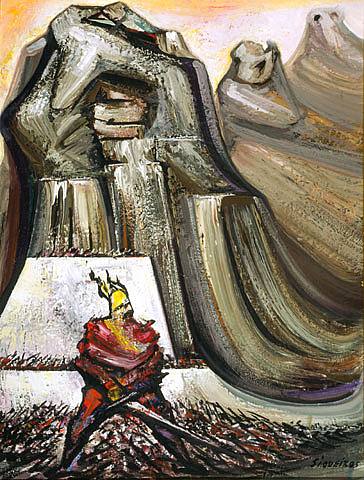
 David Alfaro Siqueiro. Macbeth or The Criminal Panic. 1964. Duco on wood panel. For sale Mary Ann Martin/ Fine Art Gallery. Rightclicked from www.artnet.gallery searched thru www.artcyclopedia.com
The DOJ Secretary finally went on lawyer-mode (after four years of being Justice Secretary) and this time gave a legal opinion in an interview: he pointed to Rule 71 of the Rules of Court on indirect contempt in answering queries on the arrest warrant issued against CHED Chair Romy Neri. The DOJ Secretary deviated from his usual vituperative, defamatory tirades . (Normally, you can ignore obnoxious and what a Supreme Court once termed “low-watt” (referring to a lawyer’s initiatory pleading) commentaries unless they emanate from persons vested with jurisdiction or from persons of public influence). Here, however, it’s not low-watt because the DOJ Secretary has at least referred to the rules. (The apparent heir to the trove of inanities however is the Presidential Legal Counsel.)
True, contempt is both criminal and civil; and procedurally it is a special civil action (these are not my ideas, i read them from Justice Regalado and from jurisprudence sometime back and used them in contempt cases i’ve filed but i’m just in a hurry to put the citation here; and besides some people are stealing research from this blog). Because of its criminal nature, in the sense that it is punished with imprisonment and or fine, indirect contempt requires notice and hearing, and it is appealable to a “superior court”. Direct contempt is not, of course; as everybody knows, that is summary in nature (that’s the one you see in the movies or in lawyer-shows, when the judge waves his/ her gavel and shouts dramatically at an Al-Pacino –wannabe “you are in contempt!”)
Indirect contempt on the other hand as a “somewhat criminal” or “semi-criminal” (my terms, i’m quoting myself, kapal ko ano? I used those terms instead of saying criminal in nature, because a crime is defined as a act or omission punished in the Revised Penal Code or in special laws while indirect contempt is punished not in the Revised Penal Code or in special laws, but in the Rules of Court. Anyway), or the punishment for indirect contempt is different from the brief detention that may result from those compulsory processes that emanate (warrants of arrest) to compel the attendance of witnesses in court, or in this case, in a Senate Committee hearing.
In other words, the assistant of the DOJ Secretary forgot to give him the pertinent and decisive qualifying provision in the last paragraph of the section of the rule he was using. It says, “But nothing in this provision shall be construed as to prevent the court from issuing process to bring the respondent into court, or from holding him in custody pending such proceedings.” (last par., Rule 71, Sec. 3, Rules of Court.)
I don’t know how the Senate worded its orders, but it has contempt powers under constitutional law (jurusprudence, Arnault cases) to compel the attendance of witnesses. It could word its orders in this wise: “Please show cause why you should not be cited in indirect contempt, xxx etc etc. Let warrant of arrest be issued against _____ etc. The sergeant-at-arms is hereby directed to bring the person of ____ on ___ (date and place)… SO ORDERED.”
This kind of warrant of arrest and any brief detention that may result therefrom is not punishment for any offense but merely for the purpose of making the person appear in court. It’s a compulsory process.
There’s also Section 8 of Rule 71 which says: “Section 8. Imprisonment until order obeyed. When the contempt consists in the refusal or omission to do an act which is yet in the power of the respondent to perform, he may be imprisoned by order of the court concerned until he performs it. (7a)” (Section 8, supra)
(In my opinion) this requires some kind of proceeding where the respondent has opportunity to explain why he/ she did not comply or could not comply with the order of the court; but in order to bring him to the proceeding itself , you need to subpoena him/her and give him/ her a show-cause order and, and upon repeated failure or refusal, order his/her arrest.
Mr. Neri can file whatever he wants to file in the Supreme Court but the mere filing of an action, without a TRO or an injunction, will not stop or cannot stop the Senate from enforcing its compulsory processes (well, it can motu proprio or on its own suspend it.)
End notes (copied-and-pasted from www.lawphil.net ; because i don’t want to type from my book):
“Rules of Court Rule 71. Section 3. Indirect contempt to be punished after charge and hearing. After a charge in writing has been filed, and an opportunity given to the respondent to comment thereon within such period as may be fixed by the court and to be heard by himself or counsel, a person guilty of any of the following acts may be punished for indirect contempt; (a) Misbehavior of an officer of a court in the performance of his official duties or in his official transactions; (b) Disobedience of or resistance to a lawful writ, process, order, or judgment of a court, including the act of a person who, after being dispossessed or ejected from any real property by the judgment or process of any court of competent jurisdiction, enters or attempts or induces another to enter into or upon such real property, for the purpose of executing acts of ownership or possession, or in any manner disturbs the possession given to the person adjudged to be entitled thereto; (c) Any abuse of or any unlawful interference with the processes or proceedings of a court not constituting direct contempt under section 1 of this Rule; (d) Any improper conduct tending, directly or indirectly, to impede, obstruct, or degrade the administration of justice; (e) Assuming to be an attorney or an officer of a court, and acting as such without authority; (f) Failure to obey a subpoena duly served; (g) The rescue, or attempted rescue, of a person or property in the custody of an officer by virtue of an order or process of a court held by him. But nothing in this section shall be so construed as to prevent the court from issuing process to bring the respondent into court, or from holding him in custody pending such proceedings. (3a)
XXXX
Section 8. Imprisonment until order obeyed. When the contempt consists in the refusal or omission to do an act which is yet in the power of the respondent to perform, he may be imprisoned by order of the court concerned until he performs it. (7a) The writ of execution, as in ordinary civil actions, shall issue for the enforcement of a judgment imposing a fine unless the court otherwise provides. (6a)
