
More female deities (still Women’s Day post)

Speaking of female deities and poses named after them (see previous post)
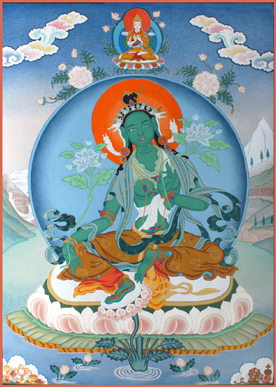
Right-clicked from http://www.dakiniswereld.nl/Thangka used here for academic non-commercial purposes

this is a modern-day rendition (a thangka) of a Buddhist female deity.

Look at one of the ankles, the inverted one. Try executing it – oops, no, don’t, if you’re not learning the asanas (poses), it might look impossible.

The ankle is turned up. It looks like a combination of two yoga poses, a combination of this pose (photo below)

the “inverted ankle pose”, [my term. Officially this is called one of the Janu poses, janu meaning knee although based on personal experience, this one actively involves the ankle more than the knee (not an expert; just based on experience)] and with half of the Maya Devi pose (i already named it Maya Devi’s pose, although some writers call it Lakshmi’s pose, same thing. Hay naku, o sige, let’s see if you want to sue me)

as depicted in some art pieces of Buddhist goddesses (the tara’s ), it is a surprise that this combination-pose was never made into a yoga pose. (well, maybe not a surprise.) Will look it up some more, i could be wrong, maybe it’s present in the other series or in the other schools. But in the meantime…

out of curiosity i executed it.

One time, on a brownout day, maybe on a dare, i could photograph and post an execution of it, and name it after the female Buddhist deity; perfectly legit — there’s a female deity that’s depicted with it; and it’s based on research. it will be named Green Tara’s pose, or if you want the Sanskrit version, it will be named syamatarasana. Syamatarasana. i named it just now.


First Century Before Christ (1st Cent B.C.)

photo right-clicked from Lankan Library Forum, sharpened & lit

…. three favourite poses, sometime, i’ll tell you which ones (poses that ease discomfort), so i researched one of them; turned out to be really ancient.

According to some scholars: this Lankan coin circa 1st Century BC depicts Maya Devi (Buddha’s mother), seated with the soles of her feet together, and that it shows Queen Maya after the  “virgin birth of Buddha” (the research has to be verified).              whaddyaknow…! (some scholars however refer to another female deity, a heroine)

i guess…

like this…?

(the legs have to form a straight, horizontal line, like in Maya Devi’s pose, knees touching the ground, the more you get there, the more it eases your discomfort)

…. for the general readers/ viewers of this blog: this pose is now called “baddha konasana”; “baddha”, Sanskrit for “bound”, “kona” for angle, “asana” for pose.

Gosh, it’s really an old pose, isn’t it. That makes it more than 2,000 years old, an artist’s rendition supposedly of Buddha’s mother. (the research has to be verified.)

i’m guessing, the Hindus, who named these poses in Sanskrit, just gave the pose a generic name (bound angle pose) instead of giving it Maya Devi’s name, a Buddhist icon. Some writers call this Lakshmi’s pose; Lakshmi is a Hindu goddess. This is one of the few poses named after a female deity.

it’s also now commonly called the butterfly pose maybe because the angle of the folded legs make them look like wings; and it’s also more contemporarily called “Cobbler’s pose” because it looks like the way Indian cobblers sit.

renaming it here — calling it Maya Devi’s pose. Sue me.

(well, at least—- there’s less gibberish when i renamed this pose this time, i based it on research, you should be proud of me)

Happy Women’s Day on Monday!