(if on mobile device: To hear the free streaming music embedded for this post, pls click “Listen in browser” on the soundcloud pod below, then click the play button. Happy viewing and listening!)
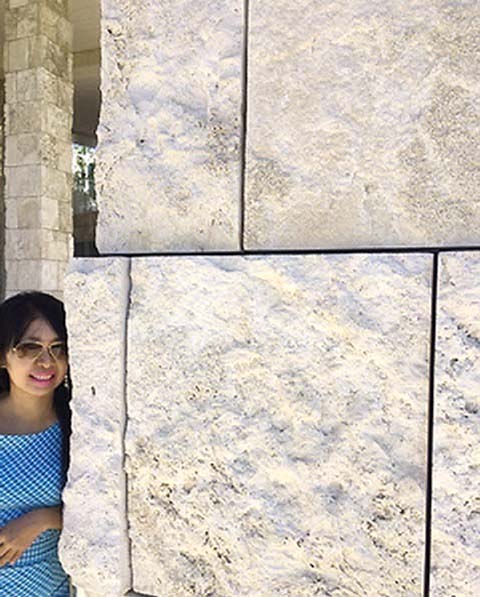
“Travertine Stone at the Getty Center by Eric Doehne …
” xxx Travertine is a product of the earth’s water and carbon cycles. As carbon dioxide-rich rainwater percolates through soil and stone, it slowly dissolves tremendous quantities of limestone along underground fissures. Reemerging at the surface as a spring (now saturated with dissolved limestone), this water releases carbon dioxide gas into the atmosphere—much like carbonated mineral water. Because of this “Perrier effect,” the limestone can no longer remain in solution.
It recrystallizes, typically as the water cascades over organic films made of bacteria, algae, and mosses. A dense, banded carbonate stone is built up over time as new material covers older layers.
“Calcite and gypsum, the minerals that make up about 99 percent of travertine stone, are colorless. The beautiful honey color of the Getty Center travertine actually has its origin in the other 1 percent of the stone: traces of yellow sulfur, brown iron compounds, and organic pigments. The intricate “Swiss cheese” texture of travertine is partly the result of gas bubbles, which are often trapped between layers of stone, creating spherical voids. Minerals crystallizing on the ever-present bacteria in travertine deposits—like granular snow blanketing a miniature landscape—preserve organic growth forms, called “shrubs,” and produce much of the rugged relief evident across the stone’s surface. In some cases, travertine layers are similar to tree rings, with lighter and darker laminations representing seasons of growth.
” Travertine is found in greatest abundance where hot and cold springs have been active for tens of thousands of years. The most famous travertine location, and the source of the stone used for the Getty Center, is Bagni di Tivoli, 20 kilometers east of Rome, where travertine deposits over 90 meters thick have been quarried for over two thousand years. xxx” (from getty.edu)
(if on mobile device: To hear the free streaming music embedded for this post, pls click “Listen in browser” on the soundcloud pod below, then click the play button. Happy viewing and listening!)
Credits: As embedded in the materials or as stated in the text; all materials are used here non-commercially for academic purposes.