

Yasmin Almonte. Kiss of Narcissus. 121 X 91 cm . Oil on Canvas . 1997. Hiraya Gallery. Rightclicked and uploaded with express permission (thanks thanks!) from the www.hiraya.com
Authored by Grace Sucgang | student 19, j192 2nd post Quote “Yesterday, Dec. 19, GMA 7’s 24 Oras aired a nicely shot and edited news feature on how the warden of the Quezon City Women’s Correctional was trying to give the women inmates a good Christmas. The shots taken showed the inmates with their backs to the camera or their feet, shadowed heads and blurred faces during the interviews in order to protect the dignities of persons interviewed as women and prisoners. According to the code of ethics, this is necessary as a sign of respect and to avoid assigning stigma to these people since there is a section there stating that women and children are given more consideration when being featured in news.” End of quote Dec 20, 6:22 PM — single-sourced; ads by a news presenter; interviewees w/ no captions
XXXXXXXX
Authored by Hazel Federico, Student #5 |Media Monitor. Unedited by blog admin
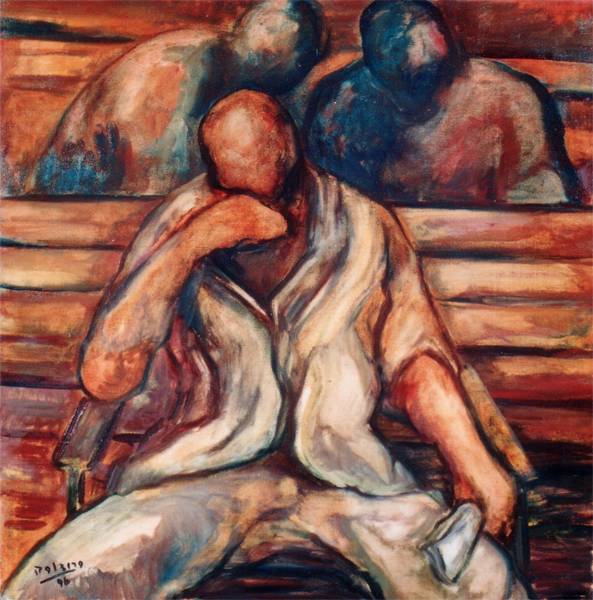
Danilo Dalena. Talo (Loss). 61.5 x 61 cm . Oil on Canvas . 1996. Hiraya Gallery. Rightclicked and uploaded with express permission (thanks!) from the www.hiraya.com
Quote “Last Wednesday (Dec. 26), a Philippine star article entitled ‘Poor families to get P800 monthly subsidy’ (written by Helen Flores) only had one source. Throughout the article, only the opinions or views of DSWD Secretary Esperanza Cabral were featured. Only the positive side of the issue was addressed, making it seem to the public that it was all there was to it. Had the writer interviewed economists, they would have likely said that this subsidy would add to government expenditure and would adversely affect the private sector as the loans they could have availed were already given to the government.
Quote “The Journalist’s Code of Ethics says that journalists must not “distort the truth by omission or improper emphasis.” They should also “air the other side.” While the writer did not write an utter falsehood, she failed to get the other side of the story, thereby emphasizing the pros and neglecting the cons.” Closed-quote. Dec 28, 3:55 PM — single-sourced; ads by a news presenter; interviewees w/ no captions
XXXXXXXXXX
Authored by Student # 2.
Quote “EDITED VERSION
Quote “On December 15, the Philippine Daily Inquirer ran a story entitled ‘Biofuels eating into food security–Golez.’ The entire article looked like a press release from the opposition congressman, since the entire article depended on Senior Deputy Minority Leader Roilo Golez’s claim that food security may be threatened by the passing of a “law mandating the use of biofuels as an energy source.”
Quote “This is in violation of Section 2, Article III of the Code of Professional and Ethical Conduct of the Philippine Press Institute which says that “Single-source stories must be avoided as a rule. There is always the imperative to get a second, third or more sources… We must strive at all times to ascertain the truth of our sources’ assertions.”
XXXXXX
Authored by Student #2

Francisco Pellicer Viri. The Slippery Intensity. 162 X 208.5cm. Acrylic on canvas. Hiraya Gallery. Rightclicked and uploaded with express permission (thanks thanks!) from the www.hiraya.com
Quote “In the December 21 issue of the Inquirer, a front page story had the headline “Adboard censures Star for making false claims.” The story was about how the Philippine Star has made “unsubstantiated” claims on its advertising reach and for containing images “disparaging” to its major competitors.”
Quote “Though the story may involve public interest, it is obvious how the Inquirer’s placing of the story on its front page is strategically done in its favor. The space could’ve been given to a story tackling issues that involves more stakeholders than advertisers and broadsheets. Quote “Also, the article is one-sided, with no statements from the Star whatsoever.
Quote “These acts are in violation of The Philippine Journalists’ Code of Ethics which says that journalists should “recognize the duty to air the other side” and “not let personal motives or interests influence me in the performance of my duties.”” Closed-quote.
XXXXXXX
Authored by Student #2
Quote “The previous stated story, along with PDI’s December 20 issue with the story ‘Adboard tells Philippine Star to pull out offending ad’ forms a series of articles meant to attack the Star. Though the KBP codes is devoted to different media, there is a clause in the Radio Code of the Kapisanan ng mga Brodkaster sa Pilipinas that may be applied to this case. The said clause is in Letter f, Section B, Article I which tackles Commentaries and Analyses which says that “Personal attacks against fellow broadcasters and other stations are considered unethical and not be allowed.”” Closed-quote. XXXXX
Authored by Student #2
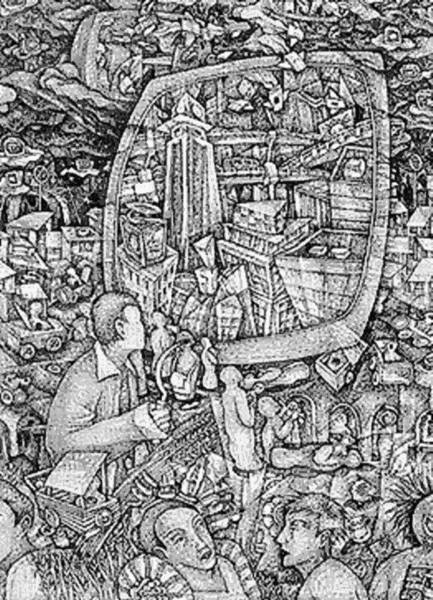
Fernando Escora. Will There Be Another Harvest? 169 X 124 cm . Pen and Ink on Canvas . 1999 Hiraya Gallery. Rightclicked and uploaded with express permission (thanks thanks!) from the www.hiraya.com
Quote “On a different note, the Inquirer’s coverage of the Sumilao Farmers’ ‘Lakaw Sumilao’ or Lakad Sumilao is worthy of acknowledgment. They have had (sic) an article on the Sumilao Farmers since October 25, and had a story on their quest for what they rightfully deserve in almost every day (sic) of December.
Quote “Also, the stories did present both sides of the issue, with stories on the San Miguel Corporation’s claims, the business sector’s concerns, and the government’s views on the matter. Their columnists (at least, most of them) have also taken their stand on the issue and, in effect, the Inquirer has run different opinions on the matter.
Quote “All these are in cognizance with the Philippine Journalists’ Code of Ethics, which states that journalists should scrupulously report and interpret the news, taking care not to suppress essential facts nor to distort the truth by omission or improper emphasis,” and Number 1 and 2, Section III of the Code of Professional and Ethical Conduct of the Philippine Press Institute which tackles ‘Writing the Story.’ Said clause states that “All efforts should be exerted to make stories fair, accurate and balanced,” and that “Single-source stories must be avoided as a rule.” Dec 25, 7:48 PM —
XXXXX

