
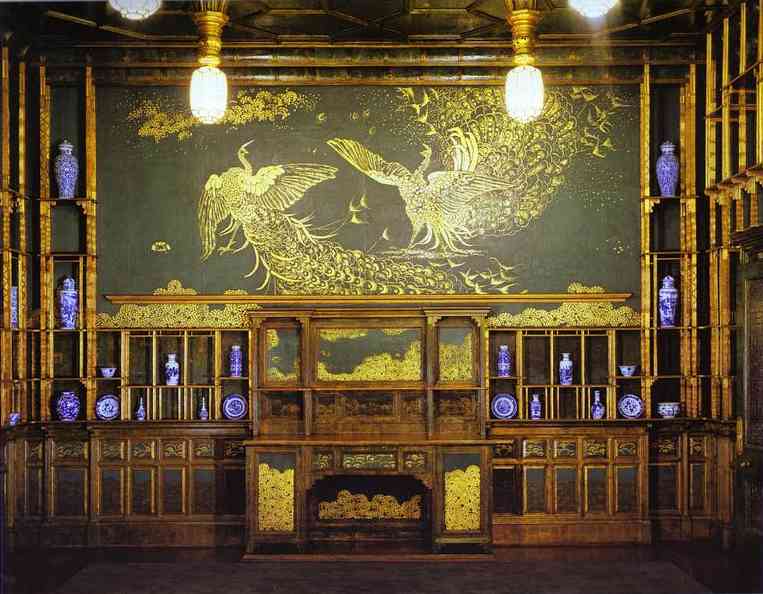
James Abbott McNeill Whistler. Harmony in Blue and Gold: The Peacock Room. 1876-77. Oil and gold leather and wood. Freer Gallery of Art, Washington, DC, USA. Right-clicked from http://www.abcgallery.com
A sheriff’s job is never easy. Years ago, a client frantically asked me to rush to them, I put up excuses, said my job was over the case was over the writ was already in their possession. (As a rule, it’s not a lawyer’s job to accompany the sheriff. Some do. Anyway.) They ordered me to drop everything. The sheriff and his personnel did not want to make a move to enforce a writ on illegal occupants of an apartment, because objects like kaldero (pots and pans) and the dish rack were being thrown at the sheriff, and the occupants were using a baby as shield. I thought: How would a lawyer standing there change the trajectory of the flying objects? Anyway, I went. It wasn’t pretty. It was like a Lino Brocka film: rough, edgy, heart-wrenching, jarring. It was real, harsh, and dark; not like a movie. I hated that part of the job and lost sleep on it.
Yesterday’s service of the writ in People vs. Estrada was cinematic. Let me congratulate the media bureau of the judgment- obligor in People vs. Estrada. The job of Sandiganbayan Sheriff Urieta here was just to serve the writ of execution. That job was done when the judgment- obligor signed the file copy or “receiving copy”. That was it. Mission for that day accomplished. (For reference, see Rule 13 of the Rules of Court on service of court orders).
But here, it wasn’t just that.
A sheriff’s job is never easy. There’s an old Clint Eastwood movie where he played a sheriff whose job was to bring a witness to court, so he went out of town and fetched the witness; on the way back he was waylaid, shot at, bombed, by those who didn’t want the witness to testify, so he and the witness commandeered a bus, fortified it with improvised steel plates from cans, etc, and it was riddled with bullets and all the tires blew up and the glass shattered and the bus rattled and sputtered with many bullet holes until it was a heap and that’s how it landed at the steps of the courthouse and he made a return-of service before the judge with the witness in tow. Only Clint Eastwood.
A sheriff’s job is never easy. Yesterday, before the judgment- obligor signed the copy, a few frames earlier than that scene, the judgment-obligor had lines. “Ang akin ay akin, hindi nyo pwedeng kunin…” (“what’s mine is mine, you cannot attach them.”). Then, several more lines after that, he had more: “Anong gagawin nyo kung di nyo makuha yan? ako ang kukunin nyo?” (soft laughter) (“what will you do if you cannot attach those? You will attach me?).
To which, Sheriff Urieta reparteed: “ay naku hindi ho, hindi na namin kayo kukunin.” (soft laughter). “oh my, no. we’re not going to attach you anymore.”
(Ginawang chattel).
And there in the soft daylight, they exchanged lines. The audio was crisp, very clear, it was almost like they were wearing lapel mikes, no ambient noise. The dozens of photographers and reporters who had been waiting were quiet and well-behaved, almost hushed, during the throwing of lines The location was wide and spacious, the lighting was not too bright, without any glare, it didn’t even bounce any reflection from Erap’s eyeglasses, it was perfect; the cinematography was excellent: In one version, the cameraman slowly panned from Estrada to the left then slowly zoomed out, for detail on surroundings, like a Marilou Diaz-Abaya film, while in another, the cameraman zoomed in for drama then tight shots of objects and hands, like a Scorcese film. Production design was unobstrusive, all the characters and bystanders wore neutral colors, almost monochromatic. The only thing missing was a crane, for aerial shots; we forgot that one, didn’t we. For our establishing shots. Next time.
I had been slow to catch on. All this time, after six years, now I get it:
People vs. Estrada was a movie.

