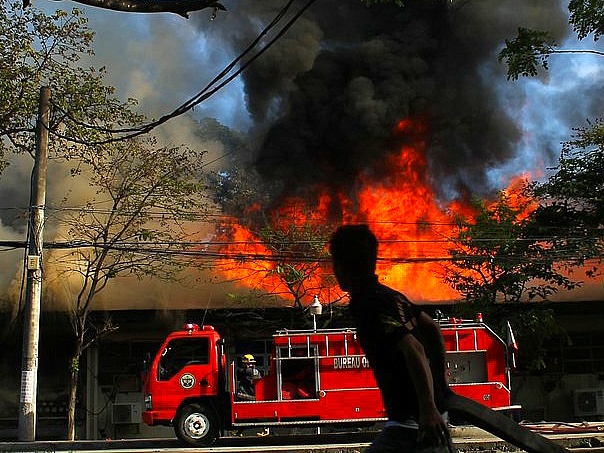
The U.P. Shopping Center burned down this morning when the stalls in the middle portion started to blaze at about 7:15am (time according to the Philippine Collegian) . Most of the stores inside were still closed when the spark broke out. The cause of the fire is still being investigated.
The U.P Shopping Center structure itself has been declared “condemned” by the U.P Office of the Campus Architect in the early 1990s. The UP Diliman administration then tried to rebuild the structure by temporarily re-settling the tenants legally thru court actions but the tenants resisted and used their resources to get a TRO and an injunction from the Court of Appeals.
UP Shopping Center bustled with business housing eateries like the iconic Rodic’s, many photocopying stalls, internet shops, and the well-known UP Maroons store — home of U.P. official T-shirts, the sablay graduation garb, and memorabilia.
The 7th regular media monitor can be posted here. Or, in the alternative, for those who want to earn bonus points, any of the bonus media monitor not yet submitted, can be posted here, including the 5th Bonus on stories on the occult and the supernatural being reported as news or news feature (discussed below).
The 7th regular or 3rd bonus, 4th bonus, can be posted between now and this Saturday morning Oct. 24, 11am (deadline).
In view of Halloween stories and All Saints Day stories, the 5th bonus on occult news stories can be posted between now and November 7. (another media monitor will be opened on Oct. 27.)
For the 7th regular media monitor: hard and soft news, entertainment shows, movies and TV movies, teleseryes (soap operas), drama/action/ sitcom serials, and content streamed online, et cetera, as covered by provisions taken up in class, may be reviewed. The media content must be from the previous three weeks (in other words: current); the 5th bonus includes stories up to Nov. 7.
(just as a heads-up, we will have a bonus media monitor on disaster reporting after the report on this topic; the bonus review includes the reporting of Typhoon Lando, so those who want to avail of this can take note of news reports on this starting now.)
As stated before, the review must state what provision is pertinent. For convenience, embedded below is a summary of the KBP Broadcast Code. Below that is the KBP Broadcast Code provision on occult news reporting:
News should Inform the public rather than merely entertain
– News shall be part of a station’s programming
– News report shall be fair, objective and factual ; opinions are avoided
– Editorials and/commentaries are to be distinct from news
– News must be cautiously chosen
– News must be credible and mere gossip should not be aired or those based on sources that are “anonymous” or unknown
– Unconfirmed news are not to be aired unless there is an urgent need for people to know and must be verified as soon as possible
– News production aids should not mislead the public.
– Archived or file video, photo, and audio materials should be properly labeled
– Morbid, violent, sensational or alarming details not essential to a factual report are prohibited
– Advertisements must be clearly distinguished from the news
– Advertisements in the guise of news are prohibited
Article 2 ANALYSIS AND COMMENTARIES
– The airing of public affairs programs and commentaries is encouraged, particularly to give the public the opportunity to participate in discussions of current issues, concerns and events
– Public affairs programs aired on time contracted to other parties (such as blocktimers) shall name who is responsible for producing the programs every time they are aired
– Opposing or contrasting sides of public issues should be fairly presented
Article 3 COVERAGE INVOLVING CHILDREN
– Child’s dignity and privacy must always be respected
– There should be a conscious effort to avoid sensationalizing, stereotyping, prejudging or exploiting children with disabilities or children belonging to minority or indigenous groups
– Surprise and unplanned (“ambush”) interviews of children are prohibited
– Children should not be required to recall and narrate traumatic experience and shall be protected from further suffering emotional distress or trauma
– Programs and materials involving children must comply with all pertinent laws, rules and regulations
Article 4 PERSONAL ATTACKS
– Personal attacks, that is, attacks on the honesty, integrity, or personal qualities of an identified person, institution or group, on matters that have no bearing on the public interest are prohibited
– When personal attacks against any person, institution or group are aired, that person, institution or group shall be given a fair opportunity to reply
Article 5 CORRECTING MISTAKES
– When a mistake has been broadcast, it must be acknowledged and rectified as soon as possible by stating the mistake and making the correction
Article 6 CRIME AND CRISIS SITUATIONS
-The coverage of crimes in progress or crisis situations, such as hostage-taking or kidnapping, shall consider the safety and security of human lives above the right of the public to information.
If it is necessary in avoiding injury or loss of life, the station should consider delaying its airing
– Anchors, reporters, or other station personnel shall not act as negotiators or interfere in any way in negotiations conducted by the authorities
– Stations are encouraged to adopt standard operating procedures (SOP’s) consistent with this Code to govern the conduct of their news personnel during the coverage of crime and crisis situations
Article 7 INDIVIDUAL RIGHTS
– The right to privacy of individuals shall be respected
Article 8 POLITICAL PROPAGANDA
– Equal opportunity in the access of airtime shall be given to candidates and political parties
– No program or sponsor shall be allowed to manifestly favor or oppose any candidate or political party
– All programs related to the campaign and the elections shall be subject to the relevant
provisions of this Code and all Election Laws
Article 9 PUBLIC COMPLAINTS AND GRIEVANCES
– Complaints, criticisms, or grievances aired against persons, institutions or group, whether public or private, shall be limited to issues which have a bearing on the public interest
– Persons involved in issues are to be given a chance to give an immediate response
Article 10 CALLS OR MESSAGES
– Requests for the airing of personal calls, appeals, personal messages or opinions shall be carefully screened to insure that they are legitimate
Article 11 CHILDREN’S PROGRAMS AND WELFARE
– At least fifteen percent (15%) of a TV station’s daily airtime should be devoted to programs suitable for viewing by children
Article 12 RELIGION
– Religious programs shall emphasize the positive role of religion in society
– Religious programs shall comply with other pertinent provisions of this Code
Article 13 SUPERSTITION AND THE OCCULT
– Programs or program materials that promote or encourage occult practices, black magic, witchcraft, and similar activities are prohibited
Article 14 MEDICAL, LEGAL AND OTHER PROFESSIONAL ADVICE
– Only duly qualified and authorized persons shall be allowed to give medical, legal or other professional advice
– Any information on alternative medicine should be identified as such and any therapeutic claim should be consistent with the regulations and certifications of the Bureau of Food and Drug Administration.xxx et cetera: pls refer to your copy of the code as distributed and discussed in class.
xxxxxxxxxxxxxxxxxxxxx
KBP Broadcast Code: “Art. 13 SUPERSTITION AND THE OCCULT
“Sec.1 Programs featuring superstitious and pseudo-scientific beliefs and practices, such as supernatural powers, foretelling of the future, astrology, phrenology, palm-reading, numerology, mind-reading, hypnotism, faith healing or similar subjects shall be careful not to induce belief in them. Care shall be taken to prevent the exploitation of people who may be easily swayed by such superstitious and pseudo-scientific beliefs and practices.
“Sec.2.Programs or program materials that promote or encourage occult practices, black magic, witchcraft, and similar activities are prohibited.” (KBP Broadcast Code)