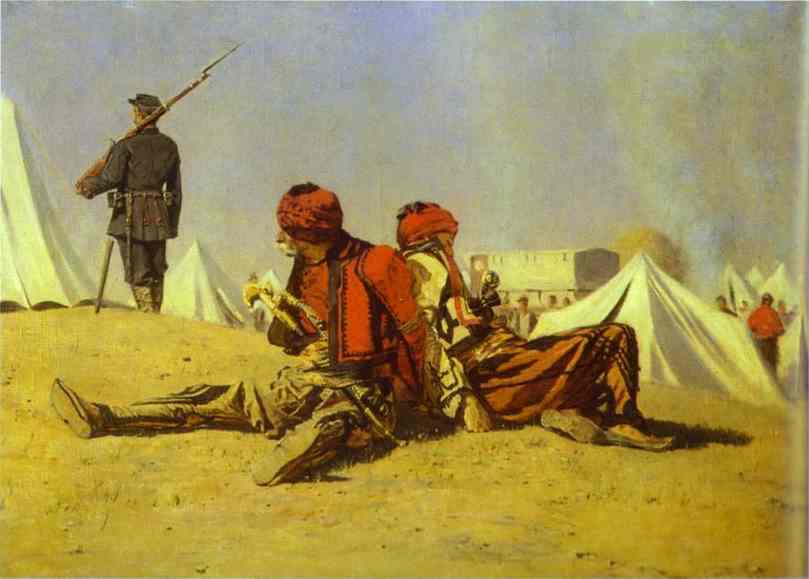
Vasily Vereshchagin. Two Hawks (Bashibazouks). 1878-1879. Oil on canvas. The Museum of Russian Art, Kiev, Ukraine. Right-clicked from www.abcgallery.com
Comment from val:
Razon said in an interview that they were following the sop when they arrested the journalists who were with trillanes in the manila pen at the makati stand off. Is this sop on the books, our laws, codes? Was the action by the police lawful?Nov 30, 9:57 AM —
My comment:
Hi! Thank you for writing. The CIDG who forcibly took the media people into custody said that they were going to be processed, not arrested. But the circumstances of forcing the media people to raise their hands, frisking them, putting tight nylon cuffs and hauling them off to Bicutan, are all acts that evidence an arrest. Under the Rules of Court provision on arrests, which implement the constitutional right against unreasonable searches and seizures:Warrantless arrests can be validly made when a crime has just been committed in the presence of the arresting officer and the officer has personal knowledge that the person to be arrested committed the crime. Here, certain crimes were probably committed and the reporters were in the vicinity. There was also reportedly an intelligence report that the Magdalo soldiers had disguised themselves into mediamen and were going to escape.
Does an intelligence report qualify as personal knowledge? In the leading case of Posadas, Torres-Yu and Lambino vs. Ombudsman and NBI agent Orlando Dizon, the Supreme Court speaking through then Justice Vicente V. Mendoza, held that: No, mere intelligence reports do not qualify as personal knowledge as to meet the requirement that the Rules of Court had set; and the warrantless arrests cannot be validly made on the basis thereof.
Therefore, the warrantless arrests made here of the media persons were not valid, were in fact illegal; illegal arrests being also defined in the cited case.
So, how does one enforce valid warrantless arrests when there is much confusion and the suspects might have mixed with ordinary persons and the reporters and photographers; and that there is a need to ferret them out. Lay down the basis of your probable cause: such as the following: 1) existence of a crime: check: 2) there are suspects in the vicinity: check. 3) approximate height, build, the gender, and physical appearance of the suspects that you are looking for. On the basis of all that, pick out from among the persons in the vicinity those against whom you might have probable cause (see my checklist) and bring them in for questioning (invite for questioning or arrest): but you have to charge them within 12/18/36 hours depending on the crime, or else you have to release them. Those against whom you do not have probable cause: verify their I.D.’s, right there and take down their names and addresses, for future summoning as witnesses.
The problem here is, i’m not even sure CIDG Chief Asher Dolina and his deputy (the bespectacled intel officer running alongside him with a checklist and a ballpen, he was ticking off his list and looking at the hapless arrested media persons for a semblance of being systematic) knew what they were looking for, so they just handcuffed everyone. Not legal.
Arresting officers who rough up, handcuff, and haul off anyone at the crime scene without probable cause, are liable for a host of crimes, which I will write about in the next post.
Thanks!
XXXXX
End notes:
Revised Penal Code. Art. 146. Illegal assemblies. — The penalty of prision correccional in its maximum period to prision mayor in its medium period shall be imposed upon the organizers or leaders of any meeting attended by armed persons for the purpose of committing any of the crimes punishable under this Code, or of any meeting in which the audience is incited to the commission of the crime of treason, rebellion or insurrection, sedition or assault upon a person in authority or his agents. Persons merely present at such meeting shall suffer the penalty of arresto mayor, unless they are armed, in which case the penalty shall be prision correccional.chan robles virtual law library If any person present at the meeting carries an unlicensed firearm, it shall be presumed that the purpose of said meeting, insofar as he is concerned, is to commit acts punishable under this Code, and he shall be considered a leader or organizer of the meeting within the purview of the preceding paragraph. As used in this article, the word “meeting” shall be understood to include a gathering or group, whether in a fixed place or moving. (Reinstated by E.O. No. 187).
Discover more from marichulambino.com
Subscribe to get the latest posts sent to your email.

Thanks for your cogent response. You might be wondering why I ask this. Well, it is because my boss (a congressman) is planning to deliver a privilege speech concerning this latest flagrant assault on journalists on Monday and he tasked me into doing research for his speech. According to ABSCBN Interactive, you are into media law (being a lawyer, of course, implies that you are into law. something like your “expretise” is in media law, i guess. Check the abscbn website for the accurate description of you) so i ask you these questions. (Also, I am interested in media issues too so I sort of encouraged my boss into delivering a priivilege speech about this.)
I heard too in the news that a judge issued an arrest warrant for the media persons at the manila pen. But I take it that police officials attempted to confiscate the videocam of Ms Webb of abs by threatening to arrest her. A while ago, in tv patrol (world), there was a footage of Ms Drilon asking a ploce officer whether they were being held up as witnesses. She was stunned when the reply was that they were being held up by the police as “suspects.” If they were suspects and if a judge issued an arrest warrant, why can’t the police specify to them their supposed crime? You may not be the right person to ask that.
Isn’t it the case, too, that there are certain privileges for journalists that allow them to be in a place of conflict (Assumption: what happened in manila pen is a conflict)? The other side described the situation then as presenting a “clear and present danger” to security. What is the limitation on press involvement in situations of clear and present danger.
You might be busy so you neeed not answer the last questions and I won’t mind it.
Thanks very much.
LikeLike