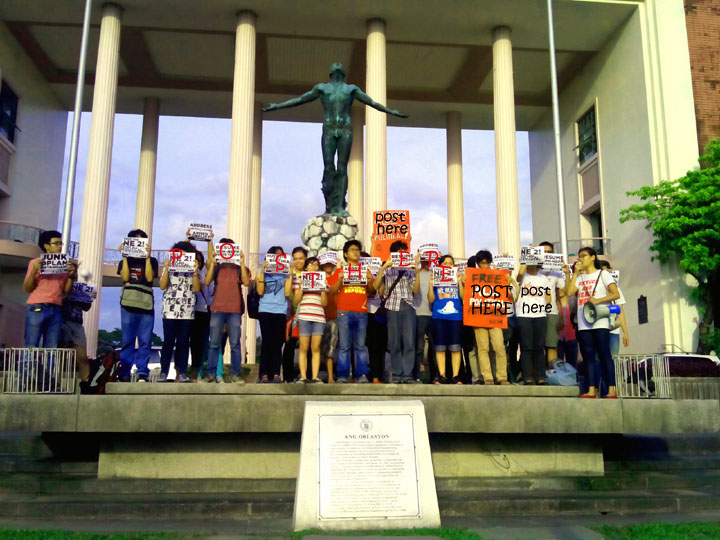
the 7th media monitor can be posted here.
as agreed upon, students who review disaster-reporting will get an additional 5 points, or 10 points for the post (with the 5 points as bonus); the monitor should cover the timeline of: from tropical storm Mario up to the moment. Disasters include: floods, typhoons and storms including strong and prolonged thunderstorms, hurricanes, landslides, mudslides, garbage avalanches, droughts, prolonged heatwaves, earthquakes, fires, volcanic eruptions including tremors from it, ash fall, lava fall, asupre (sulfuric) emissions, etc, including the breakout of diseases in the evacuation centers, sea mishaps, airplane crashes or disappearances,train wrecks, train derailment, vehicular smashups (karambola), “apocalyptic” traffic jams (those that leave commuters stranded, exhasuted, and hungry on the streets the entire day), and doomsday brownouts (those that last more than 24 hours), epidemics, food shortage.
Pls label your post with “On Disaster-reporting” after your name or pseudonym so that the department assistant can find it easily. Thanks.
Discover more from marichulambino.com
Subscribe to get the latest posts sent to your email.

On October 6, 2014, Manila Bulletin posted an article entitled “Typhoon ‘Vonfong’ expected to enter PAR on Wednesday”. It is an example good disaster reporting because of the completeness of the information presented.The writer Ellelyn De Vera was able to include facts necessary for the preparation before the typhoon actualy hits the country. Among what the writer emphasized are the current location of the typhoon as of posting time, the track it follows, and how strong it may be by the time it enters the country. According to the article, PAGASA advised fishing boats and small seacrafts not to venture into the sea while larger sea vessels are
alerted against big waves. Articles such as this are necessary in knowing what safety precautions to take to avoid or lessen damages.
Link to news article: http://www.mb.com.ph/typhoon-vongfong-expected-to-enter-par-on-wednesday/
LikeLike
On Disaster Reporting
2012-15827
On October 6, 2014, Manila Bulletin posted an article entitled “Typhoon ‘Vonfong’ expected to enter PAR on Wednesday”
It is an example good disaster reporting because of the completeness of the information presented.The writer Ellelyn De Vera
was able to include facts necessary for the preparation before the typhoon actualy hits the country. Among what the writer emphasized
are the current location of the typhoon as of posting time, the track it follows, and how strong it may be by the time it enters the country.
According to the article, PAGASA advised fishing boats and small seacrafts not to venture into the sea while larger sea vessels are
alerted against big waves. Articles such as this are necessary in knowing what safety precautions to take.
Link to news article: http://www.mb.com.ph/typhoon-vongfong-expected-to-enter-par-on-wednesday/
LikeLike
http://www.philstar.com/nation/2014/10/07/1377484/engineering-student-missing-big-waves-hit-zambo-village
Above is a link to an article about a missing engineering student who was swept by big waves in the beach of Sitio Caragasan, Barangay Maasin, Zamboanga City this 7th of October 2014. Two houses were also swept by the waves and nine other houses were partially damaged in Sinunuc Village. Five houses in uphill village of Capisan were also partially damaged by the landslide. All these incidents happened in one day. This is an example of good disaster reporting because the facts were given firsthand by the authorities and the way it was reported did not contain any ethical violations. Although there was no public storm warning signal, it was clarified that floodwater happened due to continuous raining since Sunday.
Other necessary facts include the profile of the missing person and the suspension of classes in Zamboanga City to avoid further damage.
LikeLike
ON DISASTER REPORTING
With regards to the media supposedly being the first information provider as well as the one to clarify terms, I believe this article written by Ma. April Mier is a good example: http://newsinfo.inquirer.net/640914/magma-rising-as-mayon-lull-is-over
It may not have detailed exact scientific/encyclopedia-like definitions of what magma or volcanic activity may be, but I believe the article put out the one important thing. It gave an estimated time before eruption, and it made people well aware that evacuation was necessary and in fact already going on.
As a responsible journalist should, Mier consulted Paul Karson Alanis who was a research specialist for Phivolcs. Instead of directly quoting Alanis however and whatever scientific jargon he may have used to explain the impending natural event, the article just briefly stated that magma closer to the crater, means eruption will be coming soon.
The article also made it clear that everyone within 6-8km radius will be in danger, and named the towns that will need to be evacuated because they are in the southeast quadrant, or as the journalist rephrased, “the side of the crater that is open”.
In addition to being an informative article, it also served as a call for help in behalf of the affected region. The last few paragraphs were devoted to asking for donations, with specified figures (“at least 875 classroom tents, 1,025 blackboards, 54,904 armchairs and 792 toilets for the evacuees”), so that people may know that even before the volcano erupts, there are evacuees already in need of assistance.
LikeLike
On disaster reporting:
http://www.rappler.com/nation/69840-mayon-volcano-lull-eruption
Rappler reported on September 22 about the Mayon Volcano’s on and off seismic and volcanic activities in the past days. They reported that the calmness of the volcano does not mean that it won’t erupt anymore. They quoted Ed Laguerta, a senior volcanologist from PHIVOLCS, that: “Sometimes there is a calm before the storm and there is no time to relax. Even if Mayon volcano’s restive condition appeared to be slowing down, this is just a prelude to bigger explosion.” This is one way of making it easier for the readers to understand why the residents living within and near the Permanent Danger Zone are required to evacuate from their homes.
Although, the report was not able to laymanize what pyroclastic flow is, something that the expert from PHIVOLCS explained and whose explanation the Rappler article quoted.
The article also gave emphasis on the evacuation efforts initiated by the provincial government of Albay. This is a good thing because they are helping the government in its information dissemination and evacuation efforts as they anticipate the volcano’s eruption and minimize the casualties among the residents of Albay.
LikeLike
I was scrolling through my facebook feed when I saw an article posted by Rappler with the caption “next time your date says he’s a foodie- beware!”
The headline was “Australian chef ‘cooked’ parts of girlfriend’s body”
Link: http://www.rappler.com/world/regions/asia-pacific/71204-australian-chef-cooked-parts-girlfriend-body-reports
Quite alarming right? But upon reading, turns out police did NOT confirm reports of finding body parts on the stove. The “cooking” body parts was not confirmed at all but Rappler went on and made it their headline. Very misleading, if you ask me. While it was true that body parts were found inside the apartment, it was not confirmed that he “cooked” them. Neither was it confirmed that it was in the stove. While it may be proven to be true in the future, Rappler at the moment could simply just be spreading a false rumor. The readers had a general feeling of being afraid according to their poll. There’s the proof that they created a false sense of alarm with their very misleading headline. To add to this, their “pa-witty” caption on Facebook sounded unprofessional and inappropriate. They are sensationalizing something that isn’t even confirmed.
LikeLike
(sorry for the double post, Ma’am. there were errors in linking to my twitter avatar)
I was scrolling through my facebook feed when I saw an article posted by Rappler with the caption “next time your date says he’s a foodie- beware!”
The headline was “Australian chef ‘cooked’ parts of girlfriend’s body”
Link: http://www.rappler.com/world/regions/asia-pacific/71204-australian-chef-cooked-parts-girlfriend-body-reports
Quite alarming right? But upon reading, turns out police did NOT confirm reports of finding body parts on the stove. The “cooking” body parts was not confirmed at all but Rappler went on and made it their headline. Very misleading, if you ask me. While it was true that body parts were found inside the apartment, it was not confirmed that he “cooked” them. Neither was it confirmed that it was in the stove. While it may be proven to be true in the future, Rappler at the moment could simply just be spreading a false rumor. The readers had a general feeling of being afraid according to their poll. There’s the proof that they created a false sense of alarm with their very misleading headline. To add to this, their “pa-witty” caption on Facebook sounded unprofessional and inappropriate. They are sensationalizing something that isn’t even confirmed.
LikeLike
ON DISASTER-REPORTING
http://giancoante.wordpress.com/2014/10/07/weekly-media-monitor-october-1-7/
Hi Ma’am. Here’s the link to my media monitor on disaster reporting. 🙂
LikeLike
http://newsinfo.inquirer.net/643172/man-shot-by-dog-in-south-cotabato
The article entitled “Man shot by dog in South Cotabato” dated October 7, 14 reports how a dog in South Cotabato “accidentally” fires a gun and kills a man in Sitio El Nofo in South Cotabato. Although the article attempts to get information from the police it faces an ethical issue because the only sources that it uses are the neighbors. The lack of information in the article makes it unworthy of being published or posted. To add to this, the claim of the neighbors that a dog accidentally fires a shotgun, which requires two hands to use properly, is very questionable and yet the writer did not opt to get information from different people.
The writer should have consulted the family of the victim regarding the facts of the death of the victim and made investigations if there are possible motives for murder instead of just settling with the insufficient information he had. By focusing on the claim of the neighbours of the victim, the article becomes guilty of sensationalising his death. The aim of the article should be about giving information.
LikeLike
http://mannequinreverie.tumblr.com/post/99339124048/media-monitor-no-7
Hello Ma’am. Above is the link for my seventh media monitor.
LikeLike
http://darienbas.wordpress.com/2014/10/07/media-monitor-on-disaster-reporting-oct-1-8/
Hi Ma’am! Here is the link to my Media Monitor on Disaster Reporting
Here is the original article:
http://www.rappler.com/nation/69840-mayon-volcano-lull-eruption
LikeLike
Good day Ma’am! Here’s link to my 7th media monitor: http://domguamos.tumblr.com/post/99450598209/oct-1-7
Thank you!
LikeLike
Hi Ma’am. Here’s my 7th media monitor.
ON DISASTER REPORTING
An article posted last September 20, 2014 on gmanetwork.com during the aftermath of Bagyong Mario was entitled, “VP Binay at Sec.Roxas, magkahiwalay na bumisita at namigay ng relief packs sa evacuees.”
From the very beginning, it’s obvious that this article doesn’t focus anymore on distributing relief goods but with what the politicians did to help. Again, POLITICS AND RELIEF ISSUE is evident.
Though it seems like two parties are being talked about in this article, small portion was only about Binay and on the latter part, it’s more on the point of view of Mar Roxas. There was even direct quotation from him.
Media as the first information provider should be responsible enough when it comes to disaster reporting. Politics should be discussed distantly with disaster related issues.
Here’s the link of the said article:
http://www.gmanetwork.com/news/story/380139/ulatfilipino/balitangpinoy/vp-binay-at-sec-roxas-magkahiwalay-na-bumisita-at-namigay-ng-relief-packs-sa-evacuees
LikeLike
Hello Ma’am! I e-mailed this already, but I wasn’t sure if it was received, so I’m posting it here to be sure, because I only just saw this post now.
One of the earliest updates on Typhoon Mario was of Philippine Star’s website posted last September 20 (http://www.philstar.com/headlines/2014/09/20/1371282/update-death-toll-typhoon-mario-climbs). I think this is a good article on disaster reporting because, for one, it was posted soon after the landfall of the said storm, which was September 19 at around noon. It also made sure to state where it got its sources to let people know that the information they got was credible. They even gave very definite numbers regarding the casualties, and even problems that arose with transportation. It avoids any conflict of interest or political or political issues by being completely objective in its report. Overall, it’s a very simple report, but a well-written one nevertheless.
LikeLike