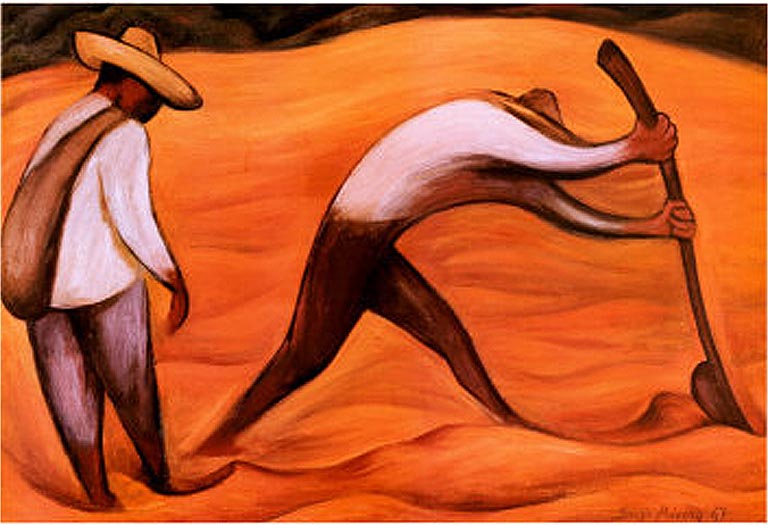
Painting by Diego Rivera. Peasants. Used here for educational, non-commercial purposes, free service by blog-use of image provided by and from www.allposters.com
quote “Lawyers, Jails, and the Law’s Fake Bargains” by Michael Tigar, July-August 2001 issue of Monthly Review at http://www.monthlyreview.org/0701tigar.htm
(FINAL excerpts (third and final installment) of a 15-page article by Michael Tigar; excerpted by this blog)
(Michael Tigar is an American University Washington College of Law Professor (Constitutional Law; Supreme Court; French legal system; criminal law and procedure; human rights); one of the most renowned lawyers in the United States; has argued seven cases before the U.S. Supreme Court and more than 100 appellate cases; written extensively about litigation, aspects of trial practice, criminal law, the death penalty, and the role of the criminal defense lawyer. His books include Fighting Injustice (ABA, 2002); Federal Appeals: Jurisdiction and Practice; and Examining Witnesses; has been active in pro bono cases, the American Bar Association, continuing legal education programs, and international human rights. During the apartheid period, he went to South Africa to train black lawyers. Prior to joining AU, Tigar served as a professor at the University of Texas Law School)
Quote “xxxx People of color are under-represented in the ranks of lawyers, and only in the past twenty years have any significant number of Chicano lawyers entered the profession, when entry is measured in percentage of the Chicano population. Once in the legal profession, people of color tend to be relegated to its lowest rungs and face race-based obstacles to advancement. One ticket to advancement is to abandon the cause of racial justice. Law school programs designed to redress historic inequality are increasingly under attack.
XXXX
Quote “It is a wonder that there is much challenge at all to the system this issue describes, yet there are challenges. xxxx In Law and the Rise of Capitalism, reissued in a new edition in 2000, I discussed the role and importance of these lawyers. They do not stand at the center of events, but they assist those who are at the center or who are brought into conflict with the state. Lawyers help to turn claims for justice into coherent demands and principles. They may show the open spaces within an old system, where change can be successful. When the open spaces close up, they can help define the conditions on which a new order will be created.
Quote “Some question my picture of lawyers’ potential role. Yet in struggle after struggle, fighters for justice have drawn on legal ideology. Nelson Mandela and Oliver Tambo were lawyers, and their continued calls for justice were phrased in terms of the legal ideology that would emerge in a transformed South Africa.
Quote “Honorable public defenders and appointed counsel, of whom there are many, fight the system one battle at a time. We salute them, while remembering Yevgeny Yevtushenko’s words:
How sharply our children will be ashamed
Taking at last their vengeance for these horrors
That in so strange a time
Common integrity could look like courage
Quote “In some law schools, such as Washington College of Law, American University, where I teach, clinical legal education helps to prepare lawyers to meet the challenges that this system poses. Nationally, however, only about 3 percent of law graduates go into public interest law, compared with some 15 percent twenty-five years ago. At WCL, we manage to place about three times the national average in such jobs. But restrictions on funding for defender services, state and federal, have seriously eroded the job opportunities in that sector. Meanwhile, the law graduate who goes into public interest work will earn less than 20 percent of what a graduate who enters private practice can expect. Twenty-five years ago, the disparity was much less—about half. Concerned law students should join up with such progressive organizations as the National Lawyers Guild.
Quote “However, human rights organizations have creatively attacked the system’s unfairness by class action lawsuits that further the demands of many defendants and target entire jail or prosecutorial systems. XXXXX
Quote “The large-scale class action is significant for the same reason that civil rights litigation of the 1940s, 1950s, and 1960s played a constructive role. Given the real world of conservative judges, this kind of litigation faces significant obstacles to courtroom success. Like much class suit litigation, however, the lawsuit can serve as a means to focus public attention on issues. It can and should be part of a broader organizing effort. In this arena as in others, the community’s demands and needs, and not the lawyer’s view of the world, have pride of place.
Quote “SOURCES
Quote “1)Angela Jordan Davis, The American Prosecutor: Independence, Power and the Threat of Tyranny, 86 Iowa L. Rev. 393 (2001) contains many useful citations. 2)The Supreme Court case on lawyer speech is Gentile v. State Bar of Nevada, 501 U.S. 1030 (1991). It must be noted, however, that the Court did reverse the disciplinary action against Mr. Gentile on first amendment grounds, while a separate majority of the Court set a standard for future cases.3)The case limiting the appointed lawyer’s representation to the specific case is Texas v. Cobb, No. 99-1702 (April 2, 2001). 4)The study of death penalty counsel is part of a superb Symposium, Carter Center Symposium on the Death Penalty, 14 Ga. St. U. L. Rev. 329 (1998). 5)Ineffective assistance of counsel cases include Strickland v. Washington, 466 U.S. 668 (1984).6)On waiver of rights, see Michael E. Tigar, Foreword: Waiver of Constitutional Rights: Disquiet in the Citadel, 84 Harv. L. Rev. 1 (1970). 7)The New York Times articles ran April 8-10, 2001, and are on the Times website at
http://www.nytimes.com/2001/04/08/nyregion/08LAWY.html;
http://www.nytimes.com/2001/04/09/nyregion/09LEGA.html;
http://www.nytimes.com/2001/04/10/nyregion/10LAWY.html.
Quote “8)The Mississippi case is Neal v. Puckett, 2001 WL 43274 (5th Cir. 2001).” Closed-quote.
click any social media icon below to share