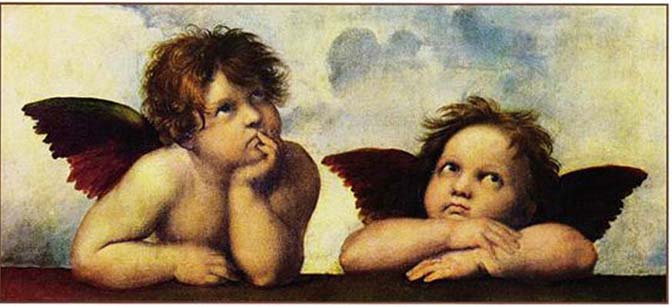
“Cherubini” by Raphael right-clicked from www.ac.cc.md.us
Sandiganbayan Presiding Justice Teresita de Castro said during the congressional budget hearing today that the Sandiganbayan was considering passing rules to regulate the conduct of surveys of high-profile cases because such constitute “prejudicial publicity” (Nadia Trinidad’s report at ANC).Shesaid that they have not come up with specific rules, but they were just studying the matter. She also said that the promulgation would be this September 13.
The exchange in the congressional hearing came in the heels of the recent media blitz of the Erap PR people, which, judging from the dates of the “events” covered in the succeeding news stories, is probably part of a media plan (campaign strat, in advertising lingo). A media plan that they are able to implement because editors allow it.
You might run into free-speech issues if the rules that would be passed are not based on some established guidelines or policies.
Since Justice de Castro used the phrase “prejudicial publicity” i’ll try to use it here the way it’s used in jurisprudence (because she didn’t say “impeding the administration of justice”, which is the contempt provision in the Rules of Court.) Prof. Perfecto Fernandez in his book “Mass Media Law” compiled pertinent jurisprudence on the matter, and referredto them as“four principal types of prejudicial publicity which interfere with the right of the accused to a fair trial”;they’re in four categories: “1) sensationalized reporting; (2)vigilantism by the press; (3) excessive publicity; and (4) prejudicial material.” He said rights of the accused.
But what if the “prejudicial publicity” were favorable to the accused and fostered sympathy for the accused? Would those policies still be applicable? Such that, you can use them for your proposed rules? Since those concepts are based on the right of the accused to a fair trial, would you also apply them if the publicity were favorable to the accused, therefore, not prejudicial to him/ her, therefore, not in interference with the accused’s right to a fair trial?
Does the State enjoy the same kind of rights that the accused enjoy?
The State, as represented by the entire prosecutorial machinery of government, cannot be said to have the same rights as the accused. (of course, you hear of complainants in criminal cases cry: “but what about the rights of victims?”)
“Victims”, or the complainants in criminal cases, well,not them but their interests, and the interests of the entire community, are, when a prima facie case is established, represented by the entire legal armada of the State, which includes investigative agencies, the police, the prosecutors — all those stand behind and in front of you when you are “victimized” and there is prima facie evidence for a criminal case. The accusedon the other hand is just represented by his/her legal team.But there’s this small phrase, this teeny-weeny thing that keeps any accused from being unjustly punished. The small phrase “presumption of innocence”.That saves your life.(that’s how it’s supposed to work anyway). When there is a prima facie case, the entire legal machinery is brought to bear upon an accused, but that small phrase saves the accused.
(When “victims” complain: “but what about the rights of victims”, they feel aggrieved; but maybe because in that instance, the system might have already been despoiled by either neglect from the executive branch or because its members are not professional or because it had been corrupted. It’s not because you need to insert an amendment in the Bill of Rights for rights of “victims”; it’s not because there’s something wrong with the rights of the accused as guaranteed in the Constitution or in the Rules of Court; it’s not because the Constitution is skewed in favor of criminals; but it’s because your investigators, prosecutors, judges, did not do their job… But that’s just my opinion.)
So, does the State enjoy the same kind of rights? Can the Courts come in with rules that say: the accused or his friends or sympathizers,pending trial and decision,cannot sponsor certain surveys, hire PR people, interact with reporters and editors, etc.? Can you do that using categories and policies meant to protect the rights of the accused?
Gee, I don’t know… I’m just checking out the cases on it. (i’m not sure you can legislate media ethics or pass judicial circulars on it; you just do your darndest to remind friends.)
(Atsaka, September 13, Thursday , Triskaidekaphobia. Didn’t the clerk of court notice it; maybe they wanted to set it in the most tailend midweek; tailend and midweek don’t go together; but you know what i mean; the last midweek day.).
click any social media icon below to share
 “The Burning of the Judases” by Diego Rivera. Detail 1923-24. Fresco, West Wall, Court of the Fiestas, Ministry of Education, Mexico City, Mexico. (source: abcgallery.com)
