
“For your eyes only”

vasily.jpg

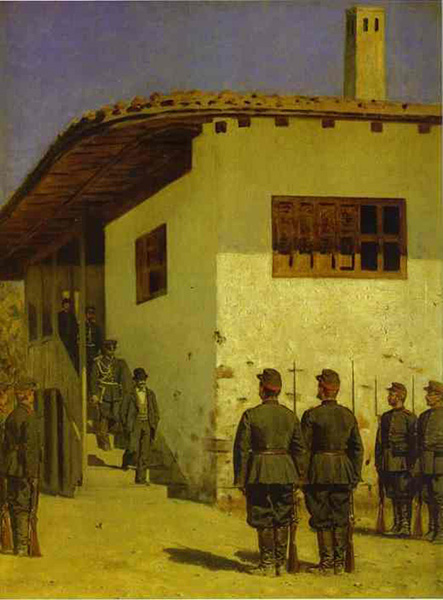
“Spy”, 1878-1879, by Vasily Vereshchagin, oil on canvas, published by The Museum of Russian Art, Kiev, Ukraine, at http://www.abcgallery.com


The Senate resolution on Agent Doble’s testimony on the Garci tapes is now mired in the Rules Committee and until it gets out of there, all discussion is futile. (to be fair, it’s obvious that many of the “presidentiables” are, this early, “positioning” or “pre-positioning” themselves for 2010; “all the world’s a stage”).


The matter was tossed there because administration senators said that the senators would be/ might get criminally liable if they play/ possess/ communicate the contents of the Garci tapes.


The tapes have been marked as exhibits and played in the House hearings. Everybody has a copy of parts of the conversation; the entire nation communicated its contents; it’s kinda unmanageable to cause a prosecution now.


But it’s the Rules Committee. Let’s be hypothetical, academic, theoretical, out-of-touch with reality, and engage those who are “afraid” of incurring criminal liability for communicating the contents of the Garci tapes.


The overt acts punishable in RA 4200 are (I short-handed this, just read the entire law, the words are plain) : 1.to tap any wire or cable; or 2. overhear, intercept, or record such communication by using a tape recorder, etc., 3. to knowingly possess such; 4. to replay the same; 5. to communicate the contents.


I wasn’t able to listen to the privilege speech or listen carefully to any discussions on it (soweee), but as I understand it, the following are sought to be investigated:


1.whether or not the MIG 21 team of Agent Doble conducted such an operation or tapped the phones of Garci and other individuals.

2.if they did, who ordered it? what other phones were tapped?

3.was this an S.O.P.? for how long now?

4.what equipment was used and how was it conducted?

5.whether or not the phone companies or any of their personnel were in on it?

6.whether or not Agent Doble’s family or families were indeed detained by the military to coerce Agent Doble to turn around; and who were involved in the detention.


If you were a fiscal or prosecutor investigating whether or not any illegal wiretapping had been committed by military agents, would you yourself (the fiscal/ prosecutor), if you marked the tapes as exhibits since you were investigating the fact of wiretapping, be criminally liable for possession? As long as you don’t communicate the contents, no.


If the senators are going to investigate the fact of wiretapping and not anymore the contents thereof which have been extensively covered by the House and published completely and discussed nationwide, then they don’t run into the overt acts; now if somebody during the Senate investigation asked, what again did the woman who sounded like Gloria say in the tapes, what did she say again; an objection can be raised. Then ruled upon. There’s a thousand ways of going about this.


And the procedure is a lot simpler than you think.


It’s the fact of who ordered the wiretaps, if it were the Commander-in-Chief who ordered those wiretaps, (or, who approved the S.O.P. but just forgot about it when she made the calls) that would make the issue of criminal liability “complicated”; who would be criminally liable, just the underlings and the listeners and the public but not the mastermind?


Beheading

One of the suspects in the beheading offered to be a state witness

twofurious.jpg

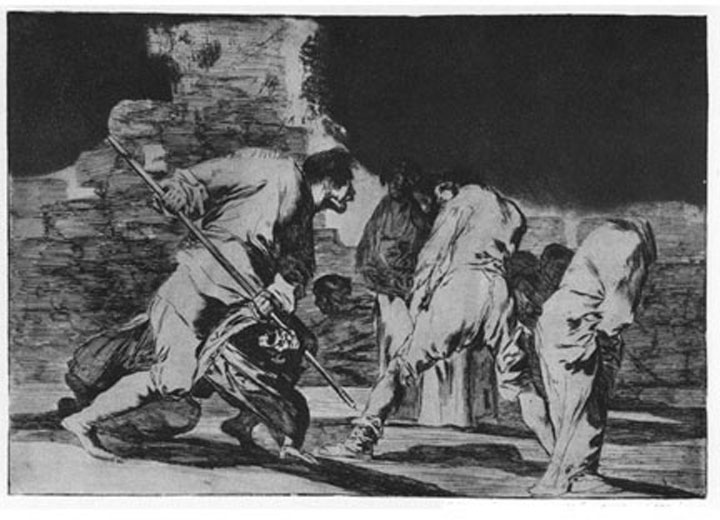
(“Disparate Furioso” (“Furious Folly”) by Francisco de Goya from www.artregister.com)

contending that he did not decapitate anyone, he just fired his gun. The ARMM police chief superintendent said that if the suspect was on the arrest warrant he could not be a state witness.

Can he be a state witness? It depends on the testimony he is offering. Like… is he telling the truth. Duh. How do you know? Since I don’t have mental telepathy, it’s probably useful to find out: 1.who he is. 2. where did he come from? 3.he claimed to have been a military asset. What was his mission? You need to verify; if not true, if he is lying, what would make you think he is not lying now. 4.some assets have been known to go to the other side and reach a point of no return when they participate directly in the crimes; so you need to see his files; 5.and his file on the contract assassination of which he was accused; 6. on the beheading: if the details of his testimony can be independently corroborated, i.e., there are other pieces of evidence other than his word, that buttresses what he says. For example, the hours, the particular area, the weapons used, the cuts, the wounds inflicted; sights and sounds; names, etc. If the testimony is general, forget it. The witness needs to supply details that only a person who was present while the crime was on-going or being planned, could supply. Otherwise, forget it.

In any case, the Rules of Court set forth the following requirements of when an accused may be discharged as state witness: 1.the prosecution absolutely needs the testimony of the accused and does not have any other evidence or even enough evidence to establish guilt beyond all reasonable doubt; 2.the testimony can be verified or corroborated in its material points; 3.he is not the most guilty (note that the rule does not say he/ she should be the least guilty; it just says “not the most guilty”). In other words, he/ she should not be the mastermind (I’d probably prefer too that the state witness was not a principal by inducement or the person who forced or induced his/her co-accused to commit the crime). 3.he/ she has not been convicted of any crime involving moral turpitude; examples are estafa, qualified theft, falsification, etc.

Here’s the verbatim rule on the matter:

“RULE 119. Sec. 17. Discharge of accused to be state witness. – When two or more persons are jointly charged with the commission of any offense, upon motion of the prosecution before resting its case, the court may direct one or more of the accused to be discharged with their consent so that they may be witnesses for the state when, after requiring the prosecution to present evidence and the sworn statement of each proposed state witness at a hearing in support of the discharge, the court is satisfied that:

(a) There is absolute necessity for the testimony of the accused whose discharge is requested;

(b) There is no other direct evidence available for the proper prosecution of the offense committed, except the testimony of said accused;

(c) The testimony of said accused can be substantially corroborated in its material points;

(d) Said accused does not appear to be the most guilty; and

(e) Said accused has not at any time been convicted of any offense involving moral turpitude.

Evidence adduced in support of the discharge shall automatically form part of the trial. If the court denies the motion for discharge of the accused as state witness, his sworn statement shall be inadmissible in evidence.

“ Sec. 18. Discharge of accused operates as acquittal. – The order indicated in the preceding section shall amount to an acquittal of the discharged accused and shall be a bar to future prosecution for the same offense, unless the accused fails or refuses to testify against his co-accused in accordance with his sworn statement constituting the basis for his discharge.”