

Thomas Gainsborough. “Pomeranian Bitch and Pup.” c.1777. Oil on canvas. Tate Gallery, London, UK. Right-clicked from http://www.abcgallery.com
By Student #6 | (unedited by blog administrator) Quote “ On August 12, 2007, an article published on the Philippine Star written by Marvin Sy only resorted to one source– Presidential Management Staff Chief Cerge Remonde.
Quote “ The article (”GMA to Morales: Attain targets or face dismissal”, page 6) was about President Gloria Macapagal Arroyo’s warning to Customs Commissioner Napoleon Morales regarding the agency’s goal to meet the collection target for this year. Everything that was written on the article was based on what Remonde said. Remonde also quoted GMA, “You better achieve your targets or what happened at the Bureau of Internal Revenue (BIR) will happen again”. (Jose Mario Buñag was removed from the BIR because of “huge collection shortfall”). Remonde was also quoted, “If they could not explain, then the President said they have no reason to stay in their posts”.
Quote “ The author of this article should’ve also wrote about what Morales have to say about GMA’s warning so that the readers will have a clear picture of the whole story. Also, if Morales was interviewed for this article then he could’ve stated the steps that the agency is already taking to achieve their goal. Since Sy did not wrote about Morales’ reaction, the readers only got GMA’s side– which is not enough and also unfair.
Quote “Another article published on the frontpage of the same newspaper also resorted to a single source. The headline of the article was “Destroy 5 seized luxury vehicles”. The only source of this article was Remonde and the author of this was also Sy.” Closed-quote.Aug 21, 5:52 AM — [
xxxxxxxx
By Student #15 | Our Practice Involves Accuracy
Quote “The front page of the August 23, 2007 issue of The Philippine Star carries the headline “Palace, Senate Gird for War”, written by Paolo Romero. The story chronicles President Gloria Macapagal-Arroyo’s response to Senator Panfilo Lacson’s revival of the “Hello Garci” issue in Senate. A quote from the President is published with the article: “I embrace work and leave just to the pythons of hate to have a monopoly on the politics of destruction.”
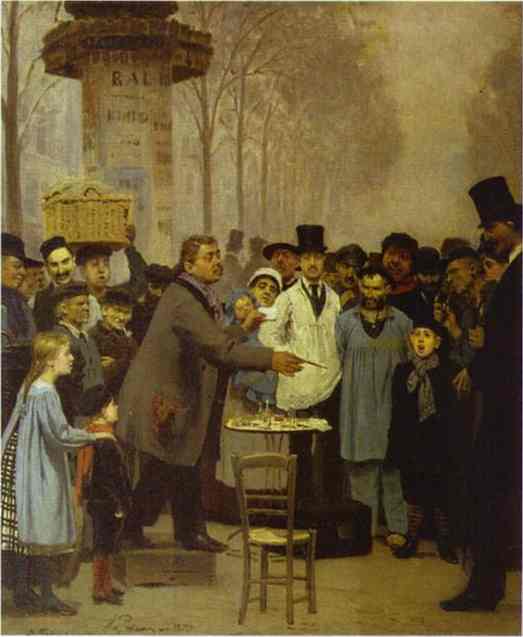
Ilya Repin. “A Newspaper Seller in Paris.” 1873. Oil on canvas. The Tretyakov Gallery, Moscow, Russia. Right-clicked from http://www.abcgallery.com
Quote “The front page of The Philippine Daily Inquirer carries a story entitled “I have a peace to win” by Juliet Labog-Javellana and Gil C. Cabacungan on the same story. The difference, however, is that the quote from the President reads as “Titans of hate”, as opposed to The Philippine Star’s “Pythons of hate”.
Quote “At this point, whoever was right or wrong in quoting the President is immaterial. Needless to say that in the journalism practice, it is of importance to quote sources, interviewees and subjects with utmost care, as comments and quotes inevitably affect the presentation of the story to the reading public. While a story may be well-written (as both stories are, in this case) discrepancies in the actual terms used by the subject being quoted affects not only the story itself but the credibility of the writers and the publication as well. Misquoting subjects also has legal implications and could be used as grounds for legal action.
Quote “In this case, though either newspaper could have committed an honest mistake in quoting the President, given that both are major broadsheets in the Philippines, the responsibility of accurately delivering the news to the reading public is given more attention than other newspapers. A vast majority of the country depend on these newspapers for news and updates. If the readers are given erroneous information, and are singularly depending upon the newspaper for information, the effect is more than obvious: misinformation. Although it was just on word, the impact of the word upon the statement (i.e. “pythons” referring to people has different insinuations compared to “titans”, and vice versa) would carry severe implications on the message the subject is trying to deliver.Aug 26, 2:04 AM —
xxxxxxx
By Emeline Andrade – Comm 191 WWX |
Quote “Last August 22, 2007, while I was watching TV Patrol, I came across Kim Atienza’s report on an earthquake occurrence. In his report, what he indicated as its intensity was actually its magnitude. The measurement in the news was expressed as a Hindu Arabic Numeral. According to a lecture we had during our visit to PHIVOLCS last month, magnitude uses Hindu Arabic Numeral to indicate its value whereas intensity employs Roman Numeral. To my dismay, the wrong term was used in the entire report together with the misspelled text “intesity” flashed on the screen.
Quote “The mistake may seem minor at first. However, the two terms, magnitude and intensity are different. Our lecturer said that magnitude measures the amount of seismic energy released during an earthquake while intensity indicates its effects or the probable damage in a given area.
Quote “This violates the provision of KBP with regard to factual and accurate news reporting. The KBP code also says that “the supervision/evaluation of content, format and presentation of news broadcasts” is the responsibility of the editors and deskmen. Newscasts are supposed to inform the audience with accurate data and give appropriate warnings during disasters. Erroneous reports may cause confusion and even panic among the people.Aug 27, 3:45 PM —
XXXXXX
By student #12, J192 | (Unedited by blog administrator)
Quote “Record companies and radio stations can be too money-oriented these days! When I switched on the radio last Saturday, August 25, I first heard the song “How Do You Fall In Love” by Jose Mari Chan. I was very surprised, however, to hear the DJ announce the title of the album (Love Letters and Other Souvenirs) and its label/brand (Universal Records) from which the song was taken! The KBP Radio Code doesn not allow that!
Quote “ The station that made this serious error turned out to be Yes FM 101.1 and it violated a provision from the KBP Radio Code which says that “the mention of the label or brand of the record played or the title of the LP album from which the selection is taken shall not be allowed.” It committed a blatant act of album promotion-in short, a shameless plug. Isn’t it enough to let the song speak for itself and let the public look for the album if the song is any good? Why should record companies and radio stations ignore ethical principles in order increase album sales, anyway?
xxxxxx
By Student # 21 A. Antonio |
A. Antonio student #21 (unedited by blog administrator)

Giorgio de Chirico.”The Disquieting Muses.” 1918. Oil on canvas. Private collection. Right-clicked from www.abcgallery.com
Quote “ Last Tuesday night (August 28) at 10:55pm, while I was switching radio stations, I came across a live concert telecast in a local barangay. This concert was sponsored by 97.1 Barangay LS FM. What caught my attention was when a local band by the name of Silent Sanctuary sang the song “Rebound” and added a curse word in the chorus of the song. It goes, “Tangna, rebound mo lang pla ako…” It was really absurd to hear a band play and curse on air no matter how ‘heartfelt’ the song was.
Quote “The act that was done by Silent Sanctuary was a violation of the radio code which does not allow any form of vulgarly and displeasing taste in words. Even if it wasn’t LS FM’s direct offense, it is their responsibility and accountability as a carrying media outfit to remind the bands to be careful of their language. To add to the injury, the vocalist of the band was trying to hype up the crowd by making ‘toilet’ jokes that goes, “First time nyo ba magkaron ng concert? Mga virgin pa pala kayo! First time nyo kaya na virginize nyo kami.” Quote “After a few minutes they made an apology statement, “Hindi nga pala pwede magsalita ng bastos, pasensya na sa mga nakikinig sa LS, hindi namin alam.” Despite making an on air apology, I believe a disciplinary action should be taken by the KBP to penalize the violation made. What has happened is not to be emulated and must be reprimanded immediately. As the saying goes, “Ignorance of the law excuses no one.”Aug 30, 4:07 AM — [

