
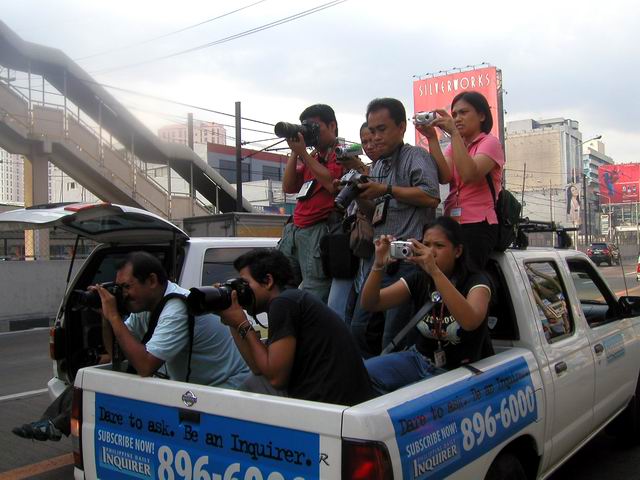
Media Law Exam

photogs.jpg

Photo from Philippine Journalism Review, Lito Ocampo.

Media Law Exam. Marichu C. Lambino. 8 October 2007. This is a closed-book closed notes exam. Answer all questions fully.

1.At the Senate hearing on the ZTE contract last week, former NEDA director-general Romy Neri testified that while he and Comelec Chair Ben Abalos were on a golf cart at Wack-wack sometime in January 2007, Abalos was telling him of the advantages of the ZTE contract and reportedly told him “Sec, may 200 ka dito.” (“Sec, you have 200 with this.”) When the senators queried what that meant, Neri said that it meant that Abalos was telling him, Sec, may 200 million ka dito (Sec, you have 200 million with this”). After Abalos resigned a week later, he threatened to sue Neri and the media outfits that published/ aired his statement. Questions: a)Is Neri likely to be liable for libel? If your answer is yes, state the elements of libel and explain each element and why he is liable. If your answer is no, explain fully.(5 pts.) b) What about the media outlets, are they likely liable? If your answer is yes, explain what malice in law means. If your answers is no, state all categories and , explain, and define fully the defenses in liable. (10 pts.)

2.In the recent episode of the CNN satire “news program” “The Daily Show” with Jon Stewart as host (a false news anchor, he is actually a stand-up comic playing a news anchor), one segment was entitled “Is America Ready for a Woman President?” with a photo of Hilary Clinton. Then stills of the following were scrolled on a laptop that was zoomed in: Indira Gandhi with superimposed “paint-sprayed” caption, ‘Oy”; Margaret Thatcher superimposed on another’s body doing a Britney-Spears-no-underwear-miniskirt- stepping off the car; and Cory Aquino with superimposed “paint-sprayed” caption “SLUT”. Questions: a)Using the American cases taken up in class, is the “Daily Show” liable for libel? If your answer is yes, explain what “libelous per se” means and cite the case; if your answer is no, explain the nature of the speech and cite/ describe the American case in point and explain what the Supreme Court said in that case. (10 pts) c) What about the fact that the statement in question here is obviously false, shocking, and in the opinion of Senator Noynoy Aquino, “in bad taste”? Explain the relevance/ lack of relevance of those observations as described in the pertinent cases. (10 pts)

3.A column by Mr. xyz came out in a national daily that stated that a package arrived at the office of a Supreme Court justice and that her secretary, who was named in the column, opened the package and that it reportedly contained 10 million pesos; according to the columnist, said secretary was fired for opening the package. News stories came out in almost all leading media outlets naming said justice as Justice Ynares-Santiago. The Supreme Court in a statement said that at the instance of Justice Ynares-Santiago, the matter would be investigated. Also, the Supreme Court issued an order to the columnist asking him to show cause why he should not be cited for contempt. Questions: a) Do you agree or disagree with the show-cause order of the Supreme Court? Why or why not? 5 pts. b) Do you think this test question itself is contemptuous, considering that there is a pending show-cause order for contempt? Why or why not? What about if these test questions were published in the internet, do you think they would be contemptuous? Why or why not? 5 pts. c)What is sub judice? Explain fully. Apply it to the two previous questions. 5 pts. d) Do you think the columnist is liable for contempt? If your answer is yes, state what kind and define and explain fully; if your answer is no, enumerate the overt acts of contempt and explain why each do not apply. (10 pts.)

4. A budding independent film maker, Dolly Leuterio, produced and directed a short film on the torture methods used during martial law and being used up to today based on testimonies. She asked her classmates to act in her film gratis. In all the torture scenes, the subjects were naked, full body shot, some scenes under bright lights and some dimly lit. The MTRCB X-rated the film on the ground of obscenity. Questions: a) What is obscenity? Use the Miller test in your definition. 10 pts. . b) Is nudity synonymous with obscenity? Why or why not? c) in your opinion, is the material in question, as described, obscene? Why or why not? 10 pts.

5. What is inciting to rebellion? Enumerate the overt acts. 5pts.

6.Enumerate all the limits to freedom of expression taken up in class. (9 pts.)

7.Enumerate and define/ describe all the limits (at least six) to news-gathering methods taken up in class. (12 points)

Our Kids: Children in the News

Notes posted by Camille Mendigorin -unedited by blog administrator 4th blog entry

bruegel131.jpg

By Pieter Bruegel the Elder. “Children’s Games”. 1560. Oil on panel. Kunsthistorisches Museum, Vienna, Austria. From abcgallery.com

Quote” I would like to commend the program Kapuso Mo, Jessica Soho for its episode on Saturday, August 18. This particular episode showcased a story entitled “Batang Sugarol” featuring children who, in (sic) such a young age, are (sic) already involved in gambling.

Quote “The episode interviewed a 12-year child who regularly bets (sic) in cockfights. He was greatly influenced by his father who even approves (sic) of his son’s habit as he is (sic) also a cockfight enthusiast. The child’s father was interviewed by the show but his face was never shown for if he will (sic) be recognizable, his child might be recognized by others as well. The program also featured other children involved in gambling such as a 10-year old boy who works (sic) as a bet collector in their community to support his studies, a teenager who collects (sic) bets for big-time gambling in campuses, and another minor who is (sic) now in juvenile detention as he once became addicted to gambling which pushed him to commit crimes such as robbery.

Quote “The faces of children featured and interviewed in the program were not entirely shown so as to protect their rights and reputation. Camera shots only showed the lower part of the interviewees’ faces and in no way are (sic) they recognizable. Moreover, the real names of the children were not revealed and they were only given nicknames.

Quote “The show also interviewed an expert, a child psychologist, to explain why children are attracted to gambling. The psychologist emphasized that parents have (sic) a great impact on children as a child may imitate a parent who is into gambling. He cited the case of the 12-year old child and his father interviewed in the earlier part of the episode. The psychologist also pointed out that children need (sic) constant guidance from parents so that they may not be attracted to unpleasant and improper habits and that parents should serve as good examples for their children.

Quote “Kapuso Mo, Jessica Soho abided with KBP’s general program standard that says, “Gambling shall never be presented as a good habit, nor shall the public be encouraged to engage in it.” The show made a clear message that gambling is (sic) a socially undesirable and unacceptable habit, not just for any person of proper age but especially for children or minors. The feature story ended with Jessica Soho saying “Ang hindi alam ng mga batang ito, nang dahil sa sugal, inilalagay nila sa alanganin maging ang kanilang sariling kinabukasan.” “ closed-quote.

Aug 24, 1:27 PM —

XXXXXXXXX

Notes posted by Student # 21 A. Antonio

secondbrueghel.jpg

By Pieter Bruegel the Elder. “Children’s Games”. Detail. 1560. Oil on panel. Kunsthistorisches Museum, Vienna, Austria. From abcgallery.com

A. Antonio student #21 (unedited by blog administrator)

Quote “While I was watching TV Patrol last night (August 22), I came across a news story about the danger of this particular kind of closed rubber slippers to children who ride (sic) the escalator. There was this recent incident where the child’s parents complained because of their son’s foot getting stuck at the edge of the escalator and having his toe almost broken. I personally never thought this accident was possible until they showed a live visual reenactment of the scene where the slippers was literally ‘swallowed’ and torn at the end of the ramp.

Quote “I would like to commend their presentation of this news item because of many favorable reasons. First, they did not hesitate to mention the brand name of the rubber slippers –CROCS, despite its popularity and international recognition. Second, it was just correct that they blurred the face of the child to protect his identity. Third, the story was impartial by making both parties talk and stand by their claim. The victim’s parents related their piece, however the CROCS’ local distributor refused to give a statement. Fourth, they made a research and showed previous incidents from other countries where this same kind of accident took place. Pictures of the kids toe and foot after the accident was (sic) also shown to prove that this is (sic) not just an isolated bizarre occurrence in our country. Moreover, they flashed on the screen a written response of CROCS to these past complains (sic) claiming that their slippers are (sic) ‘safe’ and that the escalators may be the cause of the problem. Fifth, they got a statement from the distributor of escalators regarding the problem and presented it as well. Lastly, they gave tips and precautionary steps to parents on how they would be able to prevent these kinds of accidents in the future.

Quote “I would say this is one good media practice which all news reports must follow and practice.” Closed-quote.

Aug 23, 4:21 AM

XXXXXXXXXXX

Notes posted student #12

thirdbruegel.jpg

By Pieter Bruegel the Elder. “Children’s Games”. Detail. 1560. Oil on panel. Kunsthistorisches Museum, Vienna, Austria. From abcgallery.com

Quote “Yesterday, August 20, 2007, “TV Patrol World” reported about fifteen alleged rugby sniffers/addicts caught in Rosario, Cavite. Nine of the alleged rugby sniffers were minors and two of these minors were interviewed on air. Fortunately for these youngsters, their faces (or rather, their eyes) were blurred/pixelized and their names were not revealed in the report.

Quote “This news report was an example of an ethical media practice. It followed the provision of the Philippine Journalist’s Code of Ethics, which states that a reporter (whether from print or broadcast) must be careful in revealing the names of minors involved in criminal cases so that “they may not unjustly lose their standing in society.” This provision is to be followed by all journalists to protect the privacy as well as the future of the minors (whether guilty or not)involved in wrongdoing.” Closed-quote.

from student no.12, J192
August 21, 2007, Tuesday