Shot a minute ago, from the northwest window, at the moment…
upon waking up, i do three very slow plough poses (warning: do not execute without having taken formal lessons from a certified ashtanga yoga teacher) on one’s back, go to forward bend, then invert slowly go to a soft shoulderstand to ease feet over the head for plough pose) staying long & breathing long in each– minutes long because i’m half-asleep when i do those, they’re for decompressing my lower back. As you might know by now, i have an over-arched back which creates a bubble of space in the lower back when lying on one’s back; i acquired it in high school, long story. The pose you see in the header of this site— that’s slowly getting out of the plough pose.
As a background: i learned to devise a daily mini, small regimen for personal needs after taking formal lessons. Try to get to know what your body needs.
“Decompressing” for me is the procedure to slowly pull out the knife stuck at my lower back, metaphorically speaking, that is; that is to say, upon waking up, it feels like there’s a tiny open wound there but your mind knows it’s just nerve endings pinched by discs that need to be decompressed. Then, as a concession to cardio & core, or to raise my heart rate a little, i do combined crunch-dead-bugs, 30-30-40, one set alternating with the plough pose. Then, i’m off to breakfast. But if i’m being a good girl, I’ll do 27 poses. Like… maybe now. Good morning.
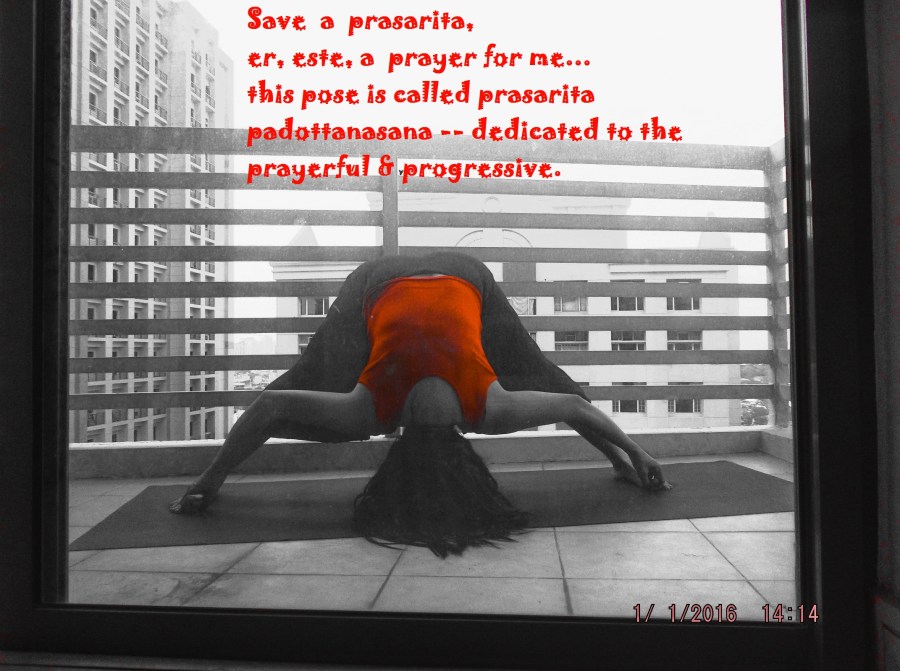
This pose is called prasarita padottanasana, or, according to yogajournal.com :
“prasarita = stretched out, expanded, spread, with outstretched limbs
“pada = foot
“ut = intense
“tan = to stretch or extend (compare the Latin verb tendere, “to stretch or extend”)” and asana means pose.
It is also called the “wide-legged forward bend”.
(warning: do not execute without having taken lessons from a certified ashtanga yoga teacher).
Prasarita and the warrior poses, in my opinion/ experience, are the most structurally stable of the standing poses — it as stable as standing on your two feet on any ordinary day, if not more stable, because your feet are at wide-angled stance: stable, safe; there is no danger of toppling or tipping over while your feet are firmly planted on firm ground… (unless you abruptly get up from the pose and the sudden rush of blood makes you dizzy– don’t execute without learning movements in ashtanga classes.)
(Now playing: “Save a Prayer” originally by Duran Duran; this is an acapella version, artists not indicated by uploader of the audio clip, pls click the audio clip embedded below if this is no longer on autoplay)
This pose is dedicated to the prayerful † and progressive ∇ : Pray for a better future but don’t forget to prepare and preposition for that future ♥ 🙂