monitoring the war: Government should map out a timetable for the military operations for purposes of organizing relief for the civilians

        The 130,000 persons or 18,000 families who were forced to leave their homes and run from the bombings and shooting in Midsayap, North Cotabato,  and now cramped in schoolhouses without enough food and clean drinking water, are what are referred to by international humanitarian law as : internally displaced persons (more commonly called refugees).


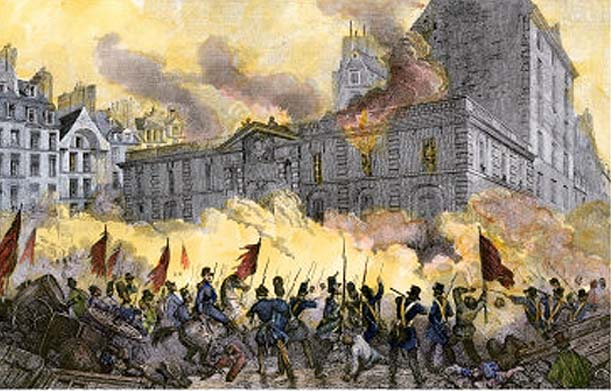
Artist  unnamed. Rioters Attack the Royal Palace during the French Revolution. Right-clicked from www.allposters.com, used here for  educational, non-commercial purposes, free service by blog-use of image provided by and from said site.
Artist unnamed. Rioters Attack the Royal Palace during the French Revolution. Right-clicked from http://www.allposters.com, used here for educational, non-commercial purposes, free service by blog-use of image provided by and from said site.


          We will not, for now, go into the military aspect of it all, who started what, which  units violated which  :  too many players have been allowed to run around North Cotabato  since June-July while the GRP and MILF were preparing for the signing ceremonies : armed CAFGU’s and other armed CVO’s; MILF base commands which this August  apparently failed to leave upon orders of the MILF Central Command either because they were surrounded by armed CAFGU’s (MILF version) or because they refused and are now a lost command (government version), parties feuding over the land which started the skirmishes, armed barangay captains and councilmen, and on the national level, the AFP and the MILF. The Joint Ceasefire Committee should come up with an investigation report before the peace negotiations could be taken further.


        Unfortunately too, the government has no timetable or estimated timetable as to the continued overrunning of the barangays. While it is conceded that in certain cases, such a timetable cannot be disclosed, it is hoped that for purposes of preparing relief for the internally displaced persons, and  for purposes of preparing the refugees themselves (so the displaced families can more or less organize their lives : which relatives and government agencies they can get relief from, how will their children go to school, where will they put their farm animals and belongings, etc.), it is hoped that the AFP unit has a plan along the lines of a timeframe.  

     The following are the pertinent provisions  of international humanitarian law on internally displaced persons:

 quote “Guiding principles on internal displacement, United Nations  document, 11 February 1998

http://cicr.org/web/eng/siteeng0.nsf/htmlall/section_ihl_refugees_and_idps

XXXXXXX

      quote “Principle 18. (1). All internally displaced persons have the right to an adequate standard of living. (2) At the minimum, regardless of the circumstances, and without discrimination, competent authorities shall provide internally displaced persons with and ensure safe access to:

     quote “(a) Essential food and potable water;

     quote “(b) Basic shelter and housing;

     quote “(c) Appropriate clothing; and

     quote “(d) Essential medical services and sanitation.” closed-quote.

             (Clean drinking water and food supply. After the President and her court  junketed at the Beijing Olympics when armed hostilities were about to break out in North Cotabato, maybe the least they could do is to mobilize resources  so that 130,000 displaced persons  would not starve.)

    XXXXX

      quote “(3) Special efforts should be made to ensure the full participation of women in the planning and distribution of these basic supplies.

       quote “Principle 19. (1) All wounded and sick internally displaced persons as well as those with disabilities shall receive to the fullest extent practicable and with the least possible delay, the medical care and attention they require, without distinction on any grounds other than medical ones. When necessary, internally displaced persons shall have access to psychological and social services.

       quote “(2) Special attention should be paid to the health needs of women, including access to female health care providers and services, such as reproductive health care, as well as appropriate counselling for victims of sexual and other abuses.

        quote “(3) Special attention should also be given to the prevention of contagious and infectious diseases, including AIDS, among internally displaced persons.

       (Hundreds families of lie next to each other without enough sanitation facilities. In order to prevent the spread of diseases, government should provide adequate temporary living quarters with enough sanitation facilities and not simply leave the refugees to their own device.)

XXXXXXXXX

        quote “Principle 21. (1) No one shall be arbitrarily deprived of property and possessions. (2) The property and possessions of internally displaced persons shall in all circumstances be protected,

in particular, against the following acts:

        quote “(a) Pillage;

        quote “(b) Direct or indiscriminate attacks or other acts of violence;

         quote “(c) Being used to shield military operations or objectives;

       quote “(d) Being made the object of reprisal; and

          quote “(e) Being destroyed or appropriated as a form of collective punishment.

           quote “3. Property and possessions left behind by internally displaced persons should be protected against destruction and arbitrary and illegal appropriation, occupation or use.

XXXXXXXXXX

         quote “Principle 25. (1) The primary duty and responsibility for providing humanitarian assistance to internally displaced persons lies with national authorities.

         quote “(2) International humanitarian organizations and other appropriate actors have the right to offer their services in support of the internally displaced. Such an offer shall not be regarded as an unfriendly act or an interference in a State’s internal affairs and shall be considered in good faith. Consent thereto shall not be arbitrarily withheld, particularly when authorities concerned are unable or unwilling to provide the required humanitarian assistance.

        quote “(3) All authorities concerned shall grant and facilitate the free passage of humanitarian assistance and grant persons engaged in the provision of such assistance rapid and unimpeded access to the internally displaced.

          quote “Principle 26. Persons engaged in humanitarian assistance, their transport and supplies shall be respected and protected. They shall not be the object of attack or other acts of violence.

XXXXXXXXX

         quote “Principle 28. (1) Competent authorities have the primary duty and responsibility to establish conditions, as well as provide the means, which allow internally displaced persons to return voluntarily, in safety and with dignity, to their homes or places of habitual residence, or to resettle voluntarily in another part of the country. Such authorities shall endeavour to facilitate the reintegration of returned or resettled internally displaced persons.

         quote “(2) Special efforts should be made to ensure the full participation of internally displaced persons in the planning and management of their return or resettlement and reintegration.

XXXXXX” closed-quote. Underscoring supplied.
 

The Impending Judicial Review of the GRP-MILF MOA on Ancestral Domain: Requirements

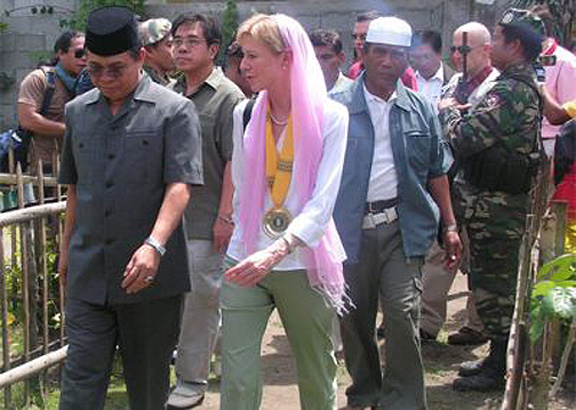
  The phenomenal oral arguments on August 15. For the first time, the photo by www.luwaran.com used here for non-commercial purposesSupreme Court of the Philippines would be asked to pass upon or exercise what the Court  


calls “judicial review” over a peace  (photo by www.luwaran.com used here for non-commercial purposes)

 agreement  (or a draft peace agreement,  or a draft agreement preparatory to a peace agreement depending on your point of view).  

        That is: for the first time, the Supreme Court of the Philippines would be asked to exercise judicial review of an agreement (or draft agreement) between the executive branch on one hand and an armed “liberation” group, on the other hand.

       The petitioner initially asked for just access to the document. Now that apparently the document has been made public (or that they have been given copies), that specific prayer has become moot and academic. Petitioner’s lawyer has made known that they are planning to amend their petition; that is, they will  ask that the Supreme Court declare the agreement (or draft agreement) unconstitutional.

      Many other politicians, because the campaign for the 2010 elections had started this week and the previous months, have come out on television to denounce the agreement and have threatened to file similar petitions in the Supreme Court to declare the agreement or draft unconstitutional.

      (Don’t you just love elections? It’s good business again: for PR people masquerading as news anchors,  for Gloria, for senator-wannabes, for presidentiable-wannabes, all at the expense of the peace negotiations , the Bangsa Moro struggle, and maybe all other liberation movements who have on-and-off peace negotiations, henceforth, your peace negotiations, joint declarations, memorandum, agreements have to passed upon by the Supreme Court, do you like that? Sorry; naiinis ako nang sinusulat ko ito.) I will humour  you. This blog post will give the requirements for judicial review (i hate doing this, because you’re talking about armed conflicts and you’re bringing those negotiations on the table of the Supreme Court, it’s ridiculous, but let’s humour you. Requirements.)

         Oral arguments before the Supreme Court en banc on August 15.

         Requirements. Hurdles. The hoops.

         (Assuming the parties have amended and by that time others have  filed Motions to Intervene or similar petitions to question the constitutionality of the  agreement or draft):

      Ripeness. Or ripeness for judicial review or ripeness for adjudication.

     The Court has time and again laid down the rule that it will refrain from exercising judicial review :

      1)“because of the danger of exercising the function in view of the possible consequences”;

      2)“comparative finality of those consequences”,

       3)“ consideration given to the judgment of the other repositories of constitutional power” (or the other branches of government); “necessity to keep within its power”;

      4)“inherent limitations of the judicial process, its largely negative character, and  its limited resources for enforcement” etc.  

      Ripeness. Petitioner has to demonstrate that the matter is ripe for adjudication. Has the agreement been signed?… Petitioner will say, no, your Honor but it has been initialled…. Do those initials mean that it has been signed? ….Your Honor, according to the MILF, the agreement is a done deal, it’s in their website….. Where is the MILF, are you going to present them? ….No, your Honor, we will just rely on their website and ask the Court to take judicial notice of their pronouncement….. Are we bound by their pronouncement as to the status of this agreement, aren’t they an armed group operating outside of our laws? ……We are not bound,  your Honor….. So what  is the status of this agreement? ….. It’s an initialled agreement.

      Let’s ask the solgen. What is the status of this agreement? …. It’s a draft, your Honor.

        Where’s the final agreement?

         None, your Honor.

         Petitioner, where’s the final agreement?

      Okay. Both of you. You come back here with a final agreement. Then we’ll see.

      But your Honor, it’s unconstitutional!! Very unconstitutional!!! Unconstitutional to the high heavens!!!

        What is?

        The agreement that was initialled and being negotiated.

        Then….. are you asking us to pass upon the constitutionality of the peace negotiations  itself?


        (i will stop here na ha. And we haven’t even traversed the nature of the Commander-in-Chief powers; calling out the armed forces to quell rebellion includes negotiations for the disposition of those armed forces and negotiations with rebel groups. You are asking the Supreme Court to strike those down. Let’s just shout during the oral arguments, your Honor, she’s a fake president anyway! Why are we talking about Commander-in-Chief powers? Let’s chant.  I will stop here na.  we haven’t even gone into the “status in law” of any peace agreement between the government and a “national liberation movement”: “Characterize the problem”, as Dean Merlin Magallona would say, “What is the characterization of the problem?”)