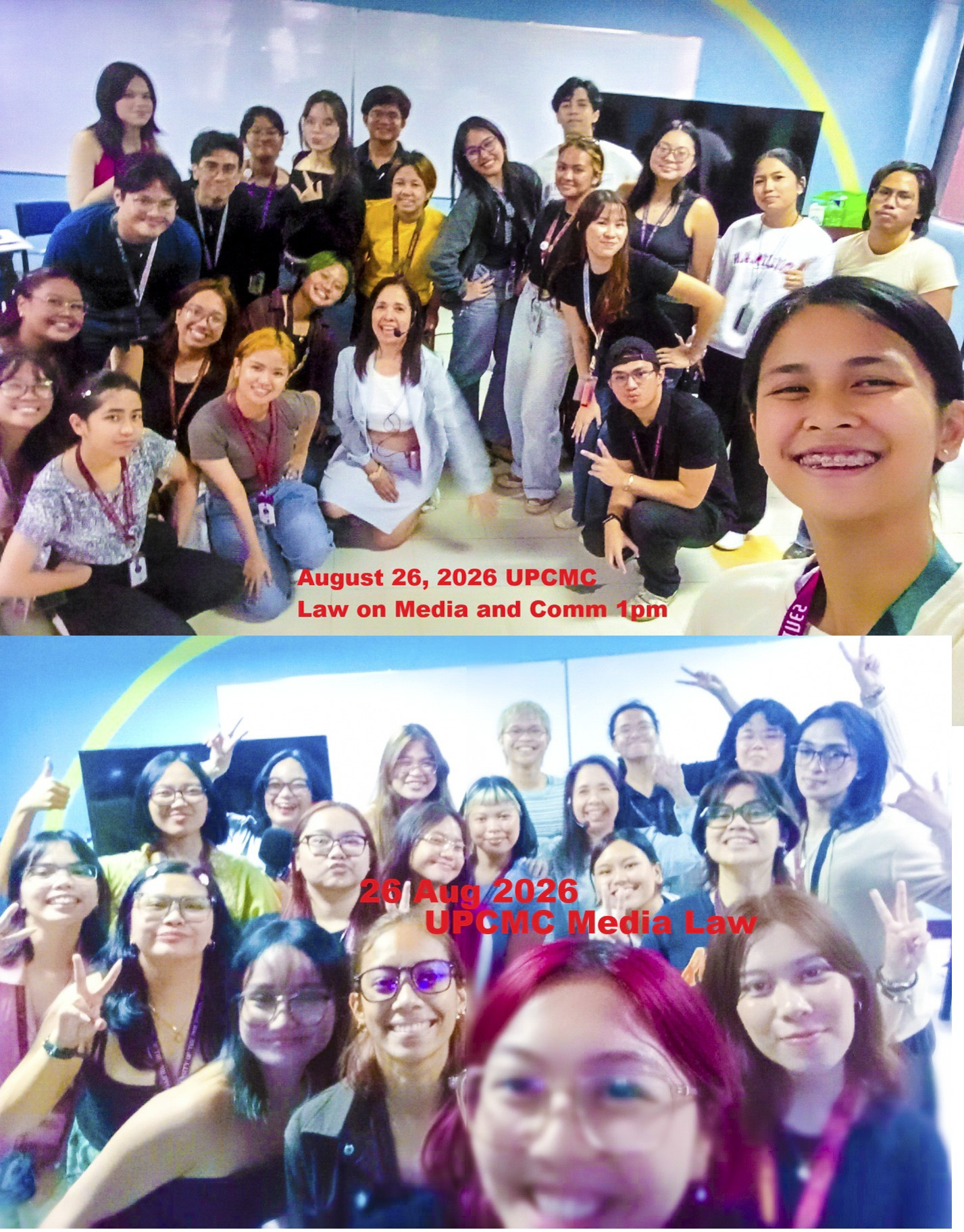
my students’ ordeal last week

resizedsealion.jpg              resizedsealion2.jpg

Law on Mass Media and Communication. First test, rights-and-privileges part of the syllabus. Answer the following questions fully. You are not allowed to leave the room until you’re done. You are not allowed to consult any materials, to talk to each other, or to use any electronic device. 50 pts with 10 pts bonus. 29 Jan. 2008, afternoon class. Marichu C. Lambino. 


     1.During the Nov. 29 Manila Pen assembly of the Magdalo soldiers, General Lim in a prepared statement quoted the Constitution: “The Philippines is a democratic and republican state. Sovereignty resides in the people and all government authority emanates from them…” And he proceeded to justify the hotel takeover. Questions: What is the Constitution? What theory is the quoted provision based on? Define and explain. In your study of history, does the theory justify the 1986 EDSA uprising? What about the 2001 EDSA uprising? What about the Nov. 29 Manila Pen takeover? Why or why not? (10 pts) 


     2.Make a diagrammatic presentation of the structure of the judiciary. (10 pts)


      3.Upon complaint of many faculty members, the U.P. administration blocked the sites “Friendster” and “Multiply” in the school computer units inside U.P. academic and administrative buildings because the massive use by students of the sites was clogging up the server and delaying internet downloading in the entire University, thus delaying and  hampering research for days on. Student Britney Sibat filed a complaint or petition in the Supreme Court stating that the act of the U.P. admin was a “violation of the human rights” of students to: “a free marketplace of ideas.” Questions: In what case and in whose opinion was the “free marketplace of ideas” used? What was that case all about? Does the principle apply to Britney’s complaint? Why or why not? In your opinion, will Britney’s case prosper? Explain fully. (10 pts.) 


     4.At the height of the Senate investigation of the ZTE broadband deal, then Comelec chair Ben Abalos resigned. In a press conference where he announced his resignation, he was near tears and his family members were crying. Friends say he had been hurt by all the allegations of corruption against him. Can Ben Abalos find comfort in what Justice Malcolm said in U.S. vs. Bustos? What is that case all about and what did Justice Malcolm say? (5 pts.) 


     5.A number of organizations, including the NUJP, the CMFR, PCIJ, and individual reporters, filed a series of suits this week against the officials of the PNP, CIDG, and DILG, for incidents arising from the Nov. 29 Manila Pen incident. The parties said the respondents violated the right of the people to access. Questions: State  the right fully. What is this right all about? Explain. In the leading case on the matter taken up in class, what conditions need to obtain before the right can be invoked? Were the reliefs granted in said case? Why or why not? In the problem stated, do you agree with the particular contention of the organizations and journalists? Why or why not? (10 pts.)


      6.Two weeks ago, the DOJ kept repeating in interviews that Magdalo soldier Nicanor Faeldon managed to slip out at the height of the Manila Pen standoff because a female reporter gave him a press card. An Inquirer reporter, using unnamed sources in the PNP, disclosed the name of said female reporter. A petition for the writ of habeas data was filed against the Inquirer and its reporter by Atty. Ambo to ask them to reveal where they got the name and who gave it to them. In your opinion, will the case/ petition prosper? What can the Inquirer invoke? Explain fully and discuss the cases taken up in class. (10 pts.) 


     7.Why are intellectual property rights referred to as economic rights? What is the “fair-use doctrine”? Under the present Intellectual Property Code, are you allowed to photocopy an entire book for use in your class assignments? Why or why not? (5 pts.)                       


                                         -30-  

Romy Neri’s arrest warrant

davidalfaro-siqueiros.jpg David Alfaro Siqueiro. Macbeth or The Criminal Panic. 1964. Duco on wood panel. For sale Mary Ann Martin/ Fine Art Gallery. Rightclicked from www.artnet.gallery searched thru www.artcyclopedia.com

The DOJ Secretary finally went on lawyer-mode (after four years of being Justice Secretary) and this time gave a legal opinion in an interview: he pointed to Rule 71 of the Rules of Court on indirect contempt in answering queries on the arrest warrant issued against CHED Chair Romy Neri. The DOJ Secretary deviated from his usual vituperative, defamatory tirades . (Normally, you can ignore obnoxious and what a Supreme Court once termed “low-watt” (referring to a lawyer’s initiatory pleading) commentaries unless they emanate from persons vested with jurisdiction or from persons of public influence). Here, however, it’s not low-watt because the DOJ Secretary has at least referred to the rules. (The apparent heir to the trove of inanities however is the Presidential Legal Counsel.)

True, contempt is both criminal and civil; and procedurally it is a special civil action (these are not my ideas, i read them from Justice Regalado and from jurisprudence sometime back and used them in contempt cases i’ve filed but i’m just in a hurry to put the citation here; and besides some people are stealing research from this blog). Because of its criminal nature, in the sense that it is punished with imprisonment and or fine, indirect contempt requires notice and hearing, and it is appealable to a “superior court”. Direct contempt is not, of course; as everybody knows, that is summary in nature (that’s the one you see in the movies or in lawyer-shows, when the judge waves his/ her gavel and shouts dramatically at an Al-Pacino –wannabe “you are in contempt!”)

Indirect contempt on the other hand as a “somewhat criminal” or “semi-criminal” (my terms, i’m quoting myself, kapal ko ano? I used those terms instead of saying criminal in nature, because a crime is defined as a act or omission punished in the Revised Penal Code or in special laws while indirect contempt is punished not in the Revised Penal Code or in special laws, but in the Rules of Court. Anyway), or the punishment for indirect contempt is different from the brief detention that may result from those compulsory processes that emanate (warrants of arrest) to compel the attendance of witnesses in court, or in this case, in a Senate Committee hearing.

In other words, the assistant of the DOJ Secretary forgot to give him the pertinent and decisive qualifying provision in the last paragraph of the section of the rule he was using. It says, “But nothing in this provision shall be construed as to prevent the court from issuing process to bring the respondent into court, or from holding him in custody pending such proceedings.” (last par., Rule 71, Sec. 3, Rules of Court.)

I don’t know how the Senate worded its orders, but it has contempt powers under constitutional law (jurusprudence, Arnault cases) to compel the attendance of witnesses. It could word its orders in this wise: “Please show cause why you should not be cited in indirect contempt, xxx etc etc. Let warrant of arrest be issued against _____ etc. The sergeant-at-arms is hereby directed to bring the person of ____ on ___ (date and place)… SO ORDERED.”

This kind of warrant of arrest and any brief detention that may result therefrom is not punishment for any offense but merely for the purpose of making the person appear in court. It’s a compulsory process.

There’s also Section 8 of Rule 71 which says: “Section 8. Imprisonment until order obeyed. When the contempt consists in the refusal or omission to do an act which is yet in the power of the respondent to perform, he may be imprisoned by order of the court concerned until he performs it. (7a)” (Section 8, supra)

(In my opinion) this requires some kind of proceeding where the respondent has opportunity to explain why he/ she did not comply or could not comply with the order of the court; but in order to bring him to the proceeding itself , you need to subpoena him/her and give him/ her a show-cause order and, and upon repeated failure or refusal, order his/her arrest.

Mr. Neri can file whatever he wants to file in the Supreme Court but the mere filing of an action, without a TRO or an injunction, will not stop or cannot stop the Senate from enforcing its compulsory processes (well, it can motu proprio or on its own suspend it.)

End notes (copied-and-pasted from www.lawphil.net ; because i don’t want to type from my book):

“Rules of Court Rule 71. Section 3. Indirect contempt to be punished after charge and hearing. After a charge in writing has been filed, and an opportunity given to the respondent to comment thereon within such period as may be fixed by the court and to be heard by himself or counsel, a person guilty of any of the following acts may be punished for indirect contempt; (a) Misbehavior of an officer of a court in the performance of his official duties or in his official transactions; (b) Disobedience of or resistance to a lawful writ, process, order, or judgment of a court, including the act of a person who, after being dispossessed or ejected from any real property by the judgment or process of any court of competent jurisdiction, enters or attempts or induces another to enter into or upon such real property, for the purpose of executing acts of ownership or possession, or in any manner disturbs the possession given to the person adjudged to be entitled thereto; (c) Any abuse of or any unlawful interference with the processes or proceedings of a court not constituting direct contempt under section 1 of this Rule; (d) Any improper conduct tending, directly or indirectly, to impede, obstruct, or degrade the administration of justice; (e) Assuming to be an attorney or an officer of a court, and acting as such without authority; (f) Failure to obey a subpoena duly served; (g) The rescue, or attempted rescue, of a person or property in the custody of an officer by virtue of an order or process of a court held by him. But nothing in this section shall be so construed as to prevent the court from issuing process to bring the respondent into court, or from holding him in custody pending such proceedings. (3a)

XXXX

Section 8. Imprisonment until order obeyed. When the contempt consists in the refusal or omission to do an act which is yet in the power of the respondent to perform, he may be imprisoned by order of the court concerned until he performs it. (7a) The writ of execution, as in ordinary civil actions, shall issue for the enforcement of a judgment imposing a fine unless the court otherwise provides. (6a)

Staying Alive: Today’s impending arrests

boyne.jpg


John Boyne 1750-1810. Non-commissioned Officers Embarking for Botany Bay. Print: etching, hand. National Library of Australia. Right-clicked from www.nla.gov.au searched thru www.artcyclopedia.com


JDV has enough to impeach Gloria, enough to stay Speaker for one more day, and a cha-cha plan. But with the presidential husband and sons having recovered from the respite given them by the Senate Blue Ribbon Committee chair, Kampi gathering momentum, and with no pending impeachment complaint against her, a one-year bar up to October 2008, how well did JDV prepare for battle?

Lawyers and big businessmen don’t give any quarters. At all. Before he and his son picked a big fight with FG, did he prepare anything, a contingent, for a fight to the finish? Did he prepare a package of undiscovered evidence, activate in advance well-placed lieutenants, back-channel power blocs, and think the unthinkable? If he had prepared well for this, he had won it before he started it. An impeachment complaint with 70 signatures can be sent out of the House straight to the Senate; and once on the desk of the Senate President, Gloria needs an injunction to stop it; the rules notwithstanding. But did JDV think unthinkable? Did he have the imagination? Or did he miscalculate, the way he does his mass campaigns?

There will be an arrest warrant served on JDV’s former consultant former NEDA chair now CHED chair, Romy Neri. It will be served by members of the Senate security. Presumably, there are not many urgent pending warrants and summons on the desk of the Senate security, so presumably they can attend to the matter right away. There is no procedure for a motion to quash here and the letter for reconsideration does not suspend the effectiveness of the warrant. Of course, since there is no pending hold-departure order against him, Neri can always take the next flight out of the Philippines, but that would be too demeaning now. Aren’t government officials demeaned when they have to take flight like a fugitive from justice?

Once served, he would be “escorted” to the Senate and asked to stay there until he is brought to the Senate hearing. There’s no “bail” not because he is charged with a “non-bailable offense” but because the arrest warrant is for the purpose of compelling him to attend the hearing. The only way he could stop the process is to get an injunction. He has to sit at the witness stand; he may invoke, when the question is propounded, whatever he wants to invoke. If he is criminally indicted in some court, he can invoke the right against self-incrimination. If he is considered a private person and the question pertains to an intimate matter about his person, he can invoke the right to privacy. He might invoke executive privilege and cite Senate vs. Ermita: he is well-advised that in that case, the Supreme Court said that executive privilege can be invoked when the matter pertains to state secrets such as the defense of the state (it has something to do with war tactics, disposition and movement of ground forces, etc.), or diplomatic secrets.

He can choose to save his answers until the final showdown with Malacañang and the tide has turned against the Palace.

At a certain break, it’s not always a choice between Gloria and the trapo equally corrupt and corruptible opposition-politicians.


When the final break occurs, to some: it’s choice between right and wrong. To others a choice between power and oblivion. To those who hold the truth, a matter of life and death. To the many who are tired of closing their eyes, of compromising, leaving the country, of pretending, and hiding and running away: now a matter of honor.