It’s that time of the year when fortune-tellers, crystal-ball-gazers, geomancers, astrologers, soothsayers occupy unlimited time and space in limitless cosmic and mass consciousness; that is to say, it is that time of the day when narrow streets and white-tiled malls abound with lucky charms, crystals, gold horses or frogs, i Ching, runes, round fruits and firecrackers, with vendors making a killing and a fortune selling serendipity and destiny.
Fortunately or unfortunately, the news media feature these only as soft news, or fluff — which means they are to be appreciated as forms of entertainment — unless they figure in events that affect the welfare or interest of a large number of people, like when they cause traffic jams, dismembered parts from explosions, or shifts in government policy.
As fluff, they are in the same category as pop psychology quizzes, health and lifestyle trends, pop personality tests (in reality, experts say people are more complicated than a type A/type B, that there are types C, D, E, F, G, etc. while many are a combination of three or more or all; i am reminded of our precocious students — when the term LGBT was used in class, students chorused: “Ma’am luma na yan… (“Ma’am LGBT is so 1990s”)… it’s now LGBTQIAPOHP&others”, and i asked “ano yung others? (what does ‘others’ refer to ?)— does it refer to …regardless of … species?” — immediately followed by squeals of laughter from students).
Nevertheless, astrology, geomancy, feung shui, etc., are legitimate discussion topics of history: historian and critically acclaimed author Benson Bobrick (Columbia University doctorate, 2002 awardee Literature Award of the American Academy and Institute of Arts and Letters) in his book “The Fated Sky” summarized famous incidents of how astrology was used by rulers to determine the fate of nations: “Astrology is the origin of science itself, as astronomy, mathematics, and other disciplines arose in part to make possible the calculations necessary in casting horoscopes. In earlier times, it was a science that won the respect and allegiance of the greatest thinkers and rulers of the ancient world, and eventually claimed adherents among the great astronomers of the scientific revolution — Copernicus, Kepler, and Newton among them. Statesmen such as Churchill and de Gaulle consulted astrologers, and St. Thomas Aquinas thought astrology not incompatible with Christian doctrine. It is even said the Incas submitted to the Spanish conquistadors without a fight because their arrival coincided with an astrological prophecy. And astrology permeates our cultural consciousness, from references in the Bible and Shakespeare to expressions such as “ill-starred” or “lucky stars.” “
This morning, the astrologer gave the zodiac prediction as follows: “You will have stress in your work, or partnerships or relationships in 2014”; “There will be calamities in 2014” “You will see children running around in 2014”.
Fortunately or unfortunately, only non-organic objects have no stress or little stress through their existence, only the non-planet Pluto will have no calamities in the solar system, and only non-earthlings will never see a human child at one point during the year.
You cannot predict even how one day will unfold before you (unless you stay indoors — and even that will have variables).
You can use statistics, probabilities, margins of error — these are descriptive of studies, extrapolated. The oft-quoted, oft-used example of course is, you have 16.6666% chance at dice-throwing but your luck won’t necessarily turn on the 6th or 7th or hundredth or thousandth throw – determinists will tell you there’s an algorithm to it. That’s astrology to the believers. The doctor will say that you have a certain percentage of getting this and that based on a microscopic analysis of your DNA: You can bet on the odds by avoiding this and that, and doing this and that. That’s science to the known world and determinists have it down to the molecular level.
However… today, you do not know, beforehand, the color of the car you will see along the road, the color of the shirt of the first neighbor you will run into, or the exact shade of purple the horizon will turn into when you look at it at 6am or 5pm.
But…
you can control how you will slow down at a blind curve, how you will say hello or nod at someone, or whether you will stop and see the sky pixelize like pink sprinkled sugar before dawn.
And that is why i have a bagua (Chinese) above the doorway, a dream-catcher (Lakota Indian) on a window frame, a rosary (Catholic) in the vehicle, boxes of incense (Buddhist) in the drawer, a pocket of crystals (new age) in a cabinet – but only because they were given by friends:
You should be able to tell the difference between what you chose, and what you chanced upon.
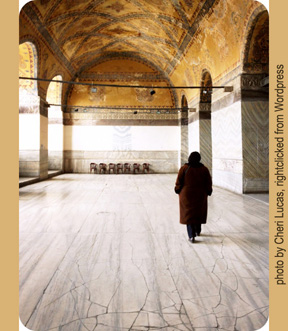
Explanation of the theme: Weekly Photo Challenge: Solitary by Cheri Lucas on September 21, 2012: “Solitary. I love capturing a person in a quiet and often unexpected moment. These kinds of images can be reflective, mysterious, or even sad, conjuring strong emotions and stirring up stories in my head. I snapped this photograph
in the grand Hagia Sophia in Istanbul, Turkey. That afternoon, it was very busy and crowded inside, but I turned a corner at one point and walked into the empty, bright, airy space pictured above. I experienced a few moments of silence as I watched a woman walk to the end of the room. We were strangers—yet alone, together. A solitary moment, frozen with my lens.”
xxx xxx xxx xxx xxx
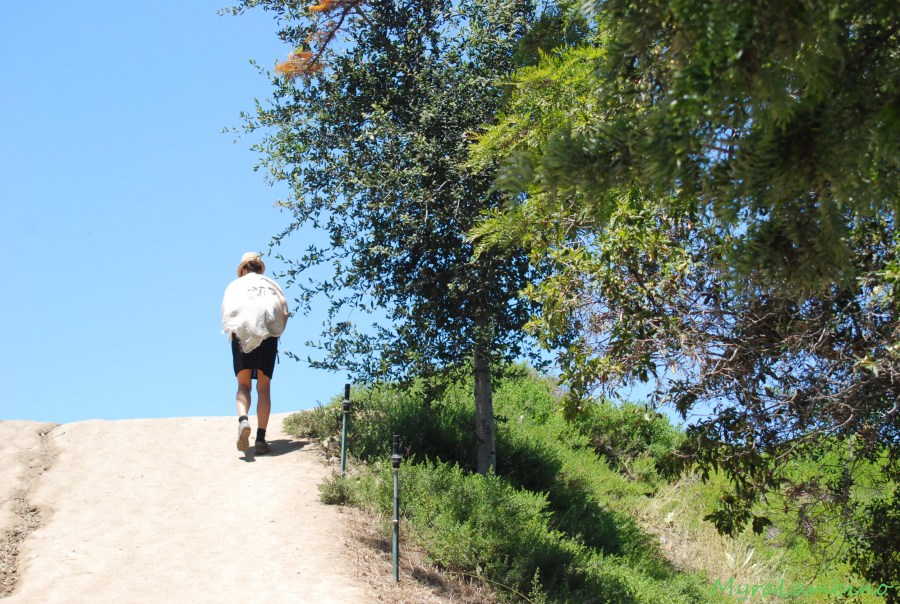
i wrote four lines for the photo above (shot by Myra, a man trekking a hilltop on his way to the Griffith Observatory) because more people were liking my photo-post in the otherblog http://www.chattel.wordpress.com , supposedly an inactive blog — maybe because i wrote three lines for it; based on the word “sliver” — a man was balancing himself on a bamboo raft that looked like a sliver because of the way it was photographed by Myra). here it is, click link below: