
Tag: University of the Philippines
(from ABS-CBN News: “European Pressphoto Agency (EPA) photographer Dennis Sabangan passed away Monday morning due to a lingering heart illness. xxx Sabangan, 41, was the head of the Manila bureau of the Frankfurt-based photo agency.xxx Sabangan previously worked with the Philippine Daily Inquirer and covered national stories for the newspaper where he was assigned to different parts of the country. xxx He found his big break documenting the Sipadan crisis wherein 21 tourists, including several Europeans, were kidnapped and detained by the Abu Sayyaf for 4 months. xxx He was one of the journalists who stayed for months on end to cover the 2000 crisis. xxx After the Inquirer, Sabangan became the chief photographer of EPA in Manila. He covered various international news with EPA, including the 2004 Tsunami, the Myanmar Unrest, the US War Against Terrorism in Pakistan and Afghanistan, World Cup and Euro Cup soccer, the 2008 Olympics, and the Australian Open. xxx “Dencio” served as chairman of the Philippine Center for Photojournalism from 2006 to 2008, where he was a founding member. xxx He also taught photography at the College of Mass Communication in his alma mater, the University of the Philippines. He is survived by his four children. xxx His wake will be at the Loyola Memorial Chapels on Commonwealth Avenue, Quezon City.”)
The Genius of Dennis M. Sabangan
Two Christmas seasons ago, on a drizzly evening, i ran into Dennis Sabangan in the department… (Dennis Sabangan: Senior Lecturer, Photojournalism, University of the Philippines Diliman, multi-awarded international photojournalist)…
(photo of Dennis Sabangan teaching at the University, shot by hamsternice.blogspot)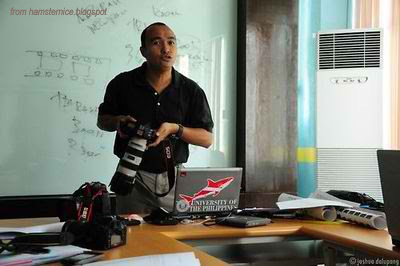

…and asked him whether he had classes at that time… why he hadn’t gone home, he replied with his usual wide grin that he was just chilling before heading out… he was lugging bike gloves… I asked what those were for, and he said:
“Nagbibisikleta ako eh. Gabi-gabi.” (“oh. i stomp the bicycle. Every night.”)
“Saan?” (“Where?) I had thought he had joined the evening bikers on the breezy, easy 2.4-kilometer UP Diliman academic oval – where toddlers learn how to walk every morning.
“Sa EDSA.” (“On EDSA”)
EDSA is a 12-lane traffic-congested accident-prone, most polluted, poisonous, nauseating, dismembered killer-highway that connects the northern part of the metro to the southern part – just for full context for the worldwide audience. People get killed on EDSA everyday.
“Bakit!!? (“Why!!?) Ba’t ka nagba-bike sa EDSA!!? (“Why do you bicycle on EDSA?”)
“Wala. Nagbaba-bike ako gabi-gabi eh. Mula rito hanggang Makati.” (“Nothing, I ride my bicycle every night. From here to Makati”)
“here to Makati” was Diliman to Makati: 13 jammed kilometers of cement jungle where bikers routinely get crushed by monster buses driven by murderous drivers or sideswiped by road criminals in SUVs.
“WHY ARE YOU DOING THAT?!! Ba’t di ka na lang sumakay?” (“ WHY ARE YOU DOING THAT, why don’t you just board a vehicle?”)
“Di ako makatulog eh. (“I can’t sleep.)”
“Ha? (“huh?”).
“…galing ako sa Tacloban. Sa Yolanda. (“…I got back from Tacloban. Supertyphoon Yolanda (Supertyphoon Haiyan).)
He laughed softly and with a wide smile, said he’d go ahead, and waved his hand.
That was two years ago. Dennis was up and about after that, still bringing to the world the most compelling images of global events that showcased the best of the Filipino photojournalist, with more heart than ever.
A sampling of his genius can be viewed from this portfolio as Chief Photographer on the Philippines of the European Press Photo Agency at: http://www.epa.eu/photographers/dennis-m-sabangan
Dennis Sabangan professionally documented the most epochal moments of history for 17 years with his lenses, from the war in Afghanistan, in Pakistan to the Beijing Olympics and the 2010 FIFA World Cup, being the only Filipino to cover the iconic international soccer game. He was also the lone Filipino recognized in Time Magazine’s “The Year in Pictures” in 2009.
We consider ourselves singularly privileged that Dennis Sabangan had accepted our humble invitation in 2009 for him to teach photojournalism at the State University.
Dennis Sabangan’s brilliance in capturing the world’s biggest heartaches, and the planet’s most endearing heartthrobs, belied any lingering heart ailment that he was enduring – and which he eventually stunningly conquered by giving us a glimpse of what it means to be human — to be lionhearted and bighearted in the midst of unfathomable heartbreak.
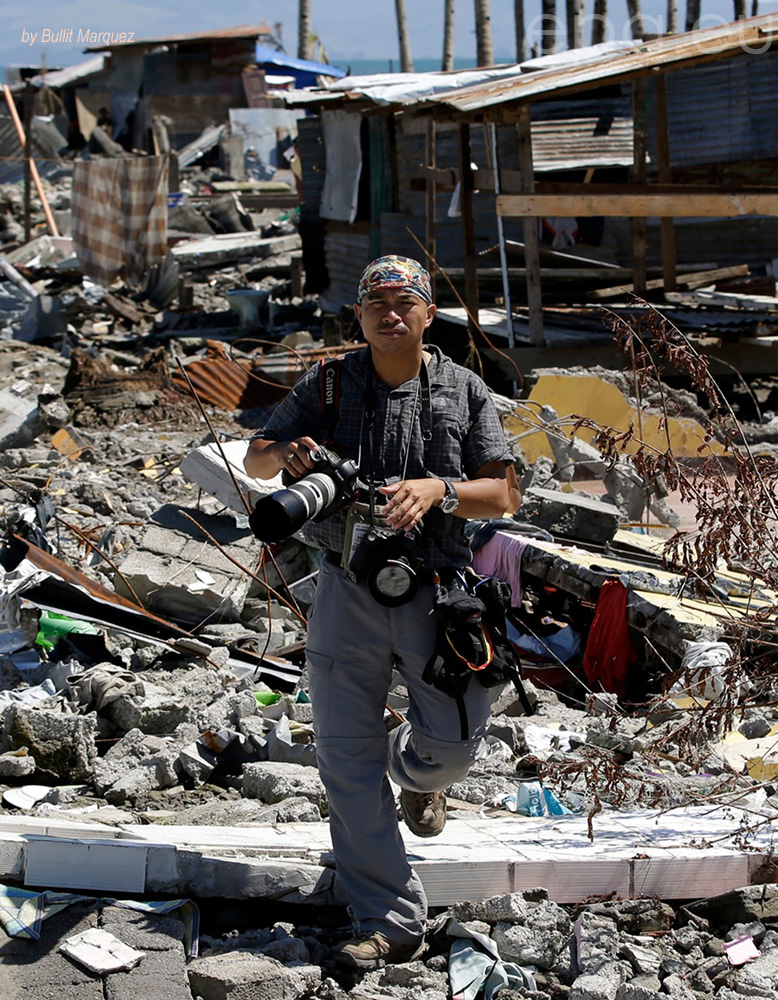
(Photo of Dennis Sabangan shot by Bullit Marquez, published by the European Pressphoto Agency, used here non-commercially for academic purposes)
♥ ♥ ♥
“Our Stories: Super Typhoon Haiyan” account written by Dennis M. Sabangan for the European Pressphoto Agency (EPA) published by EPA:
“It was the day after the Super Typhoon Haiyan slammed into the country when I trooped to the Villamor airbase to catch a C130 flight to Tacloban. Typical of journalists, it is when everyone rushes away from a disaster, that we scramble to get close. It was such that when I arrived at VIllamor, there already was a long queue of journalists waiting for a flight to ground zero of the disaster area.
“Only 15 passengers were allowed in on a first come first served basis and I was at the bottom of the list. It was only after endless negotiations with authorities that I was finally included in the manifesto of passengers.
“Yet if physically getting to Tacloban was difficult already, just imagine the situation we had to contend with when we got there. From the airport, we had to walk four hours to reach the city, which didn’t look like a city anymore. Quite frankly, it looked as if a bomb had dropped. Nothing was spared. It was at that area that we shot some of the most heart breaking pictures.
“A Night Under The Impression Of The Super Typhoon Haiyan
“When night came, we all had to walk back to the airport. We slept inside the dilapidated office building of the Civil Aviation Authority (CAAP). It has four rooms and there, packed like sardines on the muddy floor, we tried to sleep.
Air traffic officer slept beside army men who slept beside us journalists–all of us enduring the cramped space, the humidity and the constant fear that the damaged ceiling might soon collapse. Fearing pneumonia, I slept instead on top of a 2ft by 3 ft table.
“But it wasn’t just the fear of collapsing roofs and boding illnesses that plagued us. There was something more basic we had to fight with in Tacloban: our hunger. The food supplies we brought from Manila lasted all of two days. Once at the Tacloban airport, we befriended Air Force Lt. General Roy Deveraturda, former chief of the Central Command based at Mactan airbase. He gave his lunch to us to share with three other media colleagues.
“As food and water were scarce, it took the cunningness of a street urchin to survive. To find food to feed the epa crew, we would get rice from one Air Force unit, and then go to another Army unit to get some more viands.
“Francis* and I came in first along with other journalist friends, but our group soon grew.
“Eventually, the epa crew grew to comprise of Mast Irham (Indonesia) Nic Bothma (South Africa) Bagus Indahono (Indonesia) Ritchie B. Tongo (Filipino) Rolex dela Pena (Filipino based in Beijing) and two more photographers, Joseph and Romy. Just imagine eight hungry men sharing four cups of rice placed on a banana leaf.
“And then there was the time when we chanced upon an abandoned barangay** hall (office of the village chief) where three families took shelter after the storm. They shared their food with us which they said they found in a store. For a moment, I debated with myself, wondering if I should accept the food they offered knowing most likely that it was not paid for. But what the heck, I was hungry. I took the food only to realize grimly that the dead bodies we passed to enter the barangay hall were intentionally placed there by its occupants, “to ward off looters”, they said.
“A few days after we arrived in Tacloban, I had the chance to go with a SOKOL chopper to take aerial shots of Samar. The SOKOL helicopter airlifted sacks of rice, to give relief to the survivors. While on the plane, I observed how hardened pilots had to hold back their tears as they avoided the survivors rushing towards the chopper. They knew as well as I did that heads will be chopped off by the tail motor if they did not. “But I saw how much they wanted to help. The moment we landed, survivors scrambled to get inside, to have a share of the sacks of rice. In their eyes I saw hunger and pain.
“Yet, somehow we can still manage to tell jokes and laugh – a Filipino trait perhaps or a way to cope with the crises we face. Like when a survivor asked me if I had any medicine with me for his pus-filled wounds. “As much as I would like to help but the only medicine I have with me is for heart ailments. You might die of heart failure instead of your wounds”, I told him. He laughed.
“I came to Tacloban as a photographer. But this experience has taught me important life lessons and skills for survival such as resourcefulness, building friendships and the true meaning of camaraderie. Yolanda (Haiyan) has given me the most humbling of experiences as I learned to swallow my pride to ensure the welfare of the epa team; that we would all survive the day and not sleep hungry so as to have the strength to start the next day and do it all again.
“Just as I knew the mission of the soldiers and pilots we slept and ate with, I knew ours: to bring the images, and the stories behind those images to the world, and to show the realities of what this disaster has caused my country. Only then can the true magnitude of the displacement and suffering it has caused be seen, so we can help the victims regain their dignity and rebuild their lives.”
click any social media icon below to share
- Share on Facebook (Opens in new window) Facebook
- Share on X (Opens in new window) X
- Share on Tumblr (Opens in new window) Tumblr
- Email a link to a friend (Opens in new window) Email
- Share on Pinterest (Opens in new window) Pinterest
- Print (Opens in new window) Print
- Share on Reddit (Opens in new window) Reddit
