“Statement from the Office of the Secretary of the University and of the Board of Regents on UP Presidency Candidates”
“On 23 September 2016, the UP Board of Regents received the nominations for the following for the position of UP President:
Consolacion R. Alaras Danilo L. Concepcion Gisela P. Concepcion J. Prospero E. De Vera III Rowena Cristina L. Guevara Orlando S. Mercado Benito M. Pacheco Roger D. Posadas Caesar A. Saloma Michael L. Tan “At a special meeting of the Board of Regents held on 1 October 2016, the Board conducted a preliminary screening and evaluation of the nominees based solely on the following minimum requirements: 1) holder of a Master’s degree; doctorate preferred; 2) substantial academic experience at the tertiary level; 3) should be able to serve the full term of six (6) years before reaching the age of 70; and 4) no conviction for administrative and criminal offenses. Based on this, the Board then unanimously accepted the nominations of the following as candidates for the UP Presidency:
Danilo L. Concepcion Gisela P. Concepcion J. Prospero E. De Vera III Rowena Cristina L. Guevara Benito M. Pacheco Caesar A. Saloma “Four (4) of the ten (10) nominees were not included in the list of candidates for the UP Presidency due to the fact that they did not meet the minimum requirement that a candidate “should be able to serve the full term of six (6) years before reaching the age of 70.”
( image right-clicked from osu.up. edu.ph used here non-commercially for academic purposes_
“The Board of Regents’ unanimous decision to uphold this requirement, after due deliberations, was based on the following legal grounds:
“•Under Republic Act No. 9500 (the UP Charter of 2008), Section (j), the Board of Regents is given the power to elect the University President based on standards and guidelines set by the Board of Regents itself. Clearly, the Board of Regents is expressly granted the power to set the standards or requirements in electing the UP President. “•The UP Charter of 2008 is silent on the age requirement or limit for the UP President. “The old UP Charter (Act 1870), likewise, was also silent on the age limit for the UP President. Yet the Board of Regents was empowered then as now to set the age limit for the position, which it did set at 70 years old in 1961 by way of a Board Resolution at its 686th meeting held on 14 June 1961. The age limit of 70 years old now forms part of UP’s University Code.
” • The age limit of 70 years old has been in existence since 14 June 1961. Such age limit was last observed during the time of UP President Francisco Nemenzo who was elected for a term of 6 years (from 6 August 1999 to 5 August 2005) but had to resign upon reaching the age of 70 on 9 February 2005, a few months before the expiration of his term. ” • There are general legislations that provide for the age limit of 70 years old. For instance, RA 8282 (the Higher Education Modernization Act of 1997) states that the term of the President of a state college or university may be extended beyond the age of retirement (65 years old) but not later than the age of 70 years old. ” • Regarding the requirement for serving the full term of six (6) years, the UP Charter of 2008 (RA 9500) provides the basis. Section 13 (j) of the UP Charter clearly states, among others, the Powers and Duties of the Board of Regents, as follows: “Section 13 (j): “To elect the President of the University for a single term of six (6) years following a process of democratic consultation with the university community based on standards and guidelines set by the Board. In the event of a vacancy, the Board shall elect a President who shall serve a full term.”
• In addition, Section 14 (paragraph 2) of the UP Charter provides: Section 14 (paragraph 2): “The President of the University shall be appointed by the Board and shall serve for a single term of six (6) years.”
“For inquiries, please contact:
“Edna Estifania A. Co, DPA Vice President for Public Affairs 09985898022 “
Some legal provisions pertinent to the new issuances for the “Search for the Next U.P. President” 2016
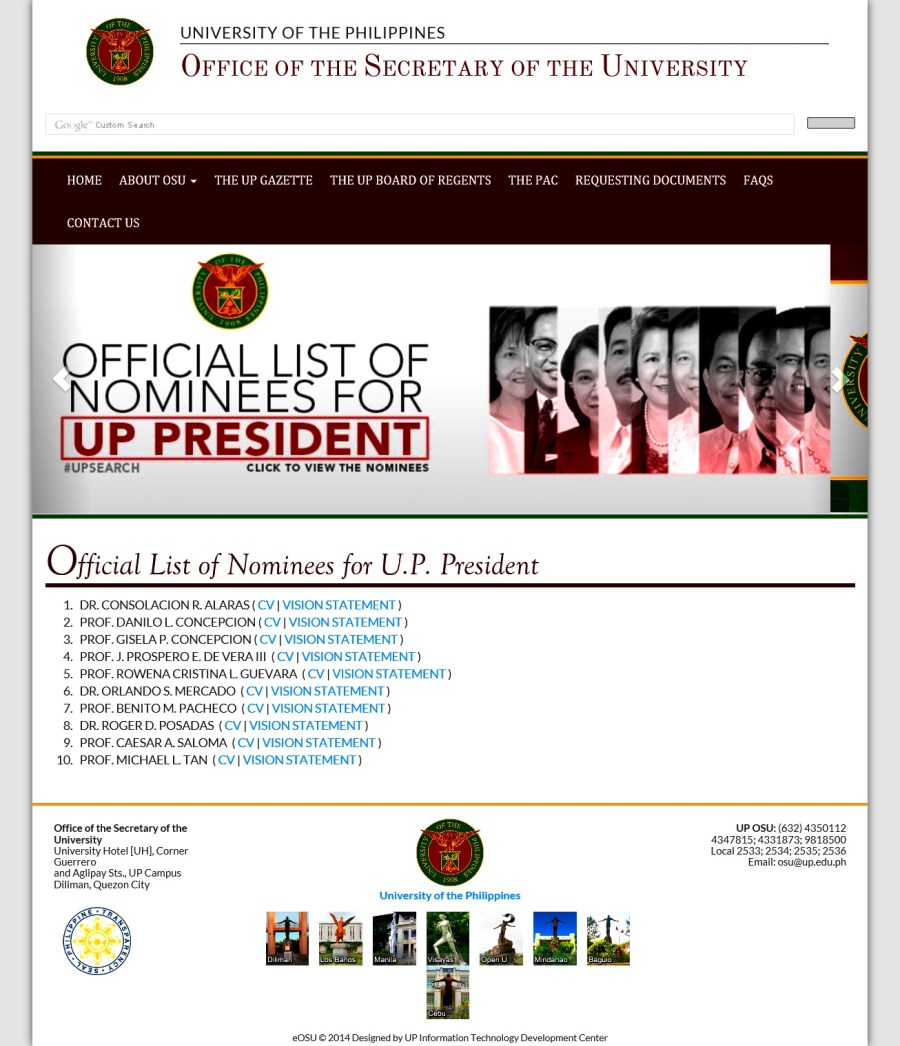
As of today, Oct. 5, 2016, the U.P. website still lists ten official nominees for the position of the next UP President including UP Diliman Chancellor Michael Tan.
Election of the next U.P. President by the BOR is on Nov. 24, 2016.
Here is a screenshot of the website of the UP Office of the Secretary of the University and the BOR:
(image screenshot from osu.up. edu.ph used here non-commercially for academic purposes)
In any case, the following are also evidenced by official records:
♦1. A few weeks ago, UP Diliman Chancellor Michael Tan turned 64 years old (this September 2016).
♦ 2.Based on the UP website: Last August 16, the UP Board of Regents announced the “Search for the Next UP President” and issued the following “minimum requirements”: 1) holder of at least a Master’s degree; 2.substantial academic experience at the tertiary level; 3.”able to serve the full term of six years before reaching the age of 70”; 4.no conviction for administrative and criminal offenses.
♦ 3.Based on the UP Charter (Republic Act 9500), the law that governs U.P., the following provisions are pertinent to the “Search for the Next U.P. President” (there are only two provisions pertinent to the search): “Sec. 13. Powers and Duties of the Board of Regents. xxx “(j) To elect the President of the University for a single term of six (6) years following a process of democratic consultation with the university community based on standards and guidelines set by the Board. In the event of a vacancy, the Board shall elect a president who shall serve a full term. A Chancellor chosen by the Board may act as Officer-in-Charge of the national university when the search process is in progress. In no case shall the search and election of the next President be longer than ninety (90) calendar days from the date when the vacancy occurs; “Sec. 14. The President of the University. – The President of the University is the chief academic officer, head of the university faculty and the chief executive officer of the University. The President of the University shall exercise the powers specifically provided for in this Act, those determined by the Board, those which pertain to the office of the president of a university, and those which are related or necessary to its functions. The Board shall determine the compensation of the President of the University. The President of the University shall be appointed by the Board and shall serve for a single term of six (6) years.”
♦ 4) Based on government records and other official records: Last August 5, 2016, the Anti-Age Discrimination Law, Republic Act 109111, took effect, 15 days after it was signed and published on July 21, 2016. The following provisions are pertinent: “Section 3, Definition of Terms, “b) Employer refers to any person, natural or juridical, employing the services of an employee or worker and shall include the government and all its branches, subdivisions and instrumentalities, all government-owned and -controlled corporations, and government financial institutions, as well as nonprofit private institutions or organizations. “3 (a) Employee refers to a person who performs professional, managerial or administrative work and is paid salaries by the employer as compensation for services rendered “Sec. 5. Prohibition of Discrimination in Employment on Account of Age. – (a) It shall be unlawful for an employer to: “(1)Print or publish, or cause to be printed or published, in any form of media, including the internet, any notice of advertisement relating to employment suggesting preferences, limitations, specifications, and discrimination based on age xxx (3) Decline any employment application because of the individual’s age xxx (4) Discriminate against an individual in terms of compensation, terms and conditions or privileges of employment on account of such individual’s age; xxx”
♣ ♣ ♣
Those are some legal provisions you might want to look into. The legal advice to all the parties concerned, since “first-time” issuances were made to limit the “Search for the Next U.P. President”, is to make sure that the entire process is not tainted with any questions of legality. The moment a portion of the process is of doubtful legal validity, the entire process is put to legal question; and even the final appointment itself would be subject to doubt. So, just be careful that all new, first-time issuances were made with authority found in the law that created the body; that no rights arising from laws, or new laws, are being infringed; that no legal doctrines or settled case law are being directly or indirectly circumvented; and that no prohibitions set forth in any laws are being violated.
 ( image right-clicked from osu.up. edu.ph used here non-commercially for academic purposes_