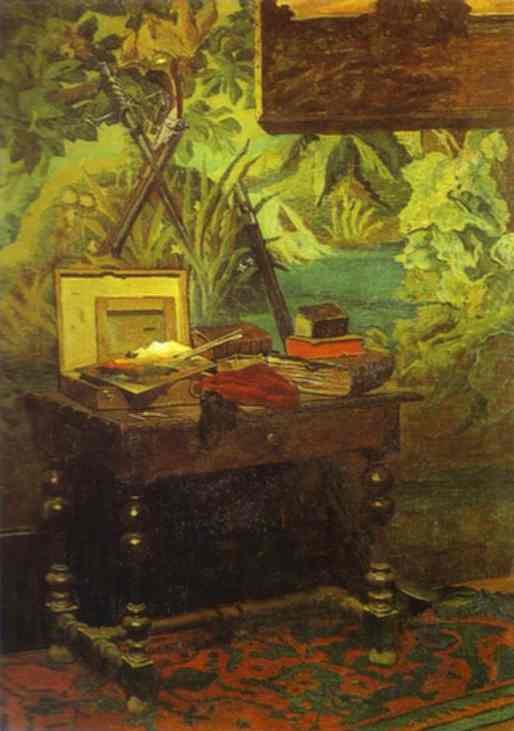
Claude Monet. Studio Corner. 1861. Oil on canvas. Musee d’Orsay, Paris, France. Right-clicked from http://www.abcgallery.com
I don’t have a complete legal opinion on the “obstruction of justice” law in the blog ( one post enumerated some cases on the interpretation of Articles 150 and 151 of the Revised Penal Code on resistance to and disobedience of persons in authority; and another post on some notes on just one provision of the “obstruction of justice” law in relation to the seizing of video tapes and camera equipment of media persons during the Manila Pen stand-off and the CIDG “order” to a media organization to turn over raw footage.) I never wrote a full article on obstruction of justice because there are too many intellectual property thieves in the internet, or those who have been assigned by their employers to write articles but steal other people’s ideas and put them out as their own. So, I thought that I’d just reserve that article for a journal or publication somewhere sometime where I can get credit for it. Since I juggle practice and teaching, I get points for academic work as follows: faculty members get credits or points for published articles under the category of research or publications or creative output (points that are computed during the round of promotions if any); and they also get credit or points under the category of extension work for interviews or legal advice or legal opinion aired over television or radio, although there’s a ceiling for it, I usually exceed the ceiling for points for televised legal opinions/ interviews; so I don’t get credit for the excess ha-ha. Blogs aren’t credited at all, so no full articles and no full legal opinion here. I’m not a fountain. Anyway.
Here’s a two-paragraph answer requested by the Integrated Bar of the Philippines newsletter staff about three weeks ago, on the question of: “Are there any press freedom issues raised by incidents during the Manila Pen caper? Please discuss, two paragraphs.” It’s some sort of a forum as I understand it.
I emailed the following two short paragraphs:
Handcuffing and detaining media persons who were broadcasting live the breaking news and the aftermath of the Manila Pen caper is not just a form of invalid warrantless arrest (for being done without probable cause) therefore illegal; is not just a means to send out a “chilling effect” on media organizations; it is a far worse form of infringement: it is an extraordinary, unusual and very physical form of prior restraint. While media organizations were allowed to continue airing images and sounds, the reporters and crew themselves were physically detained and therefore effectively stopped for five hours from broadcasting their individual reports.
As an afterthought, the police said the media persons were “guilty” of “obstruction of justice” . But under said law, what is punishable is the “harbouring, concealing, and facilitating escape” of persons who may have committed a crime. Photographing, filming, interviewing, taking down notes, airing live, cannot in any way be construed as “harbouring, concealing, and facilitating escape…” unless the police means it is punishable to not actively help them capture their quarry; in which case they mean to transform us into a police state. The police, DILG, and Malacañang tax the collective imagination of the nation when they propound such excuses. Not only do they tax the imagination, they stretch the constitutional bound to breaking point – they who profess to be our law enforcers.