(pls click “Listen in browser” on the soundcloud pod below, then the play button, to hear the free streaming music embedded for this post — if on mobile device; on laptops and desktops, the audio autoplays)
Pineapples, er, Heads should roll : DOLE photo fiasco by PNA : Some suggestions on how to manage a staff
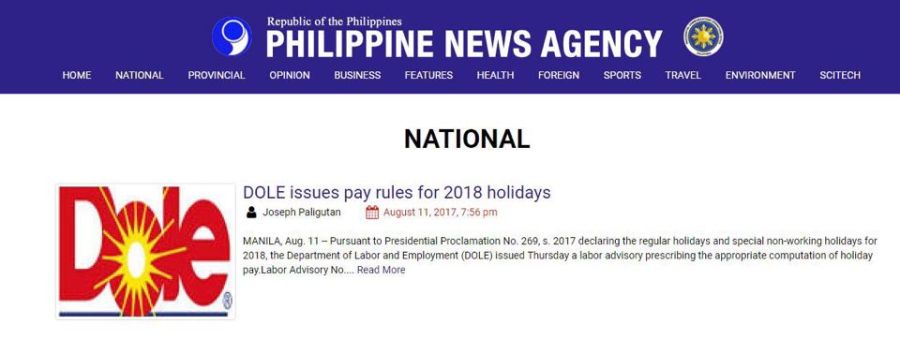
The Philippine News Agency apologized today for publishing the Dole Pineapple logo as layout photo for a press release on the Department of Labor and Employment (DOLE) issuance of 2018 holiday pay rules.
(photo rightclicked from abs-cbn news, used here non-commercially for academic purposes)
Since this is the fourth major fiasco of the Philippine News Agency (PNA) in just a few months (e.g., 1.publishing a photo from the Vietnam war for a Marawi story; 2.publishing a non-existent interview of the Interior assistant secretary; 3. publishing verbatim a XinHua editorial critical of the Permanent Court of Arbitration decision in which the Philippines won its case; and now 4.publishing the Dole pineapple logo to represent the Department of Labor), Communications Secretary Martin Andanar should seriously consider instituting immediate reforms: merely issuing memos will not do the job.
Here are some suggestions ( or the Martin- Andanar-to-do list for this weekend and next week) :
Number One: The Comm Sec should find time to review the PNA staffing pattern and each staffmember’s responsibilities, and to look at the background of each editor, section editor, copy editor, website and social media administrator, layout artist, reporter, writer, photographer, researcher, fact-checker, etc..
While the buck stops with the editor, each of the staffmembers should have the necessary background in journalism and news reporting and news editing in order to have multiple layers of fact-checking. Publishing the wrong photo is attributable to notreading the text of the story or not reading the caption of the photo being published or not checking the source of the photo being published, etc.
Number Two: Comm Sec Martin should also review the posting/ publishing process of the PNA. Apparently, the stories are tossed to a layout artist who uploads the stories to a template, then googles for images to accompany the stories by typing generic search terms (like “war” or “pineapples“– este, er, “dole“, etc.), rightclicking the images, then uploading them onto the blank spaces, then clicking “publish”.
Just to let you know: Layouting is a journalistic process and not just a form of artful designing. The process/practice of layouting is an important part of an entire journalism course in journalism schools. At the U.P. Department of Journalism College of Mass Communication, it is a substantive part of the course Newspaper Management: Students are required to learn how to produce the news page from story-conference to reporting, writing, editing, layouting. In editorial exams of the Philippine Collegian, the ability to layout a news page is required of any aspiring editor-in-chief. One could know how to write an essay that passes for an editorial but lack of layouting skills betrays one’s lack of journalistic experience: An editor-in-chief cannot provide leadership to the editorial staff if he/she lacks the necessary background in journalism: The newswriting portion and layouting portion of an editorial exam intend to measure the journalistic background of aspiring editors.
Why is layouting a journalistic enterprise and not just a form of artistic expression?
First: Because it involves lining up the stories: That is: Which stories deserve the most prominence and which ones deserve the least. That requires acumen in determining which reports are newsworthy and which goes to the trash bin.
Second, layouting involves headline-writing — Headline-writing is an entire school unto itself requiring years of journalistic experience in writing the most concise head to capture the slug of the story. Only the very best editors can write a headline that catches the attention of readers/viewers and at the same time, is accurate, factual, and concise. Not easy. In fact, layouting and headline-writing are well-developed disciplines that have different schools of thought depending on the personality of the news page and its purpose: from the sensationalism school of thought to the conservative one. (We try to achieve a balance: we still need to pander to the audience without compromising accuracy, right?)
(by the way: If you’re reading this on another day: For this post, the blog is using an all-white, conservative, minimalist layout; but on most days, the blog uses a photo-heavy or audio-visual- heavy layout because the audience consists of children with short attention span. If you’re reading this post on another day, the background will already be photo-heavy and you will probably hear a streaming nightcore-version (high-pitched on fast-play animé version) of songs, for reasons as stated.)
Third, after lining up the stories and writing the headlines for each, determining the amount of space to be devoted to each story also requires journalistic discernment.
Fourth, in many cases, the story has to be cut up or jumped to the next page: cutting up a story or jumping it to a next page requires journalistic skill because it involves editorial judgment — where to slice, or where to jump.
Fifth, of course, the choice of photos, the writing of the caption of the photos, and putting the credits for the photos, etc. all require a journalistic background (and for the more artistic ones: lighting up a photo, cropping a photo, etc. require knowledge of journalism ethics and not just photoshop skills). There’s more — i can write an entire booklet on this but due to time constraints, may i recommend a refresher course for the PNA. This could be coordinated with the University of the Philippines: For seminars and workshops, you could get in touch with the U.P. College of Mass Communication Foundation.
Number Three: Comm Sec Martin should not be afraid to reorganize and to institute reforms in the PNA. While government personnel may enjoy security of tenure, they can be transferred to posts or positions which match their qualifications.
Number Four: In the more immediate, Comm Sec Martin should employ a full-time fact-checker for the PNA. If no one within the PNA is qualified to do this, he can contract, in the meantime, and because of the urgency of the matter, a qualified professional to fact-check the PNA sites and its social media accounts hourly and daily, 24-7.
Full-time, professional fact-checker with years of experience in journalism: Get one. (or a team of fact-checkers) — answerable to you directly. That’s the more immediate; then, attend to Numbers one to three of this list within the week.
( the PNA erratum itself requires heavy editing.)
from abs-cbn news: “The state-owned news organization on Friday ran a wrong photo to accompany a government press release on pay rules for the 2018 holidays.
“Instead of using the logo of the Department of Labor and Employment (DOLE), it instead published that of DOLE Food Co.
“The wrong image quickly became viral on social media.
“The PNA later posted the correct logo of DOLE before deleting the entire article. “The page was inaccessible as of 10 p.m.
“The government news agency later issued an apology for the error. “The PNA editors, in a Facebook post, said their staff inadvertently attached the wrong photo.
” “It was a careless act on the PNA editorial staff. Rest assured appropriate action is being taken in pursuit of the delivery of accurate information to our readers. Our apologies,” the statement said.
(FROM PNA) ERRATUM
In a story titled “DOLE issues pay rules for 2018 holidays” posted on the PNA website on Aug. 11, 2017, the accompanying photo was that of Dole Philippines.
In an effort to ensure that all stories are accompanied by a photo, the staff inadvertently attached the wrong photo rather than the logo of the Department of Labor and Employment.
It was a careless act on the PNA editorial staff.
Rest assured appropriate action is being taken in pursuit of the delivery of accurate information to our readers. Our apologies.
— The Editors
“It was the latest in a string of errors committed by the PNA.
“In May, PNA apologized for posting a photo of soldiers in Vietnam for its story “Urban warfare a challenge for soldiers in Marawi.”
“Two personnel of PNA’s News and Information Bureau were suspended following the errors.
“The PNA also drew flak for its May 15 story titled “95 states convinced there are no EJKs in PHL,” which allegedly had statements from an interview with Interior Asst. Secretary Epimaco Densing, who denied that he spoke with the agency.
“The government news agency also drew flak for publishing a Chinese propaganda editorial criticizing the United Nations arbitral ruling that favored the Philippines in the disputed West Philippine Sea.
“Presidential Communications Secretary Martin Andanar has promised that heads will roll at the PNA if some of its staff are found negligent.
“He has yet to comment on the state news agency’s latest mistake.”
(pls click “Listen in browser”, then the play button, on the soundcloud pod below to hear the free streaming music for this post– if you’re on a mobile device. On laptops, it’s on autoplay. Happy viewing and listening!)
FIRST ASSIGNMENT FOR STUDENTS OF MARICHU LAMBINO: Examples of trigger warnings for persons with depression, grief, anxiety disorder, bipolarism, etc: Best practices by universities, professors, media organizations Seeing that my classes are almost fully booked as follows: J101, THE FIRST TO BE FULLY BOOKED in the first two days of enlistment: WITH FOUR SECTIONS BEING HANDLED BY DIFFERENT FACULTY MEMBERS who are probably more competent than i am, THIS SECTION IS THE FIRST TO BE FILLED UP. Such irony. A trigger warning was posted for this class. The course (fundamentals of journalism: straight news and crime reporting) involves police crime reporting including the viewing and analysis of crime scenes, viewing of scenes at the morgue, scenes involving dead bodies and persons who were killed under violent circumstances such as the drug war; plus: on-the-spot reporting and production of crime news reports onsite; collective assessment and criticism of students’ work; recitation; difficult exams, strict rules on classroom etiquette such as putting mobile devices on silent mode, no talking during exams, etc.) A trigger warning was posted by the handling faculty as follows: The rigors of this class/section does not render it ideal for persons nursing a condition that requires professional psychiatric help or medication. i took down the trigger warning because some students may have felt they were being barred or “barricaded” or discriminated against. Probably a misreading by some since there was no such barring or exclusion or barricading or discrimination. It was a trigger warning: The posting of trigger warnings is practised by universities, colleges, professors, and media organizations in the U.S. and worldwide.
Ironically, this class and section is the first to be filled up in the first two days of said trigger warning: Nakakatuwa naman ang mga estudyante. (The response from students actually enlisted/enlisting is gladdening.). This group is the most intelligent of their batch.
Following best practices here in the U.S. and in universities worldwide (nandito po ako across the Pacific Ocean (nagsagwan po 🙂 (posted July 22, 2017) i paddled my way here) examining best practices of universities and colleges, and by professors, which include the use of trigger warnings in their courses), and using the contributed work of students through this assignment, a trigger warning based on results submitted by students will be typed up in the syllabus of this section and those of other courses stated here. The debate on trigger warnings in the U.S. and worldwide is in the opposite direction: Advocates of trigger warnings seek to warn and alert persons experiencing certain conditions so they can protect themselves or avoid the situation while those who oppose trigger warnings object to overprotection of young people or of persons facing certain conditions and challenges and want all kinds of materials and speakers “relevant” to be introduced/ viewed/ listened to. Media Law, C120 two sections of several sections being handled by different faculty members who are probably better lawyers and profs than i am: running total for me: 47 students enlisted and still running, (61 students as of August 17) the largest total number in the CRS (computerized registration system) for this course (Nakakatuwa naman ang mga estudyante: Students are more intelligent than you think as can be seen in the way they choose and appreciate as shown by the numbers, data, statistics. this group has got to be the most intelligent crop of students in the university. ) Media Ethics C110 (1 of 4 sections being handled by different faculty members who probably have more expertise than i do: 26 students and still running, the largest number running at present in CRS for this course (Nakakatuwa naman sila, kahit gabi na ang section na ito, 4pm to 7pm, ako pa rin ang pinili. This group of students are the smartest on earth). … seeing that the J101 class is already fully booked and the other courses being handled by blog admin have the largest number in CRS: the following is a heads-up on the first assignment for submission online (deadline: during the second meeting of classes, a window or blog post will be opened for each section for posting of their results for the assignment): ASSIGNMENT: Please submit ten examples of trigger warnings used by universities, colleges, and professors, and by media organizations for persons experiencing certain conditions such as depression, grief, anxiety disorder, PTSD (post-traumatic stress disorder), or simply a past trauma, bipolarism, tendency toward self-injury (cutting, etc.), and other similar conditions. The deadline for submission is the day before the second meeting — as the best examples will be used in writing the trigger warning for this course. In other words, we will collectively write the trigger warning for the course. For your contribution to the work: This is worth ten points: Do not copy the work of your classmates (thus, those who submit first have an advantage.). If you copied the work of your classmate for this assignment, i will give you the benefit of the doubt that you did not understand the instruction, and will not file a case of plagiarism (but only for this time because it is the first assignment), HOWEVER, you will not be given any points for posting duplicate work whether wittingly or unwittingly. If you already have the materials right now and the window for our section is not yet open, you may use this window or blog post (type in the comments section below). Please use a pseudonym or a student number as this is a public site, then submit your name and pseudonym to the assistant. Marami pong salamat!