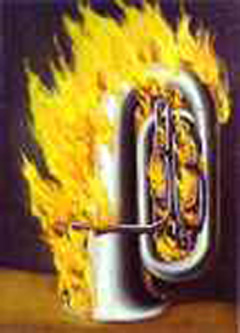
 “The Discovery of Fire” By Rene Magritte, 1934/35. Oil on panneau. 22.8 x 15.5 cm. Private collection. From abcgallery.com Notes posted by student no. 7 unedited by blog administrator
Quote “Last Saturday, August 18, 2007, “Kapuso Mo, Jessica Soho” featured a story on how great Filipinos are when it comes to inventions and creativity. A few Filipinos exhibited their creations such as vitamin-beer and a machine which can be used simultaneously both as a refrigerator and a cloth-dryer, to name a few.
Quote “ A student from Philippine Science High School was interviewed in the latter part of the report. The said school was known for its superiority in training students’ creative and imaginative minds. The student, a guy, related how such training really helped, for students like him. However, proper attribution (name and designation) was neglected in that portion, a violation of the KBP Code of Ethics for Television.
Quote “Under the KBP Code,”Voice and video clips of persons involved in the news shall be properly identified.” This is to acknowledge those persons for expressing their ideas and sharing their opinions on the issue at hand. Also, this is to let the viewers know who the sources are.
Quote “Same violation was also committed by the same TV program, on the same day, when it presented a brief account of global warming. On its discussion of the effects of global warming, Jessica Soho reported that the unpredictable changes in weather brought by global warming caused the high-level flooding in various places in the country, as well as the drying out of lands in the provinces. In line with this, interviews with people living in those affected areas were presented. Reactions of two residents from Navotas City were aired. However, both were not properly attributed.
Quote “All three people involved in the said violations were not prominent ones nor authoritative. However, no matter how short their reactions or comments were, it is still a must to put their names and designations, not only to acknowledge them, but also for the viewers to know who those persons are.” Closed-quote. Aug 20, 1:06 PM —
XXXXXXX|
Notes Posted by Student # 3
 “The Voyeur” by Salvador Dali ca. 1921. Gouache on cardboard. 32 x 50 cm. Gala-Salvador Dali Foundation, Figueras, Spain, from abcgallery.com
Quote “After having a series of reports on jeepney hold-up incidents, TV Patrol decided to broadcast a report telling how jeepney hold-uppers usually operate. According to the report, its purpose was to inform the unsuspecting public about the SOP of hold-uppers. Also, they said that the public would then be ready to avoid these hold-ups, if possible or if not, then they would know how to cope with these incidents.
Quote “The report specified the modus operandi of hold-uppers. It said hold-uppers usually come in three so they can execute their operations more smoothly. Two would sit at the back with the other passengers, and the other one would stay in the front passenger seat, so somebody can tell the jeepney driver just exactly what the hold-uppers want him to do. Snatchers usually are more subtle, although just as dangerous. They are the ones who usually resort to distraction and other inconspicuous techniques to snatch objects off the pockets of the passengers, the report said. Indiscreet hold-uppers, on the other hand, are the ones who carry and brandish weapons, such as small guns and knives, to threaten the passengers.
Quote “The TV Patrol report may have been intended for the good of the public, but the reporters and the newsmen overlooked the possibility that the report also reaches those of devious minds who are still planning to execute a hold-up incident, and are still working out just how they are going to go about it. In that case, the report also helped potential hold-uppers and snatchers in committing crimes more efficiently because they have seen on TV, and on a public affairs program at that, just how the expert hold-uppers do their thing.Aug 20, 10:31 AM —“ closed-quote.
XXXXXXXX
Notes posted by Madel Martin
Comm 191 – WWX
(unedited by blog administrator)
 “The Shipwreck” by Henri-Edmond Cross, c.1906-07. Oil on canvas. Musée d’Orsay, Paris, France.
Quote “ “Weather Weather Lang” is a portion of TV Patrol World hosted by Kim “Kuya Kim” Atienza that gives the latest update on the country’s weather conditions. After that is the “Ulat Kaalaman” and as the title suggests, it gives information on just about anything: from plants, animals, to the latest innovation in technology.
Quote “But the most remarkable feature of Kuya Kim’s “Ulat Kaalaman” is the fact that viewers can actually learn something from his trivia. Last August 16, 2007, while people are worried and panicking over the storm, he featured the process of knowing when and how to determine if there will be suspension of classes during typhoons. It was timely especially because even if typhoon Egay was not directly affecting Metro Manila and the nearby provinces, it was raining hard and there was flooding in several places. There were not even storm signals in most affected areas.
Quote “The “Ulat Kaalaman” showed that media is performing its responsibility of informing the public of important and relevant matters. It reflects how media can and should consider the welfare of the general public in delivering news and disseminating information. In this case, the viewers could now understand when will classes be suspended, where to ask about it, how the process of determining is done, and who decides on the matter.Aug 20, 5:41 AM” closed-quote.
XXXXXXXXXXXXX