SolGen oral arguments Cybercrime Law & some comments

      If you were not at the Supreme Court yesterday and want to get more details beyond the storified version of the Solicitor General’s oral arguments on the Cybercrime Law, here they are: these are right-clicked from rappler reporter Purple Romero’s twitter account (twitter.com/purpleromeropo), they’re live tweets; i copied them from bottom to top for a chronological flow of the proceedings,  consolidated where proper instead of paragraphing every 146 letters of tweet.

    We could call them:  “court transcripts by live tweets”, a new phenomenon in judicial proceedings.

   Just some comments so I won’t have to interrupt the flow. The Solgen said that surveillance of traffic data will only show the I.P. address and not the identity of the person. Jeez.

    An I.P. address is not just a number. Most of us who use the internet for work or communication use only one or two personal computers: your mobile/ laptop personal computer and a desktop personal computer in the office. Whatever computer you use, whether your PC or a public computer,  law enforcement authorities who have your IP address and are on real-time surveillance are  capable of  knowing where you are.  An I.P. address of your personal computer  leads to your office address or your home address either through the records of the internet service provider or through physical surveillance; and therefore to your identity.  And then PO1 (police officer 1)  can continue gleefully following your every activity in the internet – without a court order!

      When confronted with the absence of standards for what constitutes “due cause” as ground for real-time collection of traffic date (real-time surveillance of internet data) thru questions from CJ Sereno, Justice Carpio, Justice Tessie de Castro, and Justice Marvic Leonen, (what is due cause?), the SolGen, after hemming and hawing,  in the end, said (and I don’t blame him, his is an unenviable job): “law enforcement can start with internal rule”.

        Internal rule? Kalurky. (kaloka, rough translation: drives me crazy or are you mad). It is being suggested that  law enforcement authorities would agree among themselves that they would be angels for all time and will not snoop on anyone’s internet activity except try to track down the code-breaking & code-writing of hackers. This is like saying: Let’s just trust them na lang, okay.

            From twitter.com/purpleromeropo: “Oral arguments on the Cybercrime law now starting at SC. Solgen Francis Jardeleza: Revolutionary change has given malefactors to invent a new crime: cybercrime. Jardeleza: Most important chapters of Cybercrime law are 2,3,4. Chapters 2&3 define acts punishable under the law. Chapter 4  specifies new investigative tools to effectuate the law, to locate and identify the anonymous cyber criminal… Jardeleza outlining how Cybercrime law can help authorities trace and arrest “Mr. Hacker.” Jardeleza: The specter of Big Brother was raised. We categorically say RA 10175 does not authorize Big Brother surveillance. Jardeleza: Sec. 12 will only bring law enforcement to IP address, not address like Kalaw 1, 2, 3,4, 5. Jardeleza: We humbly submit that Sec.19 (takedown clause) be struck down, but Sec. 19 does not make void whole Ra 10175. Jardeleza: Is it unconstitutional for the State to criminalize libel? According to this Court, no. Jardeleza: If an utterance is libelous in the physical world, doesn’t it follow that it is libelous in the cyberworld? Jardeleza: Defamation is defamation, whether we communicate through megaphones, letters, radio, tv or email. Jardeleza: For journalists – defamation is defamation whether stories find themselves printed in broadsheet or internet edition. Jardeleza: A “like” is an approval of opinion. Jardeleza: Can a journalist who works for same paper with print and online edition be prosecuted twice? We humbly submit no….

Justice Abad: Can online libel be punished even without RA 10175? Jardeleza: Yes.

Abad: We have legislative admission that online libel does not clearly extend to Internet postings

Jardeleza: Things can go viral – what about reputation?

Justice De Castro: Libel will be considered under broad crimes in Sec. 6

Leonen: Congress does not seem to understand that libel in 1935 is not the libel we have today

Jardeleza: There is no freedom of expression involved in the case of Mr. Hacker.

Leonen: Wouldn’t the best way to protect us from libel is through civil action? Jardeleza: These are matters we submit to those elected

Justice Carpio: If penal law suppresses freedom of speech, it can be facially attacked? Jardeleza: Libel is unprotected speech.

Carpio: You can get traffic data from PLDT without court warrant, correct? Jardeleza: Yes, provided there is due cause

Carpio on collection of traffic data w/o warrant: Let us go to the judge! If u want we can designate a judge 24/7.You can go to his house

Jardeleza: Not all intrusions are unconstitutional, [they are unconstitutional] only if they are unreasonable

Carpio: It’s the use of internet that makes it a cybercrime? Jardeleza: Theoretically, yes

De Castro: Who will initiate determination of due cause? The law does not say how due cause is to be determined. Jardeleza: You’re right.

Jardeleza: The medium can change, but the competing values are the same. Does it harm reputation?

Justice Bersamin: Attempt in the commission of cybercrime – in the revised penal code there is overt act, we don’t seem to require it here

Jardeleza: There is no definition (of attempt in the commission of cybercrime) in RA 10175

Justice Del Castillo: There is no definition of due cause, it’s subject to abuse.

(1/2) Leonen: Are we not giving too much blanket authority to authorities to inspect data packet?

(2/2) Jardeleza: It’s constitutional but we agree there could be more robust procedures

Jardeleza: Cybersex targets cyber prostitution not obscenity.

CJ Sereno: This innocuous-looking section (Sec.3) is the one that caused the most objection (Sec.3 is the definition of terms)

CJ Sereno: You said Sec. 12 is the heart of regulation. If we strike it down, this law is good for nothing.

CJ Sereno: We might ourselves find standards for due cause,  absent.

Jardeleza: Law enforcement can start w/internal rule

Carpio: Why are we allowing law enforcers to do a shortcut? They could always go to the judge.

Abad: I do not find in cybersex provision anything on prostitution or trafficking. The law does not say that. That’s the problem.

Abad: What assurance can you give us that policeman will use real-time collection for a good purpose? None.

Parties are given 20 days to file respective memorandum. Petitioners will file second amended petition on Jan.30.

CJ Sereno on TRO extension: We will address that in due time.


My coloring book (The Cory Aquino Legacy)

a.red

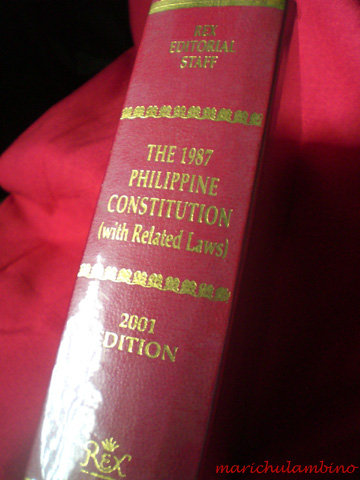
This is my copy of the Constitution; it’s a compilation; it contains not just the consti, but laws and subjects under consti law like: election law, local government code, admin law, etc. etc.

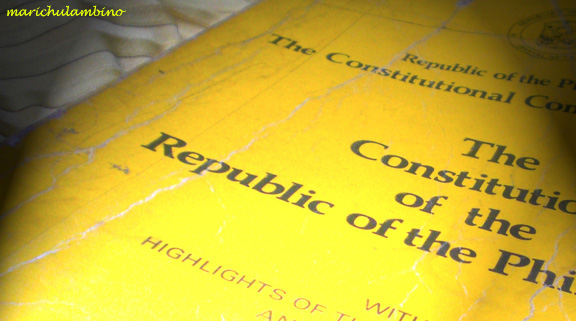
Maybe it was just a coincidence that as i glanced sideways from where i was seated today, i noticed something very yellow. I never saw it before (“never saw” means never noticed; never realized it was yellow. i wasn’t a very visual person before; i only became somewhat  visual recently, go figure.)

The book shelf here has a sliding, glass cover so you could see the titles inside. There it was, very yellow; gleaming, it happened to have been flung horizontally, instead of tucked vertically. Here it is.
a.wide copy

Our then consti law professor, VV (Justice V.V. Mendoza) said “You buy the wide one, the wide copy of the Constitution, it has a matrix that compares the Malolos consti, the 1935 consti, the 1973 consti, and the present Constitution, it’s published by National Bookstore. Plus, it’s easy to read, the letters are big. Well, you can buy others, the small ones if you want.”

Among the features of the ’87 Consti are: an emphatic, if not redundant Bill of Rights.

Like the free-speech clause; as everybody knows, “speech” in the “free-speech” clause in constitutional law jurisprudence includes all kinds and all forms of expression; yet, in the free-speech clause of the ’87 conti, the phrase “of expression” was added (a Lino Brocka amendment): “No law shall be passed abridging the freedom of speech, of expression, or of the press..” Just to make sure everybody understands the scope of free speech and  that censorship  is presumed unconstitutional.

Or, as everybody knows, the right to remain silent includes in constitutional law jurisprudence the right not to be forced to sign any statement or give any statement or to talk, by being roughed up, or by being electrocuted or by water-boarding, etc.; yet in the ’87 Consti, immediately after the right- to- remain silent provision, this was added: “No torture, force, violence, threat, or intimidation….shall be used” etc.. Just for emphasis. Just to make sure it is clear.

I like emphatic, never mind if it’s redundant, let’s keep it that way if only to make clear our intent and our will not to allow a dictatorship to rule the land again.

I’m doing this randomly. I’m sure there are other features. There is an anti-foreign military bases, troops, or facilities provision: “After the expiration in 1991 of the Agreement (on)…Military Bases, foreign military bases, troops, or facilities shall not be allowed except under a treaty….recognized as a treaty by the other contracting State.” The present Visiting Forces Agreement is not recognized as a treaty by the U.S. and therefore does not conform with the ’87 Consti.

Also, under the ’87 Consti, you only need a majority vote in the Supreme Court to strike down a law as unconstitutional (in the ’73 consti, you needed 2/3 of the Supreme Court.) Some older lawyers who did not study under the present consti still get confused sometimes and think it’s 2/3.

And of course, there’s an airtight provision that prevents the abuse of the Commander-in-Chief power of declaring martial law, by requiring that: 1) should martial law be declared, within 48 hours the President should report to Congress; Congress can revoke it. 2) Congress if  not in session, shall convene within 24 hours; 3) the Supreme Court can exercise judicial review over it; 4) the Constitution cannon be suspended; 5) courts cannot be shut down; 6) legislature cannot be shut down; 7) military courts shall not exercise jurisdiction over civilians; 8) any person arrested shall still be charged within three days otherwise, he/she shall be released; and in any case such arrested person can apply for bail or for a writ of habeas corpus; 9) and in all cases, martial law cannot be for more than 60 days.

What this Constitution did was to, as it were, “distribute” the exercise of this particular Commander-in-Chief power among the different branches of government by allowing, even requiring, the other branches to review it, and revoke it if necessary ; and by putting a time cap of two months on it.

The new government that rose from the collective struggle of the people that dismantled the dictatorship changed the legal landscape of our life.

Many of the cases that we are able to file now, many of the rights that we fight for now, many of the institutions that we try to safeguard now or watch over, were made possible by that then new government.

Sure, much more could have been done: a genuine agrarian reform program; justice for the tens of thousands of victims of martial law. The majority plodding and dying in sub-human conditions of poverty, hunger, and disease, remain mired through more than twenty years of the same.

My train of thought is being disrupted whenever i see the trapos (traditional politicians ) tonight come out and say “Ituloy ang laban ni Cory sa 2010” (“Carry forward the fight of Cory through 2010), you wonder. 2010? They’re thinking of themselves again. (nangampanya.)

Politicians have a way of inserting themselves in the scenery,  striding in with their entire entourage and their publiscists, when you’re reflecting on what had been and what should be, to guide your future action —  as i leaf through my old, yellow copy of the Consti; did you know it was as big and wide as a coloring, tracing, connect-the-dots book?

As you can see, i didn’t finish this post, cannot seem to finish a post again, much was done when the dictatorship and its vestiges were dismantled; much more could still be done.