(continuation) The “Rehabilitation” of the Marcoses

Filipino guerilla-poets during the Marcos dictatorship

poet1.gif

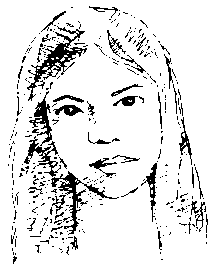
sketch of Lorena Barros, artist unknown, from http://www.cpcabrisbane.org

Sampaguita

Lorena Barros

(killed in battle in the mountains of Mauban, Quezon)

This morning Little Comrade

gave me a flower’s bud

I look at it now

remembering you, Felix

dear friend and comrade

and all the brave sons and daughters

of our suffering land

whose death

makes our blades sharper

gives our bullets

surer aim.

How like this pure white bud

are our martyrs

fiercely fragrant with love

for our country and people

With what radiance they should

still have unfolded

But sadness should not be

their monument

whipped and lashed desperately

by bomb-raised storms

has not our Asian land

continued to bloom

Look how bravely our ranks

bloom into each gap

With the same intense purity and fragrance

we are learning to overcome.

* * * * *
lacaba1.jpg

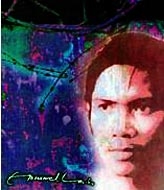
superimposed photo of Eman Lacaba on artwork, artist unknown, from http://www.bulatlat.com

Open Letters to Filipino Artists

  • Eman Lacaba

    (wounded in battle, shot and killed in custody by the government military, Davao del Norte, 1973)

A poet must also learn

how to lead an attack.

-Ho Chi Minh

I

Invisible the mountain routes to strangers:
For rushing toes an inch-wide strip on boulders
And for the hand that’s free a twig to grasp,
Or else headlong fall below to rocks
And waterfalls of death so instant that
Too soon they’re red with skulls of carabaos.

But patient guides and teachers are the masses:
Of forty mountains and a hundred rivers;
Of plowing, planting, weeding and the harvest;
And of a dozen dialects that dwarf
This foreign tongue we write each other in
Who must transcend our bourgeois origins.

1 May 1975 South Cotabato

II

You want to know, companions of my youth,
How much has changed the wild but shy poet
Forever writing last poem after last poem;
You hear he’s dark as earth, barefoot,
A turban round his head, a bolo at his side,
His ballpen blown up to a long-barreled gun:
Deeper still the struggling change inside.

Like husks of coconuts he tears away
The billion layers of his selfishness.
Or learns to cage his longing like the bird
Of legend, fire, and a song within his chest.
Now of consequence is his anemia
From lack of sleep: no longer for Bohemia,
The lumpen culturati, but for the people, yes.

He mixes metaphors but values more
A holographic and geometric memory
For mountains: not because they are there
But because the masses are there where
Routes are jigsaw puzzles he must piece together.
Though he has been called a brown Rimbaud,
He is not bandit but a people’s warrior.

November 1975 South Cotabato; Davao del Norte

III

We are tribeless and all tribes are ours.
We are homeless and all homes are ours.
We are nameless and all names are ours.
To the fascists we are the faceless enemy
Who come like thieves in the night, angels of death:
The ever-moving, shining, secret eye of the storm.

The road less travelled by we’ve taken-
And that has made all the difference:
The barefoot army of the wilderness
We all should be in time.
Awakened, the masses are Messiah.
Here among workers and peasants our lost
Generation has found its true, its only, home.

January 1976 Davao del Norte

* * * * * * * * * * *

I know. It’s Linggo ng Wika. I always make an effort, even if it’s a form of sacrilege, to translate.

Salin ng isang saknong, “Open Letters to Filipino Artists” (Mga Bukas na Liham sa mga Pilipinong Alagad ng Sining) na tula ni Eman Lacaba

Ngunit matiyagang giya at guro ang mga masa

Ng apatnapung bundok at isandaang ilog

Ng pagsasaka, pagtatanim, pag-aalaga, at pag-aani

At ng isandosenang mga wika gahigante

sa wikang banyagang nakasanayan

Tayo na kailangang lumagpas sa burgesyang pinagmulan.

The Rehabilitation of the Marcoses

The Rehabilitation of the Marcoses

papo.jpg

painting by Papo de Asis from http://www.geocities.com

By natural causes or not, in the next 50 years , all of us would have died, and it is not certain that our descendants or their descendants would remember the times we lived in. But for the textbooks, history lectures, libraries, court records, we had not documented enough, not concluded enough, rested too much, assured ourselves too much, that the textbooks, libraries, history lectures, court records, would be enough repository of the 20 years of families torn apart and tortured, 10,000 persons violated, billions of dollars of Marcos plundered unrecovered wealth.

Those textbooks, libraries, history lectures, court records, are being changed, year by year, the heirs waited then negotiated, then waited and negotiated, while we rested. We had gone on to live, not knowing that when we die in the next 50 years or so, everything we thought we had lived for, had not happened, according to the new history textbooks, history lectures, and reconstituted court records. In the Internet in Wikipedia, the future reference of your children and grandchildren, the dictator was never a tyrant but a visionary, no one has edited the long entry, because we had rested too much.

But what does it matter when our descendants and millions of our countrymen, and their descendants coexist in peace, what does it matter, except that the heirs’ heirs would be in power someday, having stashed a war chest big enough to buy a small country; the sins of the father should not be visited upon the children and grandchildren anyway; if they paid off all of us, and they have the largesse for it, would that be enough, what is the price of one’s memory, what does it matter, that there were students, workers, women, peasants, thousands, whose skulls and bones were crushed when they fought the dictator; a fifth generation would ask your grandchildren: Did it really happen? How do you know?

Too High a Price”: Letter of Abraham “Ditto” Sarmiento Jr., U.P. Philippine Collegian editor-in-chief, from prison February 12, 1976, to his father then U.P. Board of Regents member :

I hope you have already been notified of the alleged violations of PD 90 that I have been charged with – I certainly am still in the dark about these. Anyway, from what I was able to glean from my conversations with Roly Abadilla, the military feels that for me to be released, I have to at least temper the editorial policy of my paper – which would be a blatant infringement on the freedom of expression they so hypocritically proclaim exists under martial law. Since I cannot in good conscience accept these terms, I am still under preventive detention.

It would be better for me, in terms of my future professional life (and from what Roly Abadilla implied, the fortunes of the law office) if I stayed in preventive detention. At least, I wouldn’t be publishing anything which would further embroil me with the present regime.

Maybe this is why I am so calm about all these. I know that I am committed to whatever policies I have laid down as well as the course of action I had enumerated in my last editorial. To back off now would be an abandonment of principles I believe in and be a tarnish on my integrity as an individual. I do not believe I could live with myself then, less than this loss of self-esteem would be a loss of face both in Diliman and beyond. These would be too high a price to pay for a release which is only temporary.”

– Printed in “Pintig” published by Resource Center for Philippine Concerns 1979:

(Ditto Sarmiento refused to make a deal with the Marcos dictatorship in exchange for his release. He became sick in prison and when he was released, died shortly thereafter.)

(letters and poems from prison, to be continued)