
Last summer during the election campaign i promised to post some notes for discussion on surveys, but never did. Soweee; begging your pardon. Here are some notes on the survey on the “touted” presidential pardon of the accused in People vs. Estrada for plunder.
The following is a portion of the syllabus in a class, on the topic, media coverage of surveys. You might want to read these articles for a better, more comprehensive discussion:
quote “D. Covering Elections and Reporting on Opinion Polls
Articles: `Embedded’ Journalists: Philippine Style” by Evelyn Katigbak, Philippine Journalism Review, April-May June-July 2004
“Surveys in the News: Front Page Treatment, Mostly” by the editors, PJR, supra
“Reporting Election-Related Violence” by the editors, supra
“Testing for Reliability”, with sidebar:
“Reporting the Surveys” by Angela M. Banadios, Anna Patricia de Leon, and Venus Elumbre, supra” . closed-quote.
I usually pose these questions: Does it matter who sponsored the survey? The sponsors are not allowed to change the numbers, so does it matter who sponsored it, and is it necessary to provide context; and the side of other parties and their analysis?
In the opposition-sponsored SWS survey on the pardon of Erap, the angle of the Inquirer, gleaned from the choice of persons interviewed (Erap and his son), used quotes to produce a slant that an overwhelming majority was sympathetic to the ousted president.
Ironically, the supposed presidential pardon after a supposed verdict of guilt was a scenario foisted a couple of years ago reportedly by a group in Malacañang. When word of it spread, one of the volunteer lawyers for the prosecution, Atty. Nards de Vera, as I recall, exposed the supposed scenario in a media conference and said something like it negated all concepts of justice, etc.
In yesterday’s and today’s edition of the Inquirer, the banner story reported that the survey was opposition-sponsored. A coupleof years ago it was being “touted” reportedly by a group in Malacañang and today it’s being spread by the opposition. That might seem strange unless the reader sees the slant and is aware of what goes on in the release of information and the media coverage of surveys, and discerns how the story was “angled”.
There was an “excising” of context.
What was not fully reported in the news stories as background are the following:
1.As is generally known, there is a confidentiality agreement between the pollster and the sponsor such that the pollster is not allowed to disclose the results of any commissioned survey without permission from the sponsor. Pollster-organizations subsidize themselves and the staff generally through grants and commissioned studies.
2.If there were several surveys conducted, it is the sponsor who decides which of those surveys he/ she commissioned would be released or “leaked” to the public.
3.The sponsor (the person who paid for the study) decides which part of one survey, or what item of the survey, gets released to the public. For example, if there were ten items or ten questions, the sponsor decides or chooses what item or what questions and its results, are released or “leaked” to the public. For example, of the ten items, the sponsor can decide or choose that only Item Number 6, of the ten or so items, gets released publicly.
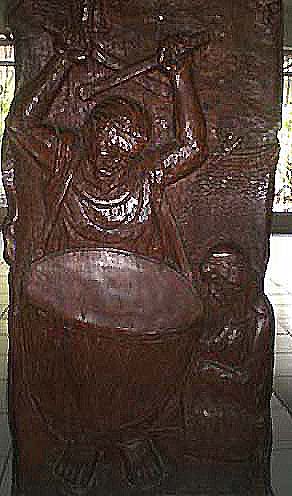
Photo, detail of a bas-relief by Napoleon Abueva
4. So, hypothetically, a sponsor can decide or choose not to include the following items: 1)Do you think that the 4 billion pesos stashed in the Velarde account belong to Estrada? 2) Do you think that those funds were payoffs of businessmen to him? 3) Do you think that Estrada received jueteng protection money during his term? Etc.
If one looks at the slant of the article, one might realize that the sponsors care less about courting the ire of the Sandiganbayan for contempt than conditioning the mind of the public (albeit, maybe incompetently). The coverage of results of the question on the presidential pardon, slanted with quotes that people are sympathetic to Estrada is no less contemptuous of the administration of justice; they influence the administration of justice no less than the answers to the above-stated questions.
But what would be the result to the above-stated questions?
Isn’t the premise of a presidential pardon, as Estrada himself stated in rejecting it, and as Mayor Jejomar Binay himself stated in an interview: a conviction, or a finding of guilt beyond all reasonable doubt? That’s the only time a pardon can be exercised.
Since there was a question on possible presidential pardon and those were the results, don’t you wonder what the previous questions were? Don’t you wonder what the premises of the respondents were? As Mayor Jejomar Binay himself stated or asked, weren’t the respondents presuming guilt (or did they understand it). Or, to put it another way, did the respondents answer or wouldn’t the respondents have answered, in overwhelming majority, the question: is there guilt beyond doubt, with a Yes?
This is either a botched-up job on the part of Erap propagandists, because it implied guilt, or a wonderful job, because it implied sympathy.
Who the sponsor is (and maybe how competent a propagandist he/ she is) , matters; because the sponsor gets to control what information is released or “leaked” to the public. When reporters and editors are either (a) lazy; (b) negligent; (c) harassed (d) incompetent; (e) compromised or received something; the context (as discussed above) is not provided; no other side or analysis is presented. The sponsor being the only source of information therefore controls how the news story is developed, written, produced.
The sponsor becomes the reporter and the editor.
We do not know better because we don’t know the context.
