(Optionally, you may click the bar “Listen in browser”, then the play button, on the soundcloud pod below: if on mobile device, to hear today’s featured OPM for free. Tnx).
First Media Monitor here or the 1st Bonus/ 2nd Bonus The first regular media monitor or 1st bonus or 2nd bonus can be posted here (Fair, Foolish, or in a Fix: good practice, violation, or dilemma), with deadline on Tuesday at 5pm.
Late posts are considered a forfeit for the week and would be credited to next week’s media monitor instead;
provided that no student would be allowed to exceed the maximum number of media monitor to make up for forfeits or to pile up his/her media monitor posts to make up for forfeits. (a week lost, is lost forever — the credits will be moved forward but only up to the last week before final exams). Instructions have been given in class. (As stated before: Students may use pseudonyms or pen names, and conceal their faces, and may also use their own platforms and simply paste the links in the comments section. (If pseudonymous, pls provide the department assistant with your pen name).
Pls use the comments section of this post. As stated, the media monitor commentary may either by typed as text in the comments section or as a link leading to the post in the platform of the classmember/ post author. Pls type in the first line whether the post is a regular media monitor [1st Regular Media Monitor) or a bonus post (1st Bonus Post) to aid the checker in locating and categorizing each box. Tnx). Baseless rants will not merit any points – the commentary should use, cite, and quote the pertinent provisions of the 2014 SPJ Code of Ethics as taken up in class this week. Failure to provide the pertinent provision will result in a score of zero. The SPJ provisions have been provided in the handouts distributed in class this week. They were also discussed in powerpoint in class. For students who are completely incapable of reading the handouts given to them, the provisions taken up in class are embedded below. As a heads-up, the following are the first two bonuses:
First Bonus: Media content on the 1) Kian killing (killing of Kian de los Santos); or 2) Killing of Carl Angelo Arnaiz; or 3)Killing of 14-year-old Reynaldo de Guzman (during class discussion on the SPJ provision on “minimizing harm”, class member Nic was able to call the attention of the class to the breaking news (GMA News, Saleema Refran) that the body of Reynaldo de Guzman had been found with 30 stab wounds and with his face wrapped up in packing tape; and to show us the photo relevant to our discussion on ethical dilemmas by setting up the TV monitor for it in class; while class member Dave also called our attention to the CNN Ph coverage of said breaking news with photos and videos relevant to our discussion on ethical dilemmas and to show us the video by setting up the TV monitor for it: They’re given ten points for voluntarily monitoring the relevant media content being discussed in class and showing the images in class; in addition, they can still post for this media monitor (the ten points have been posted in the comments box below for ease of recording and totaling the points. For Nic/ Dave: you may still open a separate comment box should you choose to post another media monitor either as another 1st bonus/ 2nd bonus, or a regular media monitor). (photo from the Inquirer used here non-commercially for academic purposes) For a heads-up, the 2nd bonus is on media coverage of the militarization/ killings/ shootings in the countryside including the Marawi bombings. (and as a further heads-up, we will have a bonus on media coverage of typhoons/hurricanes/ floods (disaster-reporting); a bonus media monitor of news reports/ news features on superstition or the occult in the runup to Nov. 1; and a bonus on advertorials in the runup to the Christmas season.)
Each of the bonuses can be posted at ANYTIME in lieu of a regular media monitor (just follow the tag assigned to the bonus, e.g. 1st Bonus media monitor on Kian Killing/ Carl killing/Reynaldo killing; or 2nd Bonus on militarization; or 3rd Bonus on the occult ; etc., regardless of the order that you post them (i.e., you can post the 2nd bonus before the 1st bonus or the 3rd bonus before the 1st bonus (since a bonus can be posted at ANYTIME in lieu of a regular media monitor) as long as you tag properly for ease of correction and recording.
As stated, only one media monitor per week (which can either be a regular media monitor or a bonus post) is allowed to avoid cramming and jamming up of posts: the purpose of observing the weekly media monitor is TO BUILD THE HABIT OF READING/ VIEWING MEDIA CONTENT REGULARLY WITH DISCERNMENT.
Pls do not embed gory images on this page without a trigger warning.
For the first regular media monitor: (2014 SPJ): “SEEK TRUTH AND REPORT IT “Ethical journalism should be accurate and fair. Journalists should be honest and courageous in gathering, reporting and interpreting information. Journalists should: – Take responsibility for the accuracy of their work. Verify information before releasing it. Use original sources whenever possible. – Remember that neither speed nor format excuses inaccuracy. – Provide context. Take special care not to misrepresent or oversimplify in promoting, previewing or summarizing a story. – Gather, update and correct information throughout the life of a news story. – Be cautious when making promises, but keep the promises they make. – Identify sources clearly. The public is entitled to as much information as possible to judge the reliability and motivations of sources. – Consider sources’ motives before promising anonymity. Reserve anonymity for sources who may face danger, retribution or other harm, and have information that cannot be obtained elsewhere. Explain why anonymity was granted. – Diligently seek subjects of news coverage to allow them to respond to criticism or allegations of wrongdoing. – Avoid undercover or other surreptitious methods of gathering information unless traditional, open methods will not yield information vital to the public. – Be vigilant and courageous about holding those with power accountable. Give voice to the voiceless. – Support the open and civil exchange of views, even views they find repugnant. – Recognize a special obligation to serve as watchdogs over public affairs and government. Seek to ensure that the public’s business is conducted in the open, and that public records are open to all. – Provide access to source material when it is relevant and appropriate. – Boldly tell the story of the diversity and magnitude of the human experience. Seek sources whose voices we seldom hear. – Avoid stereotyping. Journalists should examine the ways their values and experiences may shape their reporting. – Label advocacy and commentary. – Never deliberately distort facts or context, including visual information. Clearly label illustrations and re-enactments. – Never plagiarize. Always attribute. “MINIMIZE HARM “Ethical journalism treats sources, subjects, colleagues and members of the public as human beings deserving of respect. Journalists should: – Balance the public’s need for information against potential harm or discomfort. Pursuit of the news is not a license for arrogance or undue intrusiveness. – Show compassion for those who may be affected by news coverage. Use heightened sensitivity when dealing with juveniles, victims of sex crimes, and sources or subjects who are inexperienced or unable to give consent. Consider cultural differences in approach and treatment. – Recognize that legal access to information differs from an ethical justification to publish or broadcast. – Realize that private people have a greater right to control information about themselves than public figures and others who seek power, influence or attention. Weigh the consequences of publishing or broadcasting personal information. – Avoid pandering to lurid curiosity, even if others do. – Balance a suspect’s right to a fair trial with the public’s right to know. Consider the implications of identifying criminal suspects before they face legal charges. – Consider the long-term implications of the extended reach and permanence of publication. Provide updated and more complete information as appropriate ACT INDEPENDENTLY The highest and primary obligation of ethical journalism is to serve the public. Journalists should: – Avoid conflicts of interest, real or perceived. Disclose unavoidable conflicts. – Refuse gifts, favors, fees, free travel and special treatment, and avoid political and other outside activities that may compromise integrity or impartiality, or may damage credibility. – Be wary of sources offering information for favors or money; do not pay for access to news. Identify content provided by outside sources, whether paid or not. – Deny favored treatment to advertisers, donors or any other special interests, and resist internal and external pressure to influence coverage. – Distinguish news from advertising and shun hybrids that blur the lines between the two. Prominently label sponsored content. BE ACCOUNTABLE AND TRANSPARENT Ethical journalism means taking responsibility for one’s work and explaining one’s decisions to the public. Journalists should: – Explain ethical choices and processes to audiences. Encourage a civil dialogue with the public about journalistic practices, coverage and news content. – Respond quickly to questions about accuracy, clarity and fairness. – Acknowledge mistakes and correct them promptly and prominently. Explain corrections and clarifications carefully and clearly. – Expose unethical conduct in journalism, including within their organizations. – Abide by the same high standards they expect of others.” Have a productive and fun-filled week!
(pls click “Listen in browser” on the soundcloud pod below, then the play button: If on mobile device)
(credits as stated in the embedded materials or in the archives)
UP Diliman Chancellor Michael L. Tan
sat with the family of Carl Angelo Arnaiz, and wrote this:
“Long dark nights” by Michael L. Tan (published by the Inquirer, 6 Sept. 2017), re-published here verbatim:
“His father is from Southern Leyte, his mother from Quezon. He grew up in Makati and, the last two years, his family lived in a rented home in Cainta. “Seven years ago, his mother, Eva, left to work in Dubai. Each visit home, her son would try to convince her not to leave again, but she said it was hard making ends meet, and he seemed to understand. “Eva was proud of her son, who was consistently first in his class all through his elementary years in a public school. He ranked second among those who applied for the Makati Science High School where he again excelled. “Only UP “In his senior year he took the tough UP College Admissions Test (UPCAT). He had not wanted to apply to other universities, insisting he would go to college only if admitted to UP. In the end he did apply to, and was accepted in, two leading private universities with offers of scholarships. “When the UPCAT results were released in December 2013, he sent his mother a screenshot of his name on the list of students who passed. I looked it up when I got home from the wake and can imagine how proud he was: Arnaiz, Carl Angelo Magat. There were 83,000 students who took UPCAT that year and Carl was one of the 3,800 who made it to UP Diliman, where he enrolled in the BS Interior Design program. (photo by Rappler, used here non-commercially for academic purposes) “Carl was always telling his family about how good (magagaling) his classmates were but at his wake, his batchmates told Eva that Carl was the one who excelled, his classmates trying to “recruit” him whenever there were group projects because he did such good work. “Little did they know that Carl was grappling with depression and after one semester in UP, he had to stop schooling. He told his parents repeatedly that he would not resume college unless he could return to Diliman. “While dealing with his depression, he was able to start a small sari-sari store with the money sent by his mother. Eva explained that Carl wanted to make his mother’s earnings grow and to use this to care for his grandmother and a younger cousin. I spoke to that cousin, who is now in Grade 8, and she smiled, sadly, describing how Carl would tutor her and make sure she finished her assignments. “His family described him as a homebody with close family ties. He was an introvert but did have a circle of friends. On the rare occasions that he would not return home for the night, he would be sure to text his family. He kept in close touch with his mother even when she was in Dubai. The last message she got from him was sent out shortly after midnight on Aug. 18. She didn’t hear from him again in the succeeding days and the silence worried her. “Eva had just visited her family in July but she asked for permission from her employer to leave again for the Philippines, where she and her family began their frantic search for her son. Carl was reported to have left his house with 14-year-old Reynaldo de Guzman late night on Aug. 17. De Guzman remains missing. “On Aug. 28, Carl’s elder sister was contacted by a funeral parlor in Caloocan asking if she could identify the remains of a young man sent to their establishment a few days earlier. “Eva showed me a typed report from the Caloocan City police claiming Carl had held up a taxi driver along C3 in Caloocan at around 3 a.m. with a gun. The driver then sought help from the police who were able to find Carl, who was supposedly armed and shot at them. The police returned fire causing “instantaneous death.” The police also claimed they found “marijuana leaved” (a Freudian slip?) in his pocket, and shabu in his backpack. “The scripts, the props, are so terribly overused. Eva says Carl never even played with toy guns when he was growing up. “The Public Attorney’s Office (PAO) later did an autopsy and found five bullet wounds.
“The PAO also declared Carl had been tortured before being killed, likely in a kneeling or lying position. There was no evidence that he had fired a gun. “A new world “Carl entered UP Diliman in 2014, when we shifted our academic calendar to start in August. Carl and his fellow freshmen had a four-month vacation because of this transition, and UP used that long break to prepare a special welcome for the new students.
(photo by interaksyon.com, used here non-commercially for academic purposes) “The first day of that new school year in Diliman was festive with ABS-CBN coming in with their early morning program hosts for a special live telecast of cultural performances and interviews with the new students. I can imagine how a whole new world had opened up for Carl. “Carl had to pay tuition, but at an 80-percent discount based on an assessment of his household socio-economic status. He still had to deal of course with living expenses and costs of books and supplies and I thought of how much easier life would have become this school year, with the implementation of no tuition-no fees in UP. “In the 1st semester of 2016, Carl applied for readmission but did not push through with the application. I suspect the depression, the long, dark nights, continued to be overwhelming. “I had intended to drop by the wake for half an hour, but his mother requested that I stay on another two hours, listening, and trying to make sense of the senseless. Like so many Filipino overseas workers, Eva had to deal with feelings of guilt. Should she have left, she asked several times and I assured her she had done what she thought was best for her family. ” “Carl would have been proud his chancellor came here,” she said at one point and it was my turn to feel guilty. I had never even met Carl but wondered if we could have done more for him. Until recently, we only had counseling services for matters like career choices. We now offer psychosocial services, and a program to give more concessions to “students with additional needs” but much more still needs to be done. “It is always far more painful, far more inconsolable, when it is parents and teachers who have to mourn for the children wrenched away from us, especially as they approach the prime of their lives. “Difficult as it is, we learn to cope with the loss of our young when they die because of illnesses or accidents. It is a different matter when the young are murdered. Only two days before Carl, Kian delos Santos was killed also in Caloocan with a similar police script. “In times like these, we must allow ourselves to rage against the long dark nights and the sinister forces that slaughter our young and hijack the nation’s future. We must rage, and demand justice. “Carl would have turned 20 on Nov. 15. “
(by UP Diliman Chancellor Michael L. Tan published by the Inquirer 6 Sept. 2017 used here non-commercially for academic purposes)

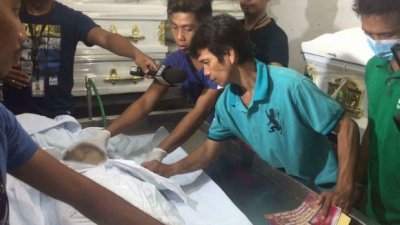 (photo from the Inquirer used here non-commercially for academic purposes)

 (photo by Rappler, used here non-commercially for academic purposes)